From Shame to Strength
Amina's experience with her first menstruation and her journey to help girls overcome the challenges they face in managing their periods.

Menstruation is a challenging period for adolescent girls, especially in Nigeria, but with support from UNICEF, these young women are being empowered with knowledge on how to deal with the fears and the taboo, through a first of its kind menstrual hygiene education programme.
The First Stain: Joy and Panic
Amina Suraj Bala was 15 when she first bled. "I felt happy because I knew I was becoming a woman," she recalls, her eyes softening. "But when I saw the stain on my dress, my heart sank,” her eyes rolling back in horror, as she recalled her first day of menstruation.
In some parts of Nigeria, including where Amina hails from, periods are shrouded in silence, and menstruating girls face social challenges, the subject itself not to be broached, a taboo. Some girls use rags to stem the flow when they step out, while many girls skip school entirely during their cycles.
I felt excited to see my first menstrual flow because I learned it was the beginning of my transformation from childhood to adolescence.
Amina’s case was meant to be different. With support of UNICEF through her school, she had adequate knowledge of menstrual hygiene management coupled with what she learnt from her elder sister and mother at home.
Despite her knowledge, Amina felt overwhelmed when confronted by this moment, admits the senior secondary school student, now a confident 17.

A Turning Point: Pads, Advocate and Pride
But all that is in the past now.
Amina’s confidence grew after she joined the UNICEF-supported Menstrual Hygiene Management (MHM) programme at her school. Amina has attended orientation sessions where facilitators explained menstruation with science and empathy, airing and clearing all young fears.
Amina now not only knows how to use a menstrual pad properly, but actively mentors’ girls in her school and community on what to do when they begin to experience their cycle. “I help them approach menstruation with confidence,” says Amina. “I teach them how to use a sanitary pad properly. I tell them about the importance of maintaining good hygiene during their period, drawing from my experience.”

In Amina's words, her confidence grew the first time she used a proper pad. She walked tall, and she smiled, "No leaks; no more worries!"
For Amina this UNICEF-supported Menstrual Hygiene Management (MHM) project has been a game changer, enabling hundreds like her to dream of completing their secondary education and going to medical college, without shame and menstrual stress.
Those times felt like a punishment.

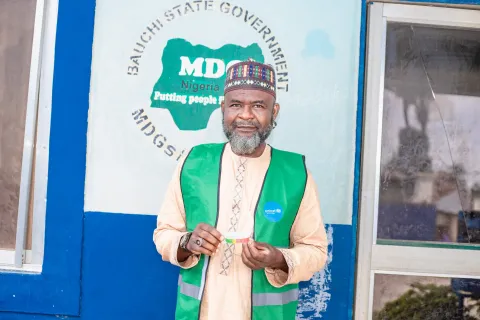
This campaign was further bolstered with community support, championed by the traditional leader of the Lambu community.
According to Wambai, the Dagachi Lambu, he ensures that girls are supported and don’t become victims of stigma because of menstruation in the community. The traditional leader affirmed that it’s easy because in Islam, girls, women and men are taught about menstruation.
Sadiya Ahmad, the Principal of Government Girls’ Secondary School Lambu further adds, “we always keep at least 100 packs of menstrual pads in our store. We encourage our students to request for these when they are having their period.”
This turnaround partnership between UNICEF and Amina’s school, buffered by the support of her community, has given young women like Amina and over 200 girls in her school hopes of a brighter future. A chance to grow into confident women, holding their heads high, empowered by this knowledge of Menstrual Hygiene Management.