Reporter’s Diary: The Children Behind the Hills
In this travelogue, Folashade G. Adebayo reports on UNICEF’s resolve to save children suffering from acute malnutrition, even in the most unlikely places.

Do not travel to Gulani and Gujba with only your laced boots, your protective gear, your water bottle and your laptop. Those twin local government areas in Yobe State are hard to reach and highly volatile. You need more than gear to get there.
You need nerves.
Pupupu. Papapa. Pupupu.
The shots rip through the early morning air and shatter the stillness. The military escort firing from an anti-aircraft gun. The humanitarian convoy does not slow down. It speeds up, pushing hard across the Yobe landscape.
“Those are warning shots,” says Jerry Abubakar, UNICEF’s Security Officer on the mission. “The escorts are warning off any threat in the area. They are saying we are here and we are armed.”
We were on dangerous ground. There was no doubt about it.
We had left Maiduguri the day before to reach children living with acute malnutrition on this axis. From nutrition to security to communications, we were a small team of UNICEF specialists with one purpose. Our lead was Joseph Senesie, UNICEF Nutrition Manager.
Our furthest point was Bumsa. A distant community tucked far behind Buni Yadi and Buni Gari, two of the most historic towns in Yobe. The Damaturu to Gujba road is notorious. That stretch is one of the most volatile in the northeast. Attacks on civilians, on military posts, on humanitarians, they happen too often here.
Like other agencies, UNICEF relies on military escort to reach women and children in these communities. This mission was no different. At designated bases we exchanged one escort team for another, a Mine Resistant Ambush Protected unit leading us through.
Once we passed the worst spots, the road came alive again. A few vehicles trickled by. People trekked to their farms or cycled. Herders watched over cattle grazing on fresh green grass fed by August rains. Local vigilantes stood guard at community entry points.
That calm did not last.


We left Buni Yadi and Buni Gari behind us and the land changed. Hills and plains stretched out, beautiful and wild, barricading the forest like countryside. Just as you started to take in the view, the shots came again. Sharp and loud. Your breath catches. Your reverie breaks.
But the children UNICEF came to reach were still further behind those shadowy hills.
Tucked between military vehicles, we pushed on. Bumsa was still ahead.
Malnutrition rates in Yobe dropped by 1.1 percent in 2025, from 11.9 percent in 2024, but the burden remains heavy. According to the latest Integrated Food Security Phase Classification, seven of the 17 local government areas in the state, Gulani, Gujba, Machina, Tarmuwa, Geidam, Damaturu and Yunusari, are in Phase 4. That is the most critical level for acute malnutrition.
To reach vulnerable children with lifesaving treatment, UNICEF worked with donors like the Government of Germany through the Federal Ministry for Economic Cooperation and Development and programmes like the Foreign Commonwealth and Development Office’s Multisectoral Integrated Nutrition Action for Children, Adolescents and Women in Northeast Nigeria. In 2025 alone, that support helped UNICEF treat nearly 150,000 children in Yobe.
In 2026, that work continues. UNICEF is working with government, community and local partners to help children survive and thrive. And with funding from the Nigeria Humanitarian Fund, it is pushing even further into the most remote and insecure corners of the northeast, delivering prevention and treatment across some of Yobe’s most critical belts: Gujba, Gulani, Damaturu and Tarmuwa.


“The availability of nutrition commodities is always a challenge in hard to reach communities with access constraints,” says Joseph Senesie, UNICEF Nutrition Manager. “It is important to monitor these locations not only to prevent stockouts but also to ensure the quality of service.”
In that one sentence, he captured UNICEF’s promise. Every child, no matter who they are or where they are born, has the right to grow up safe, healthy, educated and empowered.
The sun was just cresting when we arrived in Bumsa, a small community where sparse mountains dot the skyline. Senesie and the team moved quickly. Counting stores. Checking records. Training health workers again on infant and young child feeding.
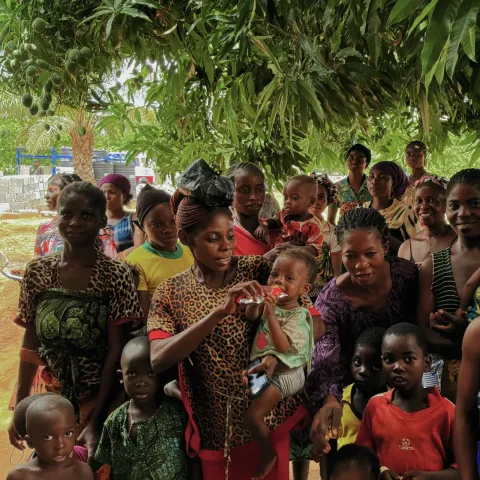
Minutes later we were back in the vehicles. Next stops: Bularafa and Buni Yadi health facilities. Children lined the path and waved with all their strength as we left Bumsa. We waved back. Our hearts were full.
“It feels like going to the moon and planting UNICEF’s flag there,” one team member said.
It does. It really does.