A Name, A Future
How Digital Birth Registration is Changing Children’s Lives in Kano

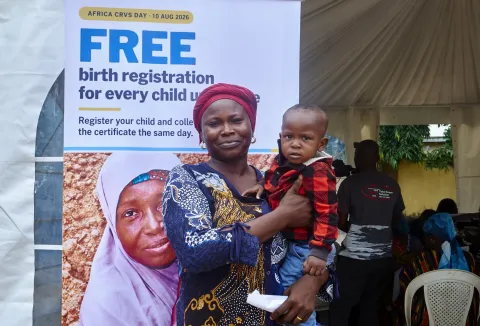
In the rural community of Gabasawa in Kano State, north-west Nigeria, a group of mothers sit closely together beneath the morning sun, proudly holding freshly printed birth certificates.
Some carefully smooth out the edges of the papers in their hands. Others stare quietly at the documents, smiling to themselves.
For many of them, this is the first official paper their children have ever received.
But these certificates represent far more than paperwork.
For these mothers, they are proof that their children now officially exist in the eyes of the state. Proof that they can one day go to school, access healthcare, claim protection and opportunities, and build a future without struggling to prove who they are.
For Hussaina Ahmad, a mother of three from Tsantsi community, the moment feels deeply personal.
“We had never heard about birth registration before,” she says.
It was her husband who first heard about the registration exercise from the village head. He immediately urged her not to miss the opportunity.
Without hesitation, Hussaina picked up her young daughter, Aisha, and began the journey to the registration centre.
“I left everything I was doing and brought Aisha immediately,” she recalls. “I did not want to lose this chance.”


The journey was not easy.
She travelled for 30 minutes on a motorcycle, spending ₦500 to reach the centre, a significant amount for many families in rural communities.
But to Hussaina, it was worth every naira.
“Now we are happy,” she says with a smile. “Aisha has a birth certificate, and I do not want her to miss opportunities in life.”
Like many parents living in hard-to-reach communities, none of Hussaina’s children had previously been registered. Not because she did not care, but because nobody had ever explained why it mattered.
“I did not go to school, and I do not have a birth certificate myself,” she says quietly. “But now I understand how important it is. It can be needed for almost everything in life.”
Nearby, 20-year-old Asmau Sagiru gently rocks her seven-month-old son, Abdulrahman, after successfully registering his birth.
She gave birth at home and, like many young mothers, never knew birth registration was necessary.
“I did not know I needed to register my child,” she says. “Now I understand what it means, and I am happy my son has a birth certificate.”
Through community mobilization and awareness campaigns, women like Asmau are beginning to understand that birth registration is not just a government exercise.
It is protection.
It is recognition.
It is access.
“Without it, children can face challenges later in life,” she says.
Across communities like Gabasawa, electronic birth registration is beginning to change long-standing realities.
In Joda Ward alone, 626 children under the age of one have already been registered during the ongoing campaign.
According to Abba Hussein, the ward focal person for birth registration, the goal is to ensure children are registered as early as possible.
“We want children to have their identity from the beginning of life,” he explains. “Every ward contributes towards the overall target.”
Gabasawa Local Government Area aims to register 12,000 children across its 11 wards during the campaign, with each ward expected to register about 1,100 children.
The growing turnout reflects something important: communities are beginning to trust and embrace the process.
For years, birth registration in Nigeria relied heavily on manual paper systems that were often slow, difficult to access and frustrating for families living far from registration centres.
Many parents simply gave up.
Long distances, transport costs, delays and lack of awareness left millions of children, especially in rural communities, without any legal identity.


To help close that gap, UNICEF has been supporting the National Population Commission to strengthen birth registration systems and expand access to underserved communities.
With support from UNICEF Netherlands/Natcom, UNICEF and partners, including the National Population Commission, the National Identity Management Commission, the Association of Local Governments of Nigeria and Banksforte Technologies Ltd, introduced an electronic birth registration system powered by a digital platform known as the Vital Registration Application.
The system allows birth registration to happen directly within communities in real time, reducing delays and improving accuracy.
It also helps connect children to the national identity system from birth, allowing them to receive a National Identification Number.
But technology alone is not driving the change.
Traditional leaders, religious leaders, women’s groups and youth networks are also helping communities understand why birth registration matters, especially for children born in remote areas who are often left invisible.
For mothers like Hussaina and Asmau, a birth certificate is more than a document.
It is reassurance.
It is dignity.
It is the feeling that their children will no longer be forgotten.
And as electronic birth registration expands across Kano State and beyond, more children are beginning life with something every child deserves from the very beginning:
A name.
An identity.
And a fair chance at the future.