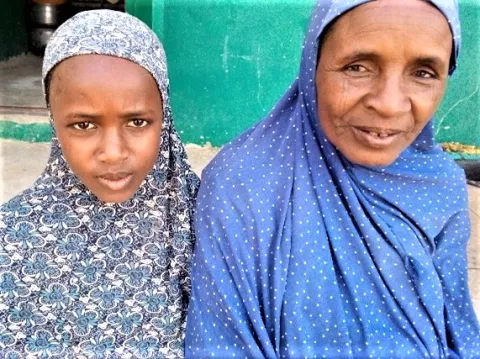
Keeping Falmata in school
In Monguno, North East Nigeria, UNICEF is providing conflict-affected children with the supplies they need to stay in school

The sun was burning hot outside a temporary learning space located at the Ngurno IDP Camp in Monguno, North East Nigeria, on a typical Monday. Dozens of internally displaced children, mostly from neighbouring Baga, listened as lessons continued undisrupted.
In Class 3, Falmata Mohammed reached for the bottle inside her school bag and took a sip of cool water. A couple of other children in the classroom did the same.
A few weeks back, the scenario would have been different. Thirsty and sweaty, many children would have run out of the school to their homes to drink water, abruptly ending their learning for the day.

“My friends and I used to rush home from school to drink water whenever it got very hot,’’ said 12-year-old Falmata. “Sometimes I waited to use the toilet before returning to school. Sometimes I had to wait for my friends to finish before we returned to school. That does not happen anymore since UNICEF gave me school supplies. I have everything I need to stay in school now.”
Indeed, schooling has assumed a whole new dimension since UNICEF, with support from the European Civil Protection and Humanitarian Aid Union (ECHO) distributed water bottles, school bags and learning materials to children at the centre.
Like Falmata, many children in the school are from displaced, vulnerable families without stable sources of income. For these children, reading and learning materials are a luxury. UNICEF is bridging this gap with critical learning materials to retain children in school.
The temporary learning space, also constructed with support from ECHO, provides shelter and a safe space for the children. While the water bottles help children stay hydrated and focused in class, the learning materials facilitate continuous education, even outside school hours.
Yohanna Ibrahim, a community volunteer teacher at the centre, says coordination has become easier with the instructional materials supplied by UNICEF.
“Classes are more manageable now and less stressful. Children have stopped going home during school hours and it has made coordination easy for us tutors. Children feel happier now to come to school and parents now bring their children willingly,’’ he said.
Barnabas Iliya, a 14-year-old Class 3 student, said the intervention will help him realize his dream of becoming a teacher.
“I never had a bag, books and water bottle before. Staying in school was difficult, especially when I got extremely thirsty. But now I have everything I need to be in school. I hope to become a teacher and do something good with my life in the future,’’ he said.