From Farm to Classroom: Hauwa’s Second Chance at Education in Northeast Nigeria
With support from UNICEF and Education Cannot Wait, a 16-year-old girl begins school for the first time, and begins to imagine a different future.

In the mornings, Kaleri Primary School, on the outskirts of Maiduguri in northeast Nigeria, hums with energy. Children fill the classrooms, voices rising and falling as lessons unfold.
By late afternoon, when the sun begins to soften, the compound is still alive. But now it is a different group of learners, children who missed out on school for years, trying to catch up on what conflict and circumstance took from them.
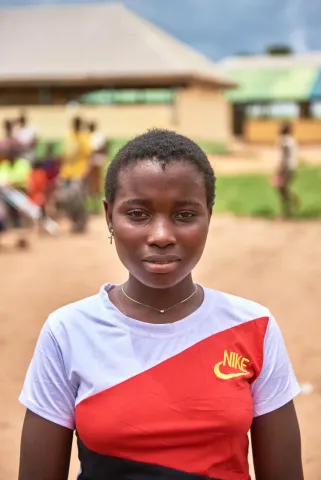
Hauwa Muhammad is one of them.
She is 16. In the mornings, she works on the farm with her parents. By midday, when the heat becomes unbearable, she returns home for lunch. And then, almost impatiently, she makes her way to school.
There is a lightness in her step.
She is not just going to class. She is going to meet friends. To hold a pencil. To open an exercise book. To finally begin.
Hauwa grew up in Gwoza, a community that has seen its share of hardship. She is one of seven children. None of them had ever enrolled in school. The family farmed. They sewed caps to earn extra income. Life moved forward, but without options.
There was no clear promise of what tomorrow could look like.
That changed when the family relocated to Kaleri.
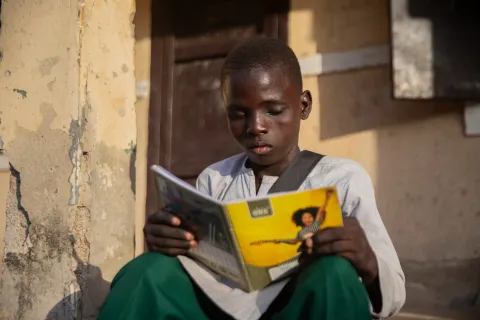
Now Hauwa attends catch-up classes under the Accelerated Basic Education Programme, ABEP. For the first time in her life, she is learning how to read and write. And she is thinking ahead.
“I would love to teach Mathematics to young girls like me. I think it is an interesting subject,” she says, her voice steady with conviction.

For children affected by conflict in northeast Nigeria, education has not simply been interrupted, it has been derailed. Years of violence have stripped families of livelihoods and narrowed economic choices.
When income disappears, difficult decisions follow. For many households, schooling becomes a luxury they cannot afford.
According to the 2025 Joint Education Assessment Needs, an estimated 2 million children are out of school in the region. Behind that number are children like Hauwa, bright, capable, but left waiting.
To respond to this crisis, UNICEF, in collaboration with the Borno State Government, is providing literacy and numeracy classes for out-of-school children. Through ABEP, learners receive nine months of accelerated instruction in local languages and in English. The goal is simple but ambitious, help them regain lost ground and transition into formal education.
The programme is supported by Education Cannot Wait. Trained facilitators receive stipends and move through communities, speaking with families, explaining why these classes matter, and encouraging parents to enrol their children. Learners receive the materials they need to begin, exercise books, pencils, textbooks.

For Hauwa, the shift is already visible.
“I am just glad that I can learn and make new friends. I no longer sit at home doing nothing in the afternoon. I can’t wait to learn how to read and write,” she says.
Her words are simple. But they carry weight.
In a region where conflict has taken so much, a classroom in the afternoon has become a quiet act of recovery. For Hauwa, education is no longer something other children have. It is something she now owns.
And with it comes something she has not had before, choice.