Empowering Girls in IDP Camps
Breaking the taboo of menstrual hygiene.

Maintaining good menstrual hygiene enables me to be healthy.
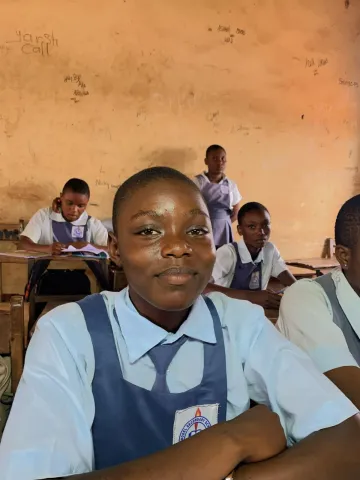
In the heart of the Anyiin IDP Camp, where life has become a tapestry of resilience, 17-year-old Kwaghnjua Kadoon embodies the spirit of hope. Displaced from her home by armed invaders, she has found solace among her peers as they prepare for their beloved annual Sac Race competition—a vibrant celebration of camaraderie and joy amidst adversity. “I and other girls still play our games when on our periods,” Kwaghnjua asserts, her voice brimming with confidence.

As the 2025 World Menstrual Hygiene Day approaches, Kwaghnjua and her friends are not just racing for fun; they are racing to reclaim their joy and mental well-being. When asked about her understanding of menstrual hygiene, she passionately explains, “Menstrual hygiene is maintaining cleanliness and continuously washing your hands with soap and water. This practice prevents me from contracting any serious diseases.”
“Maintaining good menstrual hygiene also enables me to be healthy, to be able to play with girls my age, and to be able to go to school,” she adds, her determination shining through.
Kwaghnjua is one of over 800 women of childbearing age in the Anyiin camp, which houses nearly 4,000 displaced individuals. As World Menstrual Hygiene Day 2025 approaches, it serves as a powerful reminder of the importance of proper menstrual hygiene management and the challenges faced by women and girls during menstruation. This year’s theme emphasizes collective action to ensure that menstruation does not hinder access to education or health services.

In a commendable effort, UNICEF, in collaboration with government partners, is championing menstrual hygiene and safety. Recently, the Anyiin IDP Camp was one of four camps in Benue State to receive dignity kits through the Benue State Rural Water Supply and Sanitation Agency (BERWASSA).
“Each dignity kit supplied by UNICEF in partnership with the Benue State Government contains essential items like soap, a towel, a cup, pegs, reusable sanitary pads, a pant, rope for hanging the pads, and soap for bathing and washing,” explains Dugeri Aondofa Jacob, the camp manager who oversees the distribution process.
To practice safe menstrual hygiene—a natural process that transcends circumstances—girls are encouraged to wash their hands consistently before and after using menstrual products and after restroom visits. Changing absorbent materials frequently, ideally every few hours, is crucial, as is the proper disposal of used materials, which should be wrapped before being discarded or burned.

This year's Menstrual Hygiene Day, on 28 May 2025, is an opportunity to raise awareness on the theme and celebrate girls and women, especially those in humanitarian contexts, who deserve adequate education on menstrual hygiene management.
In the words of Rebecca Bolatito Gabriel, WASH Specialist, UNICEF, practising proper menstrual hygiene to prevent infections is paramount in the life of every young girl and woman of childbearing age. With the recent distribution of quantities of dignity kits to 4 IDP camps in Benue State, containing bathing, washing/multipurpose laundry soaps, branded jerry cans with lids and caps, kettles and buckets, UNICEF demonstrates the importance of good menstrual hygiene practices during periods while raising awareness about the importance of access to period education and sanitation facilities, especially for girls and women in emergency situations.