A Black Box in Bama
In Bama, northeast Nigeria, a sturdy black box is teaching conflict-affected women more than a savings habit. It is building their resilience and capacity to support their children through school.

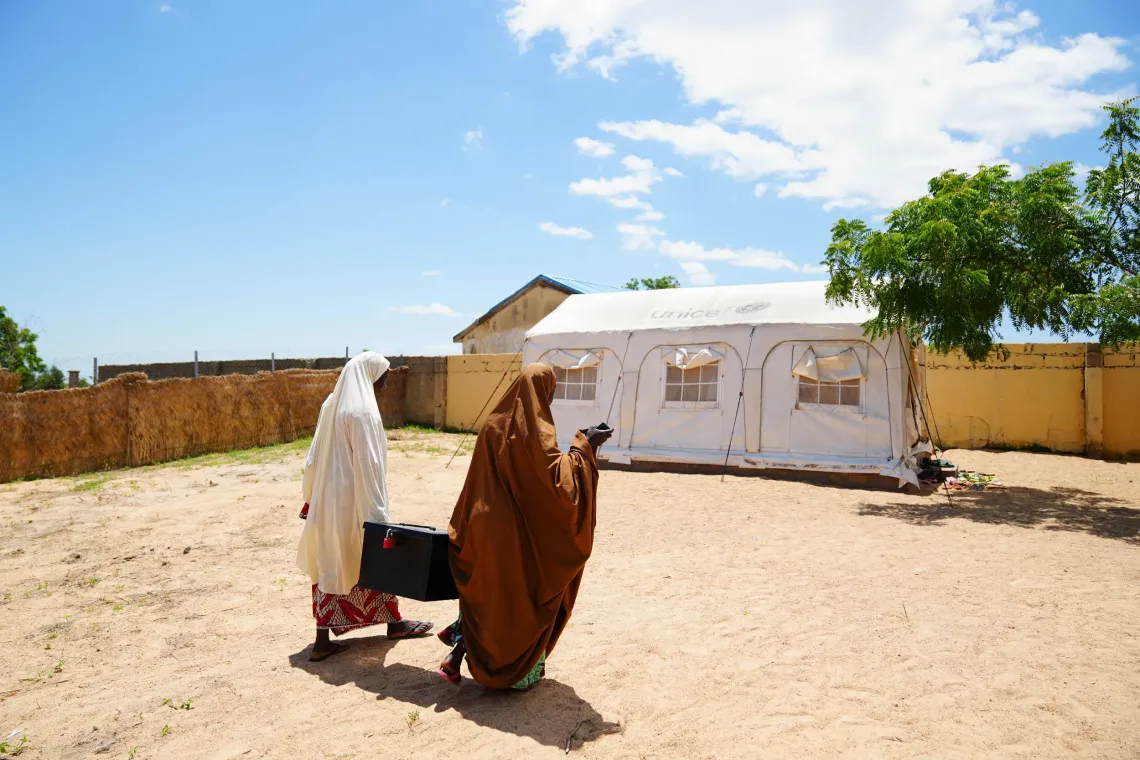
They arrive in twos and threes, their hijabs slightly floating in the afternoon wind. By the time the premises of a child-friendly space in Bama, a conflict-affected community in northeast Nigeria fills up, 25 businesswomen sit around a huge black box containing money.
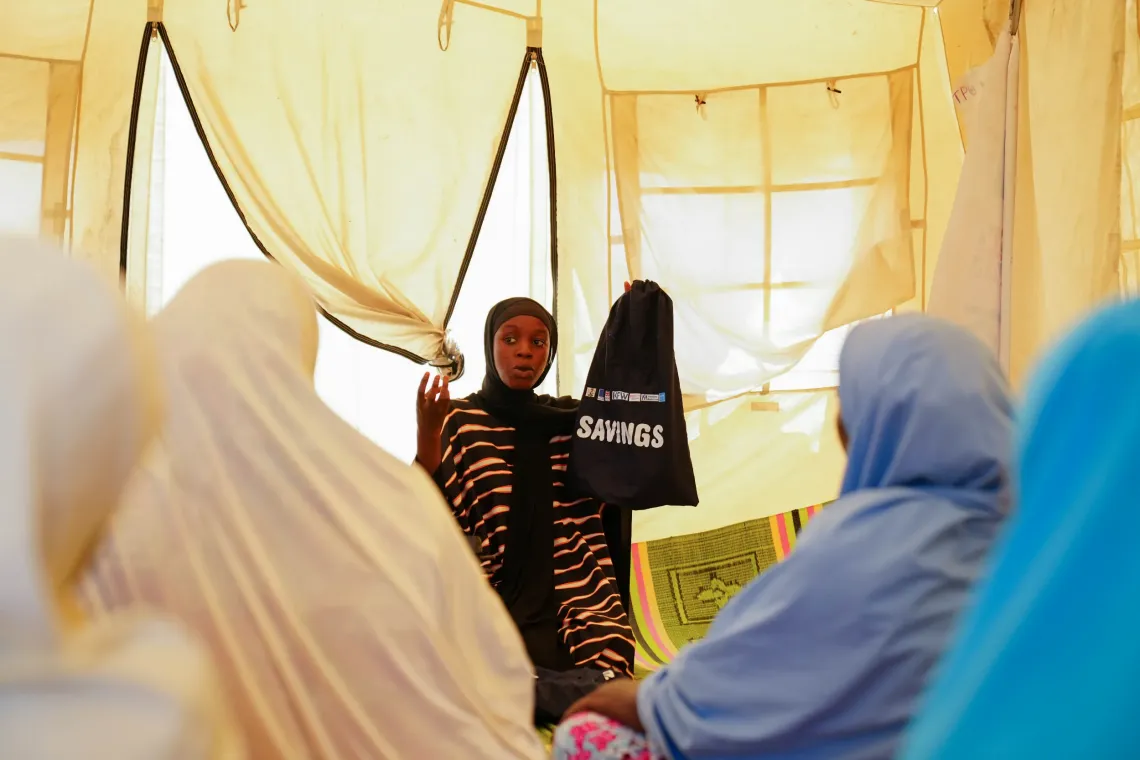
Welcome to the weekly meeting of members of the Village Savings Loan Association (VSLA) in Bama. The group, supported by UNICEF, consists of women managing small scale businesses, is led by Halima Shettima.
Constructed with metal, the black box takes centre stage each time the women hold their weekly meetings. But the giant box is not an ornament – it is a container for cash contributions and a source of small loans to keep their business running.
“It is more than a storage for our contributions. It is a symbol of how much can change if you try hard enough,’’ says Halima.
Halima, who works with UNICEF partner, International Medical Corps (IMC), has managed the group for seven months.
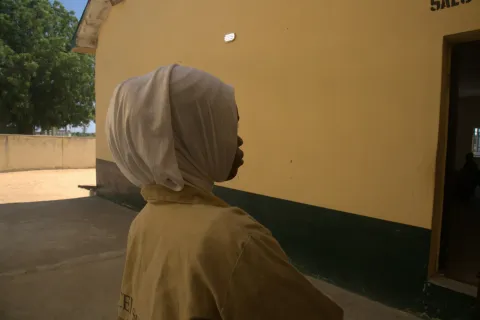
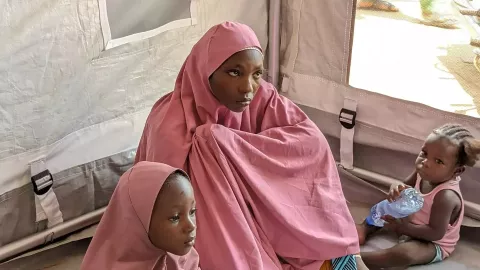
“These are women who have experienced abduction, gender-based violence and various violation of their rights. They are mostly vulnerable women, and a good number are living with disability,’’ she adds.
Funded under the European Union’s Support for the Disengagement, Review, Reintegration and Reconciliation (SD3R) programme in northeast Nigeria, the VSLA aims to promote community peace, empowerment and resilience among populations severely affected by protracted armed conflict.
The savings itself is a means to an end – to build critical skills in financial discipline, accountability and industry while preparing the women for further empowerment to expand their chosen business.
“Members of VSLA here are women who manage small businesses, from groundnut selling ventures to akara (beans cake) selling. Interestingly, these are women who have never owned a business before now. They were simply housewives and the most many of them had done before now was farming. They had no prior financial management or business skills which could earn them some income,’’ adds Halima.
For nearly two decades, protracted conflict has devastated lives and livelihood opportunities in northeast Nigeria. For instance, a 2023 report authored by UNICEF, the Economic Cost of Conflict in North East Nigeria, states that the conflict in northeast Nigeria has set Nigeria back by $100 billion.
In addition, women, adolescents and children have been particularly targeted for abduction, forced marriage as well as recruitment and use by armed groups. For families, diminished economic power has created more than economic inequality for children, it has contributed to multidimensional poverty including child malnutrition, out of school children, forced labour and gender-based violence, among others.
Besides reintegration and psychosocial support services for children affected by conflict, UNICEF in partnership with the European, is facilitating economic independence and resilience for vulnerable women for self-sufficiency and their capacity to provide basic needs for their children.
“We have weekly sessions where the importance of hygiene, delayed gratification, innovation and positive parenting are taught. These meetings are important and we have fines for late coming. Members contribute N200 weekly and can access loans up to N3,500. Most of the women have invested the loan into their business. They feed better and look better than when we started this programme five months ago,’’ adds Halima.
While the women go through the savings, loan and repayment cycle, UNICEF is planning to provide start up kit to expand their business.
“At the end of the year, the most consistent women will be provided with another loan and a start up kit to expand their business,’’ says Halima.
Through the intervention, UNICEF, with funding from the EU is improving the resilience of women living in conflict-affected communities, preventing gender-based violence and supporting them to care better for their children.