UNICEF marks World Children’s Day: Music brings children together
Young musicians from all five secondary music schools in Montenegro performed at a concert marking World Children’s Day and UNICEF’s 80th anniversary, highlighting the importance of equal opportunities for children to develop their talents and life skills

- Crnogorski
- English
PODGORICA, 28 November 2026 – UNICEF marked World Children’s Day and its 80th anniversary with a message about the power of music and culture to bring people together. Relevant institutions and local authorities should increase funding to expand the provision of free cultural and artistic programmes accessible to every child. These programmes should be developed through collaboration between schools, libraries, museums, theatres and other cultural institutions, as well as through partnerships with the private sector.
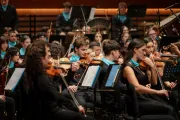
This message was conveyed at a concert by the Children and Youth Symphony Orchestra, held last night at the Music Centre of Montenegro.
“Culture and the arts play a crucial role in children’s development and have the power to bring society together. A child’s opportunity to play an instrument, take part in a theatre performance or enjoy a concert should not depend on their parents’ income or where they live. As we mark UNICEF’s 80th anniversary, we call on institutions to invest more in programmes that make such opportunities part of every child’s upbringing,” said Michele Servadei, UNICEF Representative to Montenegro.
The latest Multiple Indicator Cluster Survey (MICS), conducted by the Statistical Office of Montenegro (MONSTAT) with UNICEF’s support in 2025 and 2026, provides insight into children’s daily activities. On the day preceding the survey, only 2.4 per cent of children aged 10 to 17 engaged in arts, crafts or other creative activities, while 14.2 per cent read for pleasure.
The concert demonstrated how collaboration between educational and cultural institutions can create new opportunities for children and young people. Through the Values and Virtues in Music (ViVuM) initiative, students prepared for the concert and performed with the support of teachers, university students, professors and professional musicians.
“We want more opportunities to enjoy books, music, theatre, dance, film and visual arts. We are grateful to be sharing the stage with professional musicians tonight,” said Kristijan Fažo, a second-year student at Tivat Music School and a member of the orchestra.




The Ministry of Education, Science and Innovation highlights that well-designed and facilitated cultural and artistic activities, accessible to every child, can foster empathy, cooperation and non-violent conflict resolution skills, which are essential for preventing peer violence and building a culture of non-violence.
“Through education reform, we are supporting programmes such as ViVuM, which bring schools and cultural institutions together and help children develop creativity, cooperation and responsibility. Our goal is to make regular music, drama, visual arts and reading activities accessible from preschool onwards, with additional support for children whose participation is limited by costs, distance or inaccessible facilities,” said Anđela Jakšić-Stojanović, Minister of Education, Science and Innovation.
ViVuM is part of the My Values and Virtues programme, implemented by the Bureau for Education Services with the support of UNICEF and the Ministry of Education, Science and Innovation. The programme aims to support the development of children’s social and emotional skills in schools across Montenegro. Playing music together gives young musicians an opportunity to put these skills into practice during rehearsals and performances.
“Through ViVuM, we learn to listen to and respect one another, work together and take responsibility, both in music and in life,” said Katja Novaković, a fourth-year student at the Vasa Pavić School of Music and Ballet and a member of the orchestra.
Cultural institutions can make such opportunities accessible to more children through regular programmes and collaboration with schools.
“Rehearsing and performing alongside musicians from the national symphony orchestra gives young people a unique experience and helps build their confidence. We create these opportunities in collaboration with music schools and the Music Academy. Through workshops, open rehearsals and concerts, we aim to bring music closer to children who do not attend music schools. There is also scope for partnerships with companies wishing to invest in children’s development and culture, which is among our institution’s key priorities,” said Vučić Ćetković, Director of the Music Centre of Montenegro.
Under the baton of maestro Ivan Velikanov, students from all five secondary music schools in Montenegro performed at the concert: Vasa Pavić and Andre Navara in Podgorica, Vida Matjan in Kotor, Dara Čokorilo in Nikšić and Tivat Music School. The concert was the result of collaboration between the Ministry of Education, Science and Innovation, the Music Centre of Montenegro, the Music Academy of the University of Montenegro and UNICEF, with the support of music school teachers, students and professors from the Music Academy, conductors and musicians from the Montenegrin Symphony Orchestra.
Every child has the right to learn, develop their skills and participate in the cultural and artistic life of their community. Culture and the arts foster imagination, creativity, critical thinking and empathy. Greater support for cultural institutions, youth centres and schools would help ensure that cultural and artistic activities are accessible to every child in Montenegro.