Montenegro should urgently increase the number of Roma mediators
Roma mediators have proved to be essential for increasing the number of Roma and Egyptian children attending schools, decreasing the number of child marriages, improving the health

- Crnogorski
- English
- Shqip
PODGORICA, AUGUST 27 2023 – UNICEF, the EU and the NGO HELP are calling upon Montenegro’s national and local authorities to ensure that there is an adequate number of Roma mediators employed by the education, health, child and social protection systems to end poverty among Roma and Egyptian children in Montenegro.
“Only 16 per cent of Roma and Egyptian children attend preschool, 56 per cent complete primary and 3 per cent complete high school in Montenegro. Some simple interventions, such as free transport and the engagement of Roma mediators, can increase this number significantly within a short period of time'', said UNICEF Montenegro Representative Juan Santander.
Ensuring that every Roma and Egyptian child gets quality education, healthcare, child and social protection is the only way to lift them out of poverty.
Since 2013, the European Union, in partnership with the NGO HELP, has been providing continuous financial support to Montenegro to gradually integrate Roma mediators into the education, social care and healthcare systems, thereby giving Roma and Egyptian children better prospects right from the outset.
“Social inclusion of Roma children is of the utmost priority in Montenegro. As advised by the Ombudsman, it will be crucial for Roma mediators to get permanent rather than temporary employment, fostering continuity and stability for Roma families,” said the EU Ambassador to Montenegro, Oana Cristina Popa.
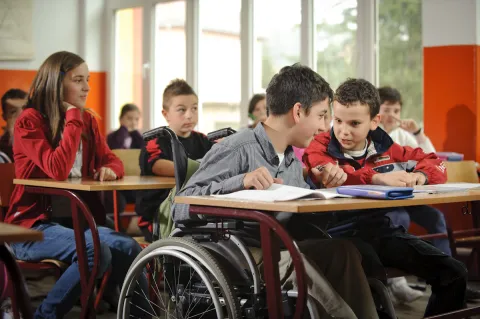
The EU Ambassador also advocated for the introduction of Roma mediators even in schools with fewer than 70 Roma pupils.
Expanding the reach of Roma mediators to schools below the current threshold is a step towards creating a stronger connection between Roma and Egyptian families and the education system.
According to the NGO HELP, there are only around 40 Roma mediators in Montenegro. They support better collaboration between Roma and Egyptian families and health centres, preschools, schools, centres for social welfare and other institutions.
“In Montenegro, Roma mediators are now funded by NGOs and the government. Sustainable funding from the national and local authorities needs to be urgently provided for all Roma mediators. Also, a greater number of Roma mediators should be employed by the ministries of education, health and labour and social welfare''.
Without these changes in the system, we will not see improvements in the lives of the current and future generations of Roma and Egyptian children.
The Programme Specialist on the Rights of Roma in the regional UNICEF office for the Europe and Central Asia, Tefik Mahmut, points out that the introduction of Roma mediators has proven to be an extremely successful intervention in all the countries of the region.
The challenge to be now resolved by Montenegro and the neighbouring countries is to ensure that there are enough Roma mediators employed full-time, working for the health, education, social and child protection systems.
One of the EU accession criteria is the improvement of the situation of minority groups, especially of those who are the most vulnerable, like the Roma and Egyptian communities. The role of mediators is to enhance access to all of the services that are available on the ground.

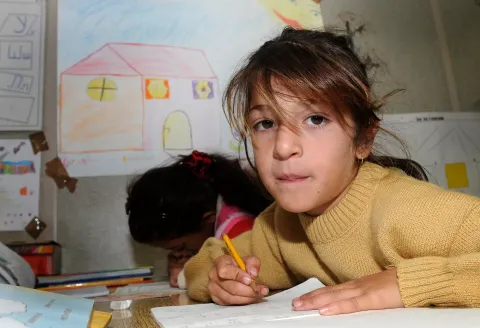
Thirteen-year-old Fljorijeta Beriša has benefitted from support from a Roma mediator in her primary school in Nikšić over the last five years.
“The mediator helps me with my homework; supports me to prepare for exams; tells me what to study when I miss school because I am sick; and informs me when there are catch-up classes so that I do not miss any of them. Without the mediator, I would have a harder time,” Beriša explains.
Twelve-year-old Abedin Delija, who attends a primary school in Nikšić, shares similar experiences.
“When we celebrated Roma Day and we sang, the Roma mediator was my key support. Roma mediators are always there for me,” Delija points out.
Having in mind that a new school year will begin in the coming days, Veljbana Naza, a Roma mediator in a primary school in Nikšić, points out that employing more Roma mediators is needed to ensure that a greater number of Roma and Egyptian children attend preschools and schools.
It would be good to introduce Roma mediators into all institutions, as we are a significant source of support to these children due to the language barriers. We help them study better and attend classes regularly. We share all information with their parents regularly. In this way, their collaboration with schools is much more effective.
As a party to the UN Convention on the Rights of the Child and a candidate country for EU membership, Montenegro has committed itself to guaranteeing the right to education, health, social and child protection and a decent living standard for every child.