Mona knows her rights: Arranged marriage is slavery
A fifteen-year-old girl from the Roma community participated in a workshop on child rights in Niksic

- Crnogorski
- English
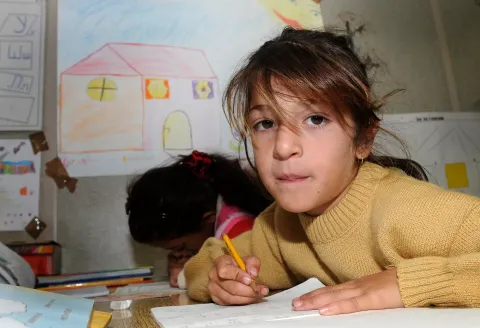
Podgorica, 3 July 2023 – Mona Besimljaj often hears rumours in the Roma community about girls dropping out of school and entering into marriage. She recently learned what arranged marriages are and how they can be prevented by participating in an educational workshop on child rights organized by the Centre for Roma Initiatives, with the support of UNICEF.
In addition, children and young people were introduced to the concept of child rights, such as the right to education and freedom of choice, while the focus of the workshops for adults was on the consequences of arranged marriages and the penalties for engaging in that practice.
“I learned that girls should not drop out of school, run away from home, or be forced into marriage. Now I know that arranged marriage is slavery, and that no one can force us to get married against our will,” Mona says. Thanks to a quiz, she also learned who she can turn to if her rights are violated.

When someone mistreats us, prevents us from going to school, or forces us to work, we can report it to the police, the Centre for Social Work, and the Centre for Roma Initiatives.
She says she talked to her parents after the workshop. Her parents advised her to finish school and not get married early.
“I would like to become a hairdresser,” says Mona, visibly contemplating. “Maybe I would also like to go to university if I do well in secondary school.”
Samir Salja, a father of four, also attended the child rights workshop. He received advice on how to discuss these issues with his children.
“I tell them not to get married like my mother did at the age of 13. It’s terrible,” Salja says.
Forced marriages still happen in the Roma community, but less frequently than before because we are constantly working and talking with the younger generations, so they now know how to recognize if someone wants to get married to them against their will.

Although child marriages are rare in Montenegro, they remain a worrying practice in the Roma and Egyptian communities as this is considered a tradition rather than a violation of child rights. One third of girls and one in six boys in the Roma and Egyptian populations aged 15 to 19 are married or in a union.
To assist children and young people in the Roma and Egyptian communities, the Centre for Roma Initiatives has launched two licensed services – psychological counselling and the National SOS helpline for potential victims and victims of child marriages.

We make an effort to talk to children and young people as much as possible and show them that their lives can change when they learn to recognize their rights and know who they can turn to in case of rights violations.
The workshops for children and adults are interactive and fun, designed to motivate participants and facilitate knowledge acquisition.
“In addition to working with children, parents, and engaging with the local community, it is extremely important for us to work with institutions and schools and respond together to prevent the violation of child rights,” Sacirovic emphasized.
The workshops were organized as part of the “United in the Realization of Child Rights” programme. Over 500 participants from 11 Roma settlements in Montenegro attended the workshops from October 2022 to April 2023. This initiative was supported by UNICEF Montenegro.