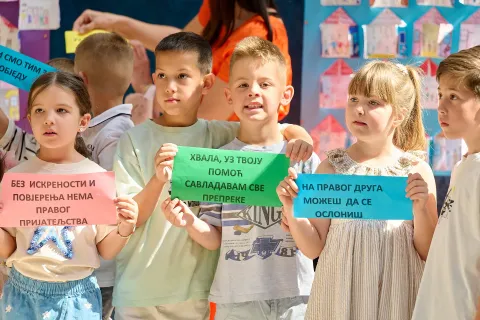
The largest survey on children and families in Montenegro begins
UNICEF and the Statistical Office launch a new round of the MICS survey

- Crnogorski
- English
- Shqip
PODGORICA, 24 JULY 2025 – UNICEF and the Statistical Office of Montenegro have officially launched the seventh round of the Multiple Indicator Cluster Survey (MICS), the most comprehensive survey on the situation of children and families in the country.
The Memorandum of Understanding was signed by Michele Servadei, UNICEF Representative to Montenegro, and Miroslav Pejović, Director of the Statistical Office of Montenegro.
The MICS (Multiple Indicator Cluster Survey) is part of a global research programme supported by UNICEF, aimed at collecting statistically reliable and internationally comparable data on the rights and living conditions of children and women. Montenegro has been conducting MICS surveys since 1997, with the latest, fifth round providing important insights for evidence-based policymaking in the areas of health, education, child development, social and child protection, as well as justice.
MICS will play a key role in Montenegro’s reporting on the implementation of the Convention on the Rights of the Child, as well as in monitoring progress towards achieving the Sustainable Development Goals (SDGs).
„MMICS plays a central role in the EU accession process and in implementing the 2030 Sustainable Development Agenda. The data from the previous MICS survey (2018) was widely used by the Government, the EU Delegation, civil society, the Ombudsman, Parliament, and the UN system. MICS is essential for understanding the extent to which children’s rights are being realized and for guiding reforms affecting children and women. It helps Montenegro develop or adjust its policies based on reliable evidence,” said Michele Servadei, UNICEF Representative to Montenegro.
The Government of Montenegro, through the Ministry of Finance, has allocated €300,000 from the national budget for the implementation of MICS, while UNICEF is providing US$650,000 from its core resources. The statistical Office will carry out the survey with technical support from UNICEF, using a nationally representative sample of 6,720 households. A dedicated survey will also be conducted among Roma and Egyptian communities.
All data will be disaggregated by geographic, social, and demographic characteristics, including the age groups of children (0–4 and 5–17 years), as well as women and men (15–49 years), allowing for comprehensive analysis.
What did the previous MICS reveal about children in Montenegro?
Findings from the previous 2018 MICS round highlight the urgent need for updated data:
- Only 23% of children aged 3–4 attended early education programmes.
- 16% of children under the age of 5 were at risk of developmental delays.
- Two-thirds (66%) of children aged 1–14 were subjected to physical punishment and/or psychological aggression by adult household members in the month preceding the survey.
- The malnutrition rate among children under 5 was three times higher in the Roma population compared to the rest of the population.
- Only 1 in 4 mothers (24%) initiated breastfeeding within the first hour after birth, and just 1 in 5 continued exclusive breastfeeding during the first six months. These figures were even lower among the Roma population.
- One in three (33%) Roma girls aged 15–19 was married or in a common-law union.
- Only 20% of Roma children aged 7–14 attended school regularly.
What will the new survey enable Montenegro to do?
Through the implementation of MICS, Montenegro will be able to:
- Fill data gaps needed for monitoring and improving national strategies, policies, and action plans;
- Improve systematic monitoring of children's rights using globally standardized indicators;
- Generate key indicators relevant for the EU accession process and SDG monitoring;
- Provide updated and comparable data to assess progress since previous MICS rounds;
- Strengthen national capacities in data collection and analysis related to children.
„MICS is the largest social statistics survey after the population census and presents a significant challenge for the national statistical system. At the same time, it is an opportunity to further strengthen our capacity to collect and analyze data that are crucial for understanding the status of children and families in Montenegro. In this process, it is important for citizens to recognize the importance of this survey and participate in large numbers,” said Miroslav Pejović, Director of the Statistical Office.
The results, including all standard statistical tables, will be published in 2026 and made publicly available for both the general and Roma populations. The data will be accessible on the global MICS portal, as well as on the websites of UNICEF Montenegro and the Statistical Office.