Building confidence in child vaccination through communication: Future doctors as agents of change
As immunization rates in Montenegro reach a historic low, UNICEF is investing in the communication skills of future healthcare professionals to help rebuild trust in childhood vaccination

- Crnogorski
- English
- Shqip
PODGORICA, 25 November 2025 – In Montenegro, UNICEF is taking decisive action to address one of the most serious public health challenges facing the country today – growing parental hesitancy regarding childhood vaccination.
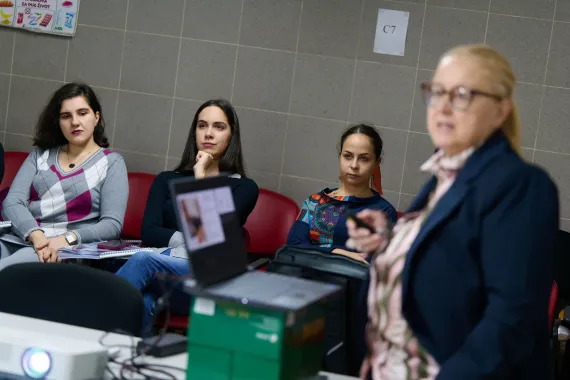
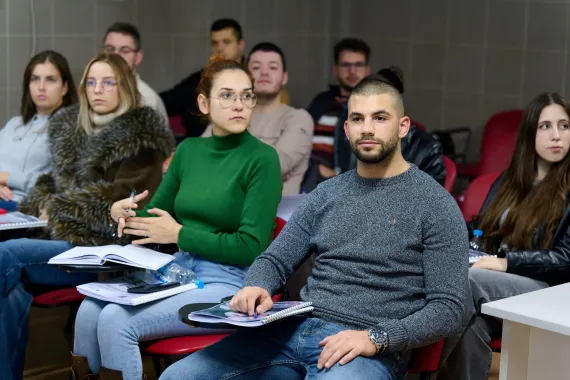
With the support of the Republic of Korea and in partnership with the Student Parliament of the Faculty of Medicine at the University of Montenegro, UNICEF Montenegro is implementing an Interpersonal Communication for Immunization (IPC/I) training programme for final-year students in medical fields – future physicians, pharmacists and dentists.
“I realized that it is not enough to know the facts and health recommendations; the way I listen, ask questions and speak often determines whether people will trust me and be willing to have an open conversation,” says medical student Miloš Čolaković.
This programme is not merely about transferring facts, but about building empathy, dialogue and trust. Although Montenegro provides free and comprehensive preventive protection against infectious diseases and leads the region in introducing the latest vaccines, the country has recorded an alarming decline in immunization coverage over the past decade.
Several years before the COVID-19 pandemic, timely coverage with the first dose of the measles, mumps and rubella (MMR) vaccine stood at around 90 per cent. Today, according to data from Institute of Public Health of Montenegro from April 2026, that percentage has dropped to just 13% among children born in 2024, by far the lowest level in Europe.
Student Mateja Vujović says she was not aware of the seriousness of the situation until she was confronted with the statistics.
“Here, for the first time, we as students had the opportunity to engage with the different concerns parents have and to learn how to approach them with understanding, compassion and by listening to their uncertainties,” she said.
According to joint data from UNICEF and the World Health Organization, coverage with the second dose of the measles-containing vaccine, administered before school entry, is approximately 68 per cent. This trend is already having visible consequences: at the beginning of 2025, 12 measles cases were recorded, following 35 cases in 2024, indicating a continued risk of a larger outbreak.
These figures are not an isolated case. Across UNICEF’s Europe and Central Asia (ECA) region, approximately 130,000 measles cases were reported during 2024. Children under five accounted for more than 40 per cent of all infections, while more than half of those affected required hospitalization.




Why interpersonal communication matters
Traditional, one-way approaches to vaccination communication in Montenegro are no longer sufficient. Parents’ hesitancy does not stem solely from a lack of information; it reflects deeper social and cultural dilemmas, fear of potential side effects, and confusion caused by conflicting messages available online.
At the same time, many doctors and pediatricians face a shortage of time and the communication skills needed for meaningful conversations with parents. The IPC/I training addresses this challenge by equipping future healthcare professionals with practical skills in active listening, empathy, acknowledging parental concerns, and providing clear, evidence-based information without judgement or pressure.
Through practical exercises and simulated conversations, students develop the skills necessary to lead difficult discussions and support parents in making informed decisions in the best interests of their children.
The IPC/I training has been adapted to the Montenegrin context, taking into account challenges within the healthcare system, including the heavy workload of pediatricians and the shortage of staff in primary healthcare. Special emphasis is placed on cultural sensitivity, empathy, trust-building, digital literacy and early community engagement.
“The knowledge and skills students have acquired will be an excellent tool for building two-way communication, enabling them to convey facts and expertise to patients and parents in a way that is understandable, clear and acceptable,” said Dr. Sci. Med. Nelica Ivanović Radović, lead trainer during the November 2025 training.
Immunization is not only a medical intervention – it is also a conversation. By strengthening communication between healthcare workers and parents, the foundation is laid for greater confidence in vaccination and better protection of children’s health. To this end, UNICEF Montenegro calls on partners, educational institutions and health authorities to expand such training programmes and integrate them into regular curricula at all levels of medical education – pre-clinical, clinical, postgraduate and specialist training.