Day care centres for children with developmental disabilities: A key support for families
With the support of UNICEF, day care centres across Montenegro provide children with developmental disabilities with a safe environment in which to acquire new knowledge and skills

- Crnogorski
- English
- Shqip
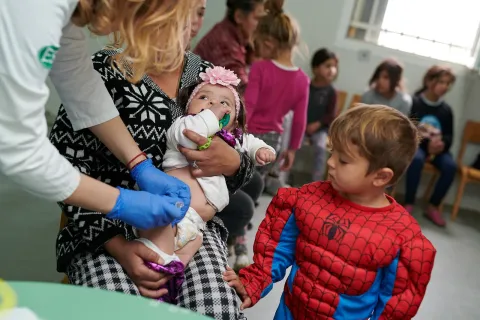
PODGORICA/CETINJE/BUDVA, MAY 2025 – Every morning, when Ognjen, Viktor, and Nikolina arrive at the Day Care Centre, their parents know that the children are not only safe – but also in places where they are growing, learning new skills and receiving the attention they need. Day care centres for children and young people with developmental disabilities across Montenegro have become spaces of empowerment not only for the children, but for their families as well.
Four-year-old Ognjen Cicarevic no longer needs to travel twice daily with his mother Jelena to Podgorica for treatment, as he now receives services from a speech therapist, physiotherapist, special education teacher and other specialists at the Day Care Centre in Cetinje. His favourite place is the sensory room – equipped with special tools that stimulate his senses.
“Ognjen loves coming here. The sensory room excites him the most – there is a blue slide which he uses independently,” his mother Jovana Cicarevic says.
Thanks to a major fundraising campaign, new and varied equipment and didactic materials have been provided for 17 day care centres for children and young people with developmental disabilities in Montenegro.
According to teacher Dijana Mladjen from the Cetinje Day Care Centre, this equipment “enriches the work, offers new opportunities, and presents both a challenge and a motivation for everyone working here.”
Ognjen now has access to activities that encourage him to become more independent and to develop. At the Day Care Centre, he feels safe, happy, and accepted, and his mother Jovana emphasises that attending the centre represents enormous progress for both of them.
“For us, the Day Care Centre is a real boost. Ognjen feels safe and happy here, and the cooperation with the professional staff is excellent. The twice-daily journeys to Podgorica used to exhaust him, but now, having a centre in our town positively affects him because he arrives well-rested and in good spirits,” she says.

More than 400 children and young people with developmental difficulties use the services of the day care centres every day – receiving free eight-hour care, therapies and a variety of activities aimed at developing each child’s potential.
Fourteen-year-old Nikolina Kovacevic has been part of the Bijelo Polje Day Care Centre community for the past three years. Her mother, Jelena, proudly highlights how much progress she has made, particularly in speech, understanding, and emotional expression. “We hardly recognise her. Nikolina used to be unable to identify an animal, a plant, or anything. Now, on the street, she will point out a tree, an animal, a letter – anything,” she said.
All day care centres for children and young people with developmental disabilities in Montenegro have recently received modern equipment thanks to a large fundraising campaign which raised over €167,000 last year. This support was provided through a public-private partnership between the Women’s Club of the Parliament of Montenegro, the International Women’s Club of Montenegro, the HEMIIAS Foundation, and UNICEF. The funds were used to purchase equipment and didactic materials tailored to the needs of children and young people with developmental disabilities, including assistive technology, IT devices, sensory stimulation equipment, physiotherapy aids, and rehabilitation tools.
The Bijelo Polje Day Care Centre currently supports 43 children and young people, and the new equipment, which includes didactic materials, has further strengthened their work.
“Progress is visible every day – small but very significant steps, which give us satisfaction and give parents hope that their children’s lives will become easier,” says Evica Krgovic, a pedagogue at the Day Care Centre.
Nikolina’s mother confirms this: “Every donation to our centre is a great help to us parents.”
The services and support offered by the day care centres play a vital role in preventing the separation of children from their families – children and young people with developmental disabilities remain with their loved ones, without being placed in residential institutions. In a safe and stimulating environment, with professional assistance, they learn daily life skills, develop their potential, and build self-confidence.

This is confirmed by Mila Hajster from Budva, mother of 22-year-old Viktor, who attends the centre.
“The centre means a lot to us because it gives my child the opportunity to go out, not to be closed in, not to be institutionalised – he comes here and works with professional staff.”
Thanks to the donated assistive technology, Viktor has made further progress.
“When he started using the tablet, I noticed that he also began using the smartphone more readily at home. He no longer resists like before – now he points to the screen himself,” Mila shared.
At this centre, assistive technology, such as interactive boards, helps children who communicate non-verbally.
“This equipment is very useful for children with autism, as well as for those with intellectual and motor difficulties,” says psychologist Anja Lalicic from the centre.
Community-based support services are essential for the development of children with disabilities and are a crucial support for their families. Their availability and quality can only be ensured through the joint, dedicated support of all actors in society – from local and national institutions to the private sector and individuals who recognise the importance of investing in every child. However, in nine municipalities in Montenegro (Bar, Tuzi, Andrijevica, Petnjica, Gusinje, Pluzine, Savnik, Kolasin and Zabljak), there is still no day care centre for children with developmental disabilities. Developing these services must become a priority for decision-makers at all levels. UNICEF is ready to work with them, as well as with parents and children, to make these and other support services for children and families accessible to everyone as soon as possible – because every child has the right to grow up with support, respect, and opportunities in their own community.