We must fight air pollution every day
Op-ed to call for action
- English
- Mongolian
The harsh reality is that air pollution claims the lives of 7 million people annually across the globe. Shockingly, it shortens lifespans by up to six years, surpassing the deadly impact of smoking, car accidents, and even HIV/AIDS. Children, in particular, bear the brunt of this crisis.
My time in Mongolia has fueled a pressing question: How many children must fall ill or perish before we collectively recognize the urgency of combating air pollution on a daily basis? It's time we declare air pollution unacceptable; it's time to acknowledge that the air pollution crisis is a direct assault on the rights of children.
According to the National Center for Public Health, as the average daily concentration of PM2.5 and PM10 particles rises, so do instances of flu and pneumonia among children under 5. The costs of air pollution on human health are staggering, with pneumonia-related deaths constituting over 50% of respiratory system-related deaths as of 2022.
A decade-old study revealed that one in every 10 deaths in Ulaanbaatar is attributed to air pollution. The situation demands immediate, concerted action.
A single day's delay in our efforts translates to another day of lost progress. Ulaanbaatar, among the most polluted cities globally, has long since ceased to be the sole battleground. Deadly air pollution levels have infiltrated most provincial centers.
UNICEF conducted a small-scale biomonitoring study (2022) to determine toxic metals in blood of young children (1-5 years old) associated with air pollution exposure in 3 provinces and 2 districts of Ulaanbaatar.
The research team worked on data collection of 507 children 17th khoroo of Bayanzurkh district and 15 and 18th khoroo of Khan-Uul district of Ulaanbaatar as well as in Bayankhongor (Bayankhongor soum), Govi-Altai (Esonbulag soum) and Umnugobi provinces (Dalanzadgad soum).
The study showed that children are most exposed to air pollution during the daytime while in the kindergarten. Almost 21.4 percent of the study participants spend their day exposed to the air pollution levels exceeding permitted levels.
Lead concentration exceeds the limit of 3.5 µg/dL in 67% of children from Bayanzurkh district of Ulaanbaatar, 58% of the children from Govi-Altai, 58% of the children from Khan-Uul, 40% of the children from Bayankhongor, and 3.0% of children from Umnugovi aimag, respectively.
There is no level of exposure to lead that is known to be without harmful effects. It must be noted that the Centers for Disease Control and Prevention (CDC) in USA has reduced blood lead reference value in children from 5 5 µg/dL to 3.5 µg/dL.
In addition, 10.6 percent of blood samples revealed existence of mercury. In particular, 46 percent of these samples were from children in Bayankhongor soum in Bayankhongor province – much higher compared to the samples from other areas.
It should be noted that the sample size is small, nevertheless, the result is alarming, and we need more in-depth research to identify sources of exposure and take immediate preventive and treatment measures.
UNICEF implores all stakeholders to take decisive action, prioritizing children's protection in schools, kindergartens, dormitories, and health facilities. The CHIP initiative, reaching nearly 2,000 households and issuing numerous loans, promises a cleaner, healthier future through sustainable finance mechanisms.
Changing behavior is pivotal, and Mongolia's greatest resource lies in its people. The innate decisiveness and determination of the Mongolian population can be harnessed through awareness campaigns and persistent communication.
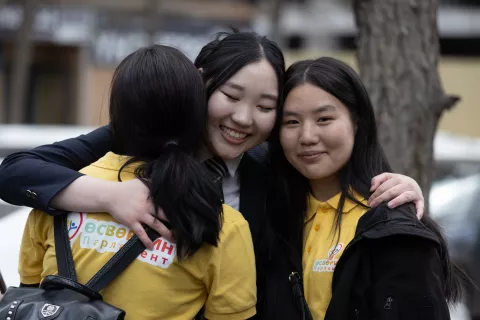
Youth participation is crucial, with UNICEF's YOUCCAN and Teen Parliament platforms engaging children and adolescents. Empowered with knowledge and skills, the youth can lead positive changes in society.
Let's unite our resources and mindset to eliminate toxic pollutants from the air for the sake of our children. Every child deserves clean air.