When the right support changes a child’s educational journey
Nadejda Grigorii – a support teacher helping children build confidence and reach their potential

For Nadejda Grigorii, a support teacher at the “Alexandr Pushkin” Theoretical High School in Căușeni, inclusion begins with simple things: a child’s courage to answer in class, a smile, or progress that once seemed impossible. For her, these moments are more than results — they are signs that a child is starting to believe in themselves.
“Inclusion is not just a theoretical concept, but a daily practice. It’s about patience, flexibility, and seeing the potential in every child, not their difficulties,” she says.


Originally trained as a primary school teacher, Nadejda has been working as a support teacher for six years. To better respond to her students’ needs, she retrained in special psycho-pedagogy at the “Ion Creangă” State Pedagogical University and continues to attend training courses, including those focused on supporting children with autism.
At her school, 322 students are enrolled, including 41 refugee children from Ukraine and 21 children with disabilities and special educational needs. The school also serves as a hub institution, with students commuting daily from the nearby villages of Grădinița and Grigorievca.

Small steps, real change
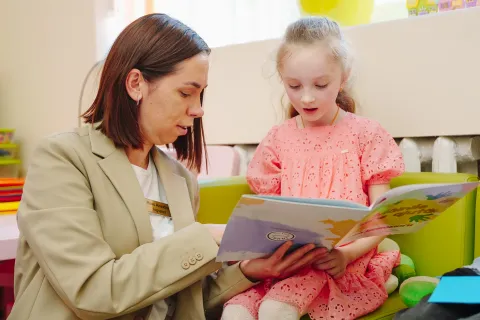
Nadejda’s day starts with discussions with teachers about children’s needs and planning educational interventions. During lessons, she supports students, helping them understand tasks and integrate into classroom activities.
“My day is very full. I spend many hours working directly with children. Even breaks are not really breaks — they’re time for observation, communication, and individual support. Sometimes, it’s simply about being there for a child who needs you,” she says.

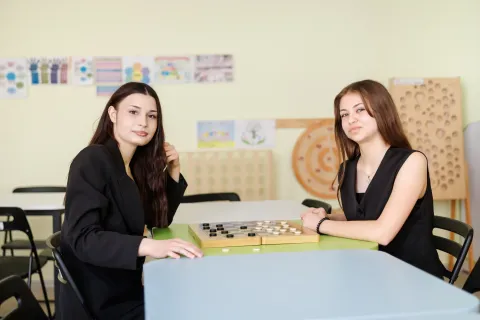
After classes, her work continues in the Resource Center, where she organizes individual and group activities to develop attention, memory, speech, and social skills.
“In the Resource Center, some children can’t stay focused for more than a few minutes. We work together, step by step. After some time, you see them complete a task from beginning to end. For me, these small changes matter the most — they’re the moments when a child begins to believe in themselves.”
To support children’s balanced development, activities go beyond academic support. Children also take part in nature trips, museum visits, creative activities, cooking workshops organized together with the Vocational School in Căușeni, and road safety lessons held in partnership with the police.
Progress doesn’t happen overnight. It shows in small steps — in gestures that may seem insignificant to others.
“A child who used to avoid communication now starts to greet others and make eye contact. These changes aren’t always visible to everyone, but for us, they are real victories,” Nadejda shares.


When school and family work together
One of the most important lessons Nadejda has learned in recent years is the role of collaboration between school and family.
“It’s the foundation of success. Without parents’ involvement, results are hard to sustain in the long term. When there is trust and communication, the child receives support both at home and at school. Family relationships improve, and tears of despair turn into tears of joy.”
Participating in mentorship sessions focused on school–family partnerships helped her better understand the role of parents in the educational process and develop skills to build trust-based dialogue.

The “Alexandr Pushkin” Theoretical High School is one of the institutions benefiting from the UNICEF project “Empowering children, parents, teachers, and communities to promote inclusive education in the Republic of Moldova.”
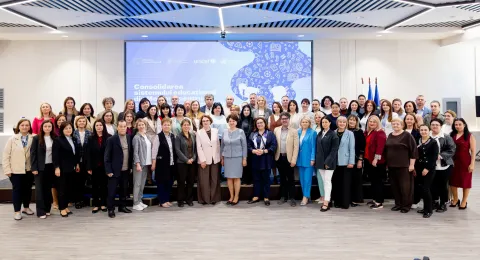
Under this project, implemented by CCF Moldova in partnership with the Ministry of Education and Research and the Republican Center for Psycho-Pedagogical Assistance, and funded by the UK Government through the Foreign, Commonwealth & Development Office, 63 teachers and education specialists from nine districts were trained as trainers.
These trainers, in turn, have provided mentorship to over 550 teachers — from beginners to experienced educators who choose to keep learning and growing to better respond to the needs of all children.
“These trainings helped me look differently at collaboration with parents. I learned how to build trust-based dialogue and involve them more actively. Parents know their child best, and when we work together, the results are completely different,” says Nadejda.


When a child starts to believe in themselves
For Nadejda, the greatest achievement is not a better grade or a newly acquired skill, but the moment a child starts to believe in themselves.
“With the right support, a child can unlock their potential and become more independent. But most importantly, they begin to believe in themselves,” she says.
For children with special educational needs, this support means not only better school results, but also greater independence and a sense of belonging within the school community.
“Inclusion is not something difficult or impossible. It’s about taking steps towards each other. The most important thing is to see the child not as a diagnosis, but as a person. Every child needs to be accepted.”