From contagion to protection: Reframing the Werther effect in Maldives
The stories we tell can either deepen vulnerability or build resilience. In Maldives, the choice has never been more important.

When news of a suicide spreads across an island community, the silence that follows is never truly silent. It moves through WhatsApp groups and gatherings, through whispers and family dinner tables. It enters the minds of young people who are already struggling to name what they feel. And in that circulation, it does something. The question we have not asked loudly enough is: what?
For too long, the answer has been shaped more by habit than intention. We have grieved publicly and incautiously. We have shared details that should have stayed quiet. We have framed tragedy in ways that, however unintentionally, made the unthinkable feel familiar, even logical, to minds already searching for a way out of their own pain.
This is not a failure of compassion. It is a failure of awareness. And it is one we have the knowledge, the tools, and the community to correct.
The story that started a contagion
In 1774, Johann Wolfgang von Goethe published The Sorrows of Young Werther, a novel about a young man who, consumed by unrequited love and a sense of futility, takes his own life. The book became one of the literary sensations of its age. It also, by most accounts, triggered a wave of imitative suicides across Europe. Young men dressed like Werther. They carried the novel. They died the same way.
Two centuries later, the sociologist David Phillips gave this phenomenon a name and a framework. Analyzing suicide rates in the weeks following prominent media coverage of high-profile deaths, he demonstrated a consistent pattern: detailed, emotionally resonant, widely circulated narratives of suicide measurably increase suicidal behavior in the populations that consume them. He called this the Werther Effect.
The mechanism is not a crude imitation. It is something psychologically subtler, and therefore more dangerous: identification. When a vulnerable person encounters a narrative that mirrors their own distress, which describes the same loneliness, the same trapped feeling, the same exhaustion that has no name, they do not consciously decide to replicate what they have read. They experience recognition and the realization that another person understood exactly what they felt. And in that recognition, a door that was previously invisible becomes visible. Suicide ceases to be unthinkable. It becomes, in the most chilling sense of the word, an option.
The risk intensifies when narratives are repeated, emotionally saturated, and stripped of complexity. When a life of invisible suffering is reduced to a single, tidy cause such as a failed relationship, public shaming, or a poor examination result, it creates a false sense of inevitability. It tells every watching mind: this is what this feeling leads to.
In digital environments, this process does not slow down but accelerates. Algorithms reward emotional intensity. Content that provokes grief or shock travels faster and further than content that is measured or hopeful.

Why Maldives is especially vulnerable
There are places in the world where stories stay local. Maldives is not one of them. In an island nation bound by kinship, shared faith, and near-total social media penetration, information does not travel, but floods. A post shared in a private group becomes common knowledge before anyone has considered whether it should be.
This is the geography of our vulnerability. The same intimacy that makes island life sustaining, such as the dense networks of mutual recognition, the impossibility of anonymity, the community that holds you even when you did not ask to be held, also creates conditions in which grief circulates without pause and without filter. Young people who are already struggling are repeatedly exposed to narratives of loss. Without counterweight, without careful framing, these narratives accumulate into something more than grief. They become a cognitive environment.
Compounding this is the persistent stigma that surrounds mental health in our communities. Where open, compassionate conversation about psychological distress is constrained by shame or judgment, young people turn to informal spaces such as group chats, comment sections, and peer networks as their primary sources of understanding. In the absence of anything better, those spaces fill the vacuum. They shape perception by default. And they are largely unguided.
Yet this same quality, this capacity for rapid, intimate, community-wide connection, is also our greatest protective asset. The same channels that can spread harmful narratives can spread hope with equal velocity. The same social density that amplifies risk can amplify resilience; if we choose to use it that way. The question before us is not whether we will talk about suicide. The question is how. With what words. And to what end.
In practice, harmful narratives can look like:
- Sharing the method or location of a death on social media, however sympathetically framed
- Framing suicide as the inevitable consequence of a single event, such as a breakup, an exam failure, or a public humiliation
- Posting photographs, personal messages, or details that romanticize or memorialize the act itself
- Describing the person who died as finally at peace, free, or beyond pain, without acknowledging the tragedy of that loss
- Speculating publicly about motive in ways that simplify complex, invisible emotional experiences into a single explanation
- Repeatedly resharing coverage that itself violates safe messaging principles, extending its reach and emotional intensity
Why national guidance on this is a public health intervention
When the Media Guideline on Reporting Mental Health in Maldives discourages detailed descriptions of suicide methods and urges the consistent inclusion of help-seeking information in all coverage, it is not being overly cautious. It is not sanitizing grief or denying death its weight. It is doing precisely what public health policy is designed to do: interrupt a known pathway of harm before it reaches those most at risk.
The logic is identical to food safety standards or road design requirements. We do not wait for preventable accidents and then study their patterns before acting. We build protections based on what we already know about how harm spreads.
What national guidance also addresses is the structural role of stigma. Communication guidelines that insist on respectful, person-centered language that models the normalcy of distress and the acceptability of help-seeking are not merely stylistic preferences. They are structural interventions in the conditions that allow suffering to become invisible until it is too late.
Reclaiming the narrative: the Papageno effect
In Mozart's opera The Magic Flute, the comic character Papageno, who is described as lovesick, despairing, and on the verge of ending his life, is talked back from the edge by three spirits. He is not diagnosed or lectured at. He is simply accompanied and reminded that he is not alone, that his suffering is known, and that there is still something on the other side of this moment worth reaching for. He goes on. He finds love. He lives.
Researchers studying protective media narratives named a phenomenon after him: the Papageno effect. It describes something measurable and reproducible: stories of people who faced suicidal crises and found a way through, actively reduces suicidal ideation in those who hear them. Not by minimizing the reality of pain. Not by offering false reassurance but by expanding what feels possible within the pain and demonstrating that the state is survivable.
This is the narrative shift we need. Not silence, as silence has protected no one. But stories told differently: stories in which distress is visible and real, and in which people move through it. Stories in which seeking help is not a sign of inadequate faith or personal failure, but a form of courage the community recognizes and honours. Stories that do not conclude with a death, but with a phone call answered, a conversation that changed something, a morning that arrived after a night that seemed like it would not end.
The emerging visibility of campaigns like Kihineh? is evidence that Maldivians are ready for this. What is required now is not inspiration but intention: coordinated, sustained, institutionally supported commitment to telling stories differently.
The dual edge of cultural framing
Islamic teaching is unambiguous about the sanctity of human life, and it offers genuine resources for endurance and frameworks for sense-making in instances of hardship that, when engaged with care and genuine compassion, can function as powerful protective forces. The concept of sabr, of patient perseverance through trial as an act of faith, is for many people a lifeline.
When religious framing of mental suffering slides toward moral judgment, when distress becomes evidence of insufficient faith rather than a medical and psychological reality deserving of care, it builds barriers precisely where bridges are needed. A young person who fears spiritual condemnation alongside their pain is less likely to speak, less likely to ask for help, and more likely to suffer in isolation until the situation becomes critical.
The invitation here is to insist that compassion is itself a religious obligation. That the person in distress is precisely the person the community, guided by its deepest values, is called to surround with care. Religious leaders who speak about mental health with openness and humanity are enacting one of its most essential commands.
When trusted figures such as imams, elders, and local leaders model compassionate language, acknowledge emotional suffering as real and treatable, and actively encourage help-seeking, they do something no campaign can do alone. They change what is normal. They signal, to everyone within earshot, that vulnerability is not shameful, and that asking for help is an act of faith.
Protection is a system, not a gesture
It would be convenient if suicide prevention was something that could be reduced to a single intervention. It is not. It is the cumulative, coordinated work of multiple systems, each essential, each strengthened by the functioning of the others:
- Communication: Media professionals, content creators, and influencers must understand the dynamics of contagion such as how narratives can inadvertently increase risk, and how they can be reframed to promote safety and hope. Every public narrative touching on suicide should include a clear, accessible pathway to support.
- Education: Schools are where young people spend most of their waking lives. Embedding social-emotional learning, trained counsellors, and clear referral pathways into everyday school culture transforms educational institutions from passive settings into active protective environments.
- Community: The difference between escalation and safety often comes down to a single conversation. Equipping families, peers, and community leaders with skills in active listening, psychological first aid, and nonjudgmental responses transform everyday relationships into the first line of care.
- Health systems: Encouraging help-seeking is empty without accessible help to seek. Quality mental health services integrated across the full continuum of care, including tele-mental health for outer atolls, must be the foundation on which everything else rests. Systems must ensure timely response, continuity of care, and follow-up.
None of these systems operates in isolation. A school counsellor who identifies a student in distress must be able to refer to a functioning health system. A community member who wants to help must know what resources exist. A media professional practicing safe messaging must feel supported by a broader professional culture that values responsible communication. This protective power doesn’t lie in just one system, but in the connections between them, which must be deliberately built and maintained.
Young people as the solutions of the future
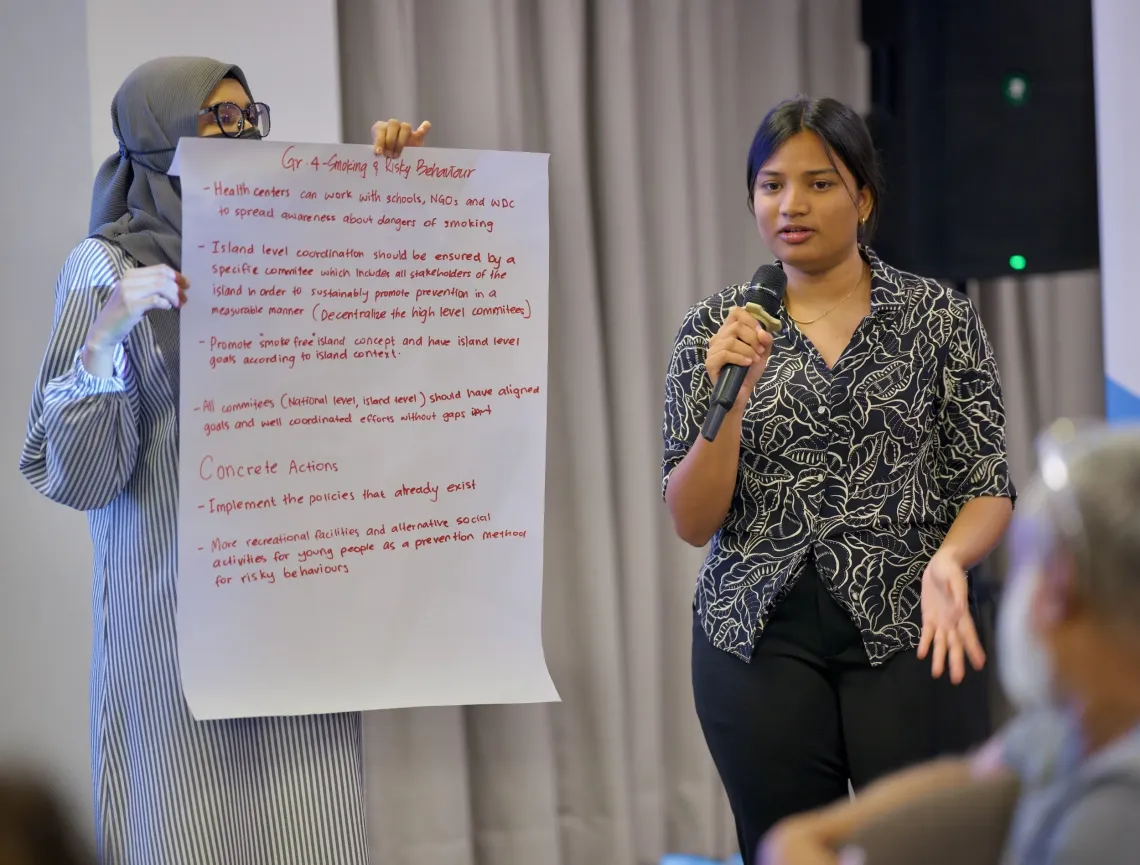
There is a tendency in public health frameworks to position young people as targets of intervention. As populations to be protected, educated, or reached. This framing, however well-intentioned, contains a subtle condescension that often undermines the goals it is meant to serve. It treats the people most affected by a problem as passive recipients of solutions they had no hand in shaping.
Young people in Maldives are already shaping the narratives their peers absorb. They are the most active users of platforms where contagion can spread and where protection can be built. Their voices, their language, and their stories carry weight in peer networks that no institutional messaging campaign can fully penetrate. When a young person shares their own experience of struggling and seeking help, it reaches places that a government poster does not. Creating spaces where young people can contribute, connect, and lead helps shift narratives from silence and stigma to openness and support. Their participation must be guided, safe, and rooted in connection rather than spectacle.
A collective call
The evidence is unambiguous: stories influence behavior. Narratives can narrow what feels possible, or they can expand it. We do not control all the forces that shape a person's vulnerability but we do control what stories we put into the world. We can control whether we include a helpline number or not or whether we frame distress as a permanent state or a navigable one.
Reframing how we talk about suicide is not about avoiding difficulty. It is about choosing, with full awareness of the stakes, how we enter difficult conversations, what we emphasize, what we leave out, what possibilities we open or foreclose for the person who is listening from a place of pain.
The same social forces capable of amplifying a harmful story can amplify a protective one. The same intimacy of island life that accelerates contagion can accelerate hope. The same speed with which grief travels can carry something else: the message that help exists, that support is close, and that the night, however long, will pass.
If you are struggling, please reach out. Help is available. You do not have to carry this alone.
1677
National Mental Health Helpline