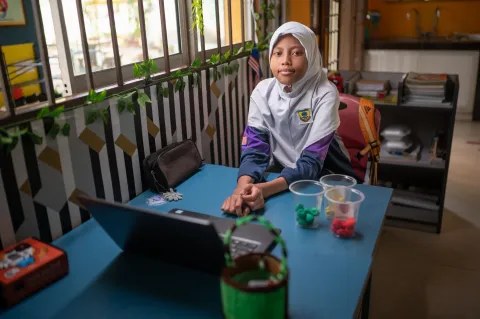
Healthy Central Kitchen: Helping TASKAs serve healthier meals
In a small childcare centre in Gua Musang, teachers help young children to eat well while parents work.

GUA MUSANG, KELANTAN – By seven in the morning, children begin arriving at a small childcare centre tucked in a quiet village in Gua Musang, Kelantan. Some arrive quietly, holding their parents’ hands. Others step in confidently, already familiar with the rhythm of the day.
Cikgu Maizon is waiting for them. For more than 20 years, she has opened these doors each morning, welcoming children, easing anxious moments and guiding them through the routines that shape their earliest years. Beside her is Cikgu Suhaida. Together with two assistants, they care for 15 children aged two to four, feeding them, teaching them and helping them grow.
"I always treat the children like my own,” Cikgu Maizon says. “Patience is something we must have, and we must remember that this responsibility is a trust. We will be accountable if we are careless in carrying it out."

Childcare becomes home for the day
Many of the children come from low-income families. Their parents work as cleaners, dispatch riders, lorry drivers, teachers and small-food operators. For these families, putting balanced, nutritious meals on the table every day can be hard. Not because they do not care, but because of rising costs and limited time.
For the children, this KEMAS TASKA is where most of their day unfolds. It is where they learn, play and eat most of their meals.
As more parents work, young children in Malaysia may eat up to four meals a day in childcare. While they may eat regularly, the quality, safety and balance of those meals can vary from one centre to another.
Mealtimes that teach trust
For teachers like Cikgu Maizon and Cikgu Suhaida, mealtimes are not just about serving food. They are moments that require patience, encouragement and care.
“When it comes to their meals, we must be patient,” Cikgu Maizon explains. “It’s our responsibility to make sure they are eating well, because this is where they spend most of their day.”

Between the ages of two and four, children’s bodies and brains grow fastest. What they eat during this time helps shape how they grow, learn and thrive.
But not every child has the same chance to eat well.
A reality many families face
Yet across Malaysia, many young children are missing out on the nutrition they need during this critical stage.
National data shows that one in five children under-5 are stunted – meaning they are too short for their age because they have not had the right nutrition over time. This can affect how they grow, learn and stay healthy, even later in life.
Nearly half are anaemic and some are already overweight.
This reflects a complex reality. Families and caregivers care deeply about their children, but are constrained by cost, guidance and the environment around them.
In childcare settings, teachers carry much of this responsibility. They guide children through daily meals and help shape habits that can last a lifetime.
Making every ringgit count
At KEMAS TASKAs, only RM4 per child per day is available under the meal assistance allocation. Variety was limited and nutrition was often compromised by what was affordable. Still, the teachers did what they could, stretching every ringgit to make sure no child went hungry.

Every meal required careful choices. What could be bought, what had to be skipped and how to make ingredients last.
Even then, feeding young children was never straightforward.
“We have one child who is very good at spotting greens, no matter how small we chop them,” Cikgu Maizon says with a smile. “He will be busy picking them out while his friends are already eating. But there are also those who happily finish everything, sometimes even their friends’ food.”
These moments point to a simple truth. Feeding young children is about more than food on a plate. It is about routine, trust and learning.
A new kind of support
Today, things at the TASKA are beginning to shift.
Through the Healthy Central Kitchen (HCK) pilot, led by the Ministry of Health Malaysia with support from UNICEF Malaysia, meals are now planned with nutrition in mind and in Kelantan, prepared on site at the childcare centre.
With RM15 per child per day provided through UNICEF-supported funding, teachers receive fresh ingredients and clearer menus. This allows them to prepare more balanced meals, including vegetables, fruits and protein rich dishes suited to young children.
Teachers are also supported with practical guidance on nutrition and food safety. This strengthens not just what is served, but how meals are prepared, handled and shared throughout the day.
The pilot recognizes the critical role teachers already play, not only as caregivers, but as the adults shaping children’s daily experiences with food.
Proper nutrition in early childhood is not just about growth. It supports brain development, strengthens a child’s ability to learn and lays the foundation for a healthier future.
UNICEF works alongside the government to strengthen standards and everyday practice, focusing on childcare settings that serve marginalized and underserved communities.
Small changes you can see

For the children at this childcare centre, the change can be seen in small but meaningful ways. Meals are more consistent, routines feel calmer and mealtimes support both care and learning.
By testing the Healthy Central Kitchen in different settings, UNICEF and its partners are helping to show what works – so the Government can consider expanding and rolling out better meals in KEMAS TASKAs nationwide.
For teachers like Cikgu Maizon and Cikgu Suhaida, the pilot brings support to a responsibility they have always taken seriously.
And every morning, as the doors open and the children arrive, the work continues. One meal, one routine, one patient moment at a time.
Dr Joey Eng is UNICEF’s Nutrition Specialist in Malaysia.