Zomba, Chikwawa youth set on being self employed
Already planning to transfer their skills to other youths for free

Hawa Kassim and Dackson Dickson are rewriting expectations for young people in their communities. They are proving that with the right support, youth from vulnerable households can build careers, earn income and inspire others to follow.
At 25, Hawa Kassim from Chinamwali in Zomba faced a life‑changing ultimatum from her fiancé: get married or abandon her education. She chose a different path. She chose to pursue a career.
“I have always dreamt of having a career that gives me financial independence. Marriage can wait,” she says.
The decision strained her relationship and cut off the financial support she once received. But her aunt encouraged her to apply for opportunities available to adolescents from Social Cash Transfer Programme (SCTP) households.
Through the Social Protection for Gender Empowerment and Resilience (SP‑GEAR) programme, also known as Amai Titukuke, Hawa was enrolled by TEVETA at Sakata Community College to study electrical installation and electronics. The programme, funded by the European Union and the Government of Ireland, equips young people with technical skills for employment and entrepreneurship.
Now in her second year, Hawa is interning at Zomba Central Hospital, where she installs and repairs electrical units in the cold room, kitchen, and other departments.
“The skills I am gaining are preparing me for self‑employment. I applied for this internship myself, and I believe I will find work once I graduate,” she says with a confident smile.

Hawa is the first in her family to reach tertiary education, and her journey is already inspiring others.
“In my area, child marriage is common. But now many girls, including my siblings, are applying to colleges to study fields like mine. When I open my own workshop, I want to train girls for free. It’s my way of giving back,” she says.
In Chikwawa, 20‑year‑old Dackson Dickson from T/A Mlilima is also charting a new path. After scoring 16 points in his MSCE, he enrolled in Information Communication and Technology (ICT) at Galamukani Community Skills Development Centre under the same programme.
In just five months, he has turned his training into income.
“I am already making money,” he says. “I get jobs at internet cafés and schools. I make K20,000 to K25,000 per day—about K100,000 per week.”

During the recent examination period, a school hired him for two weeks and paid him K280,000. With this income, he has been able to support his family of seven with maize and other essentials during the lean season.
But Dackson’s ambitions stretch further.
“I want to go to university. I applied through NCHE to study Nursing and Midwifery, Biomedical Science, Optometry, Chemistry, Cyber Security and ICT. Now that I have a feel for ICT, I would be happy to pursue it,” he says.
McShon Chikopa, Principal of the Development Centre and TEVET Regional Director for the Informal Sector, says the programme is already showing strong results.
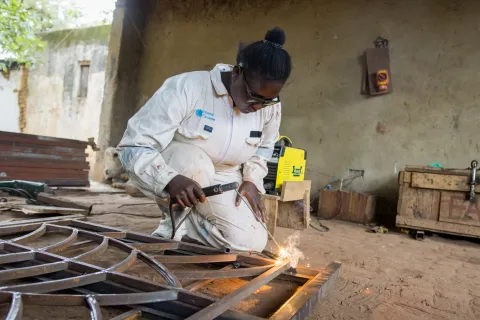
“At this centre, we have trained 35 students in ICT, Welding and Fabrication, Bricklaying, Tailoring and Fashion Design, and Carpentry and Joinery. Across the district, 297 students were trained in the first cohort of 2025, and another cohort begins in March 2026,” he explains.
He adds that follow‑ups show that at least 10 of the 35 graduates are already in gainful employment—including Dackson.
For both Hawa and Dackson, the SP‑GEAR programme has done more than provide skills. It has opened doors to independence, dignity and leadership. And as they prepare to build their own futures, they are already thinking about how to lift others with them.