From missed doses to new hope
From early-morning queues to community outreach, a refugee camp’s quiet routine is saving young lives

As dawn breaks over Dzaleka Refugee Camp, narrow footpaths begin to fill with quiet movement. Women arrive in small groups at the clinic based at the camp’s early childhood development (ECD) centre, some with infants wrapped securely on their backs, others gently guiding toddlers still heavy with sleep.
In their hands are health profile books, creased and well-kept, marking both responsibility and hope.
A long queue forms quickly. Baby cries cut through the morning air, softened by murmured reassurances in multiple languages spoken by women from across the region.
Colourful chitenje cloths rustle as mothers shift patiently. By the time the sun rises fully, the clinic is already alive, another familiar routine shaped by patience and the promise of protection against vaccine preventable diseases.
For many mothers, the visit is part of Dzaleka’s routine immunisation programme, which health workers urge families to follow closely. For others, it represents a second chance.
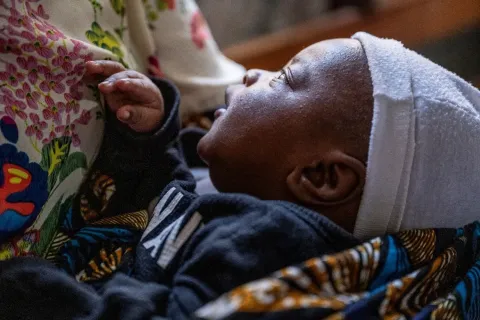
Among them is 24-year-old Darcine Busime, who missed her nine-month-old son David Price Levis’ third dose of the polio vaccine, scheduled for July 2025 at 14 weeks.
“I was not aware of the vaccination schedule,” Darcine says quietly. “Later, the health workers explained that my child had missed a dose, so I came back to the clinic.”
Her experience reflects a common challenge in refugee and host communities, missed or delayed vaccinations caused not by refusal, but by information gaps, mobility, livelihood pressures and other constraints.
“I now understand how important routine immunisation is,” Darcine adds. “Since my child started receiving vaccines, his health has been very good. I know these vaccines protect him.”
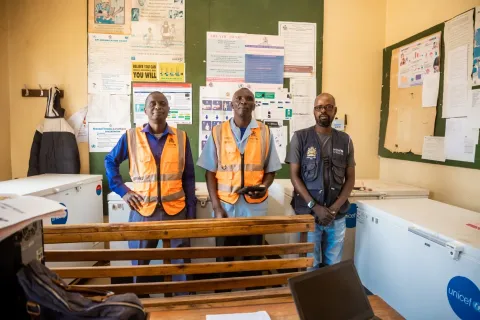
To close such gaps, UNICEF, with funding from Gavi, has supported Dowa District to strengthen immunisation services. The support includes immunisation data analysis sessions, mapping of zero-dose children, a mini-vaccination campaign targeting under-vaccinated children, and training health workers on vaccine management, focusing on stock control, cold-chain management, and accurate documentation.
The immunisation data analysis trainings covered 53 health facilities across the district and involved Environmental Health Officers, data clerks, and Senior Health Surveillance Assistants (SHSAs), equipping them to use data for planning and decision-making.
Goodson Chagwa, Senior Disease Surveillance and Control Assistant at Dzaleka Refugee Health Centre, says missed vaccinations often stem from practical realities.
“Some mothers are busy with small businesses, others relocate frequently, and some simply lack information about schedules,” he explains. “At times, we also face transport challenges for outreach clinics.”
Despite these challenges, Chagwa says vaccination coverage at Dzaleka remains encouraging, noting that the UNICEF-supported trainings have made a tangible difference.
“Through the zero-dose trainings, we learned how to analyse data properly, forecast vaccine needs, and manage stocks better,” Chagwa explains. “This has helped us reduce stock-outs and minimise vaccine wastage.”
He says the new skills have improved record-keeping, daily monitoring of vaccine consumption, and early identification of shortages, without placing unnecessary strain on the system.
Dzaleka Refugee Health Centre serves a population of about 16,675 people, including refugees and surrounding host communities.
John Buleya, the Expanded Programme on Immunisation (EPI) focal person at the facility, says routine immunisation services are now running more smoothly.
“We follow up with mothers who miss appointments, provide health talks, and remind them of their schedules,” Buleya says. “We also conduct outreach clinics and work closely with traditional leaders and community volunteers.”
According to Buleya, the Zero-Dose Campaign conducted in November last year significantly boosted vaccine uptake. “It helped us identify children who had completely missed vaccinations and bring them back into the system,” he says.
UNICEF emphasises that vaccines are most effective when administered at the recommended age and dosage. Children are particularly vulnerable to certain diseases at specific stages of development. Polio, for instance, most commonly affects children under the age of five.
Routine childhood vaccines include Bacillus Calmette-Guérin (BCG) given at birth, Oral Polio Vaccine (OPV-0) at birth, followed by OPV doses at six, ten, and fourteen weeks.
Beyond health workers, community volunteers play a vital role in ensuring immunisation messages reach households.
Innocent Kamsonga, 57, has volunteered since 1991. He says trust is key.
“Health workers often stay far from the people,” Kamsonga explains. “But when information comes through us, communities understand it better because they trust us.”
He says training from health officials has enabled him to support immunisation exercises and sensitise families about the importance of vaccines such as polio and measles.
Traditional leaders are also central to the effort. Chief Nkhondonanasi of Traditional Authority Sakambewa says chiefs help counter myths and misinformation that discourage vaccination.
“When we receive messages from health officials or volunteers, we share them widely in our communities,” he says. “The trainings help us communicate clearly and correctly.”
Globally, immunisation coverage is improving but remains below pre-pandemic levels. According to WHO and UNICEF 2024 estimates, 85 percent of infants received three doses of the DTP vaccine, yet 14.3 million children worldwide remain unvaccinated, classified as zero-dose. Measles coverage stands at 84 percent, with gaps continuing to drive outbreaks, particularly in conflict-affected settings.
As the sun begins to set over Dzaleka Refugee Health Centre, women walk home with measured steps, babies resting peacefully on their backs. Each stride carries relief, resolve, and a quiet promise of protection.
For mothers like Darcine, once left behind by missed information, hope has been renewed. And with sustained funding, stronger systems, and community-driven action, missed doses need not define a child’s future.