Giving every child a firm start in life
ECD for every child

Quality lifelong learning for all is one of the mantras of the global goals to end poverty, hunger and inequality by 2030, however, some Malawian children are not getting a solid start to life.
In primary schools, teachers lament that less than a tenth of standard one learners can read.
Efurida Frank, 25, does not want her three-year-old daughter, Catherine, to be amongst those left behind. Catherine goes to Makankhula Community-based Childcare Centre (CBCC) near Chimbiya Trading Centre in Dedza district.
“Catherine is clever and eager to learn. At her age, she can read the alphabet and write some letters. When she returns home, she shares what she learned with me and her playmates. My daughter can do better if she continues going to the CBCC,” says Efurida.

Catherine is among 230 children at Makankhula CBCC, which is one of two centres constructed by UNICEF in Dedza. They are currently being supported by the Finnish National Committee for UNICEF under the strengthening integrated early childhood development for every child project. The project targets the most disadvantaged children to enable them to develop to their full potential.
Community members contributed land, sand and bricks towards the construction of the CBCC, which receives children from 22 villages within the district.
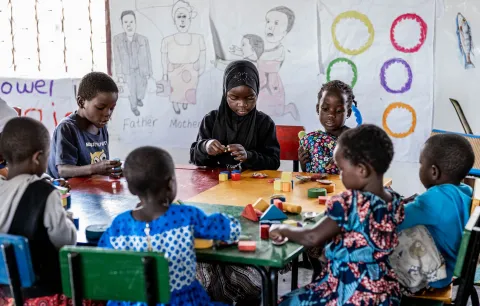
From Monday to Friday, with the exception of Wednesday, the centre buzzes with children singing, playing and learning in groups. Catherine and her peers do their exploratory learning through games, with assistance from the caregivers.
Efurida says since Catherine joined CBCC, her life has changed a lot. Previously, she would need to combine looking after her child while managing household chores and would even take her to the garden. This kept her busy all the time, but now with Catherine at the CBCC during the day, she is able to quickly get all the work done without interruption.
Catherine’s social skills are also improving, says her mother.
“The once reserved girl is increasingly becoming confident and inquisitive. She is curious about her environment. She rarely played with her friends at home, but now she plays a lot and is learning a lot from her playmates both at school and at home,” says Efurida.
Catherine’s development strides reflect the importance of CBCCs for children from vulnerable families in rural communities. Since the Centres are free, they also provide a great alternative for those who cannot afford to send their children to nursery schools, which are scarce in rural areas such as Chimbiya.
“The CBCC is giving these children a firm foundation. A house will collapse in no time if the foundation is shaky,” says Stella Kadzuwa, one of the five caregivers at Makankhula CBCC, who received training supported by UNICEF.
She adds that children who are preparing to transition to primary school are getting a solid start because the Centre provides an enabling learning environment, trained caregivers, good sanitation and community support.

The support from UNICEF and its partners in Finland has assisted the children to move from learning in risky spaces, as is the case with the majority of the 49 CBCCs in Dedza, to a more conducive environment. In nearby villages, children learn under trees, in dilapidated communal buildings and prayer houses which have one room, lack safe water, and proper sanitation.
Before the Makankhula CBCC opened, the children were learning in a run-down traditional court that belonged to the former group village head, who died in 2001. The building was hazardous to their health. They need quality early childhood development in a safe environment in order to do well and stay in school. The new Centre now has three rooms, separating children by age.
A male caregiver at the school recalls, “the old CBCC had one room, overcrowded by children of different ages and with differing needs. It was hard to teach them. The roof was rusty and leaky and the walls were falling apart. There was also a wasp nest in a corner of the shelter and children used to get stung, in which case we would suspend all activities. There was a certain day when a caregiver and 25 children were stung. This is now history.
The new CBCC is a significant structure in the feeder villages. Surrounding communities take turns to provide water, soya, beans and maize for the children’s daily meals. Children are now assured of a chance to attain proper early childhood development.