Malawi and India exchange experiences on foundational learning ahead of Pan-African FLEX gathering
Evidence‑based approaches from India inform Africa’s push for universal foundational literacy and numeracy

LILONGWE, 15th July 2026 - The governments of Malawi and India, together with UNICEF, on Tuesday convened a high-level dialogue on strengthening foundational learning in Lilongwe, bringing together experiences from India, Malawi and other African countries.
The event served as a precursor to the Foundational Learning Exchange Conference (FLEX2026), taking place in the capital city of Malawi from 15th – 17th July.
Malawi’s Minister of Education, Science and Technology Bright Msaka opened the meeting, which was joined by Mr. Sanjay Kumar, Former Secretary for the Department of School Education and Literacy in the Government of India and Ms. Alison Parker, UNICEF Deputy Regional Director for Eastern and Southern Africa.
Msaka said the South-South exchange provided an opportunity for countries to learn from each other on how to accelerate access to quality foundational learning for children.
“We are united by one common purpose, which is ensuring that every child acquires the foundational skills needed to succeed in school and in life, and to participate fully in society and help shape Africa's future. Across Africa, foundational learning is now at the centre of national education agendas as foundational learning and numeracy are not simply educational goals, they are economic, social and development goals," said the Minister.
Additional Secretary in the Department of School Education and Literacy under the Ministry of Education of the Government of India, Ms. Archana Sharma Awasthi, said: "India's experience has reaffirmed that improving foundational learning is not about a single programme or innovation—it is about strengthening the entire education ecosystem. Lasting change comes when evidence informs policy, technology supports teachers, communities become partners, and every intervention is adapted to local contexts.
“Through India’s national education policy and a foundational literacy and numeracy initiative, we have sought to build resilient systems that place every child at the centre of learning. We are pleased to share our experiences and learn from countries across Africa as we work together towards the shared goal of ensuring every child acquires strong foundational skills."
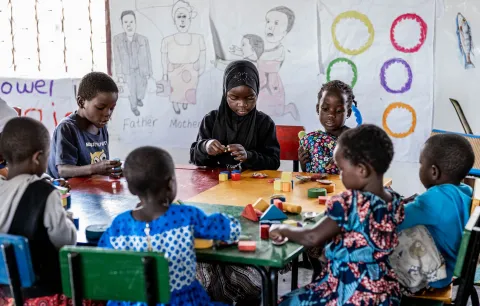
UNICEF Deputy Regional Director Alison Parker said UNICEF advocates for expending 10 percent of national education budgets on early childhood education to ensure that every African child can attend at least one year of quality pre-primary education.
"The greatest asset of any nation is its human capital. When we don’t invest in the early years, it compromises not just education, but also the health, wellbeing and psychological development of young people. If we miss the opportunity of nurturing our young citizenry at an early age, then our returns on investment will be questioned down the line. One dollar investment in early years can translate to seven dollar returns to our countries,” said Parker.
Sessions throughout the day examined India's large-scale, system-wide approach to foundational learning which is known as NIPUN BHARAT - including policy design, financing, curriculum coherence between early childhood and primary education, multilingual instruction, teacher professional development, and community and parental engagement.
India's foundational learning journey demonstrates how large-scale education reform can be driven through leadership and a whole-of-government approach. The National Education Policy 2020 designated Foundational Literacy and Numeracy as the highest priority of the education system, establishing it as a requisite for all future learning. The National Initiative for Proficiency in Reading with Understanding and Numeracy (NIPUN Bharat) Mission aims at ensuring that every child in the country attains foundational literacy and numeracy by the end of Grade 2.
To accelerate progress, the country aligned curriculum, teacher professional development, multilingual education, classroom assessment, parental engagement and data driven decision making to strengthen foundational literacy and numeracy across one of the world's largest school systems.
Early results show clear progress. The PARAKH Rashtriya Sarvekshan 2024 national assessment found that Grade 3 learners—the first cohort under NIPUN Bharat—scored 64 per cent in Language and 60 per cent in Mathematics, with rural students outperforming urban peers. The Annual Status of Education Report (ASER) 2024 also reported steady gains, with literacy rising by about 3 percentage points and numeracy by 7 points since 2018. Government schools recorded their strongest improvements in two decades.
Participants in the dialogue emphasized that strengthening foundational learning requires locally grounded solutions, and that South-South cooperation offers countries the opportunity to exchange experience, adapt promising practices, and accelerate progress toward universal foundational learning.
Presentations were led by senior officials from India's Ministry of Education and the National Council of Educational Research and Training (NCERT), alongside state-level representatives from Rajasthan, Assam, Uttar and Jharkhand.
Discussions were grounded in priorities already underway in Malawi and across African education systems, with participating governments examining which elements of India's experience — from large-scale teacher coaching to multilingual classroom materials — could offer useful practices to adapt to local contexts.
The FLEX2026 conference has convened Education Ministries and senior government education officials from more than 30 African countries across Africa to share evidence and practice on early-grade literacy and numeracy. Together, the two events underscored the power of peer learning in accelerating foundational learning outcomes for children.
ENDS
For more information:
Ministry of Education, Science and Technology: Ms. Lily Kampani [email protected]
UNICEF:
- Chief, Communication, Advocacy and Partnerships: Eulette Ewart [email protected]
- Communication Officer: Phillip Pemba: [email protected] +265995271671
Media contacts
About UNICEF
UNICEF promotes the rights and wellbeing of every child, in everything we do. Together with our partners, we work in 190 countries and territories to translate that commitment into practical action, focusing special effort on reaching the most vulnerable and excluded children, to the benefit of all children, everywhere.
For more information about UNICEF and its work for children, visit www.unicef.org.