

Launch of a cash transfer programme targeting nearly 68,000 children in the Atsimo Atsinanana region
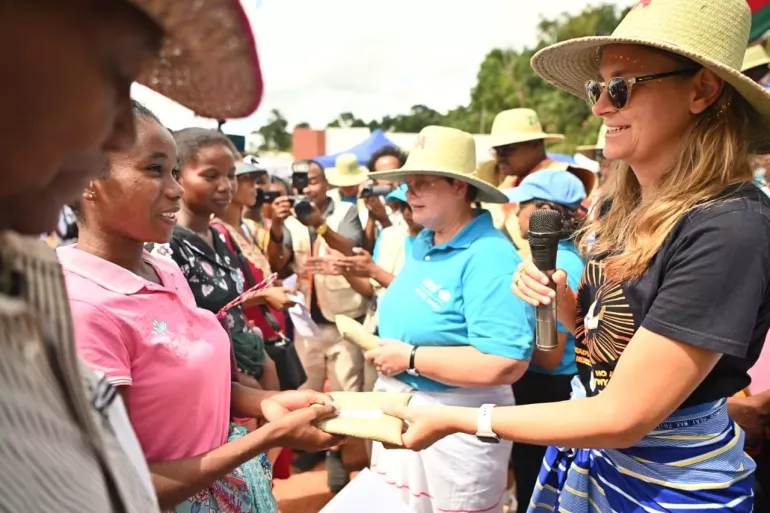
The Zara Mira programme, a universal child allowance programme implemented by UNICEF, was launched in the district of Vondrozo, in the Atsimo Atsinanana region, by the Minister for Population and Solidarity, the UNICEF Representative and representatives of the European Union.
Vondrozo, 5 April 2025 – New districts will benefit from the Zara Mira social protection programme for children in the Atismo Atsinnanana region. The programme was officially launched today in the presence of the Minister of Population and Solidarity, the team leader for governance and social work of the European Union, and Christine Jaulmes, the UNICEF Representative in Madagascar.
This programme is one of several supported by the European Union and implemented by UNICEF, which will support interventions in the areas of social protection, child protection and health in Madagascar, with funding worth 116 billion ariary (€23.2 million) over a three-year period.
Until October 2027, nearly 68,000 children in three districts – Vondrozo, Midongy and Befotaka – will benefit from cash transfers so that their parents can invest in their well-being and provide them with the best opportunities in life. Persons with disabilities, both children and adults, will also benefit from this financial assistance. These three districts are in addition to eight districts that benefited from the programme between 2022 and 2024 in other regions of Madagascar.
Through this programme, each household will receive an unconditional cash transfer of 10,000 ariary for every child aged 0 to 17 and for pregnant women living in the localities targeted by the project. An additional monthly transfer of 30,000 ariary will also be allocated to people with severe to moderate disabilities to account for the direct or indirect costs associated with their disability.
Finally, a set of supportive measures will be implemented to maximize the impact of the transfer on children's well-being and bring about behavioural changes in their parents, such as the adoption of key family care practices, gender equality, and productive and financial inclusion.
“Investing in children and their families, it means building a better future for them, for a fulfilled human capital and a prosperous nation,” said Ms Aurélie Razafinjato, Minister of Population and Solidarity.
“Investing in social protection means investing in the well-being of children. Cash transfers are among the most effective measures for enabling children to realize their rights. They reduce the financial barriers faced by families, whether in terms of access to health services, nutrition or education, while ensuring better protection for children through a referral system to social services, including registration matters and protection against violence,” said Christine Jaulmes, UNICEF Representative.
“The European Union is renewing its commitment to children. This is an investment in human capital, economic growth and a future where every Malagasy child has the opportunity to flourish,” said Anna Cichocka, Team Leader, Governance and Social Work, European Union.
Together, UNICEF and the European Union will work to improve people's access to resilient health services while strengthening the resilience of children, pregnant women and people with disabilities in the face of health, climate and economic shocks. In the area of health, in particular, the programme focuses on the rehabilitation and construction of health facilities in four regions, Diana, Vakinankaratra, Haute Matsiatra and Atsimo Atsinanana. These new facilities will serve more than 6 million people.
« Investir pour les enfants et leur famille, c'est leur construire un avenir meilleur pour un futur capital humain épanoui et une nation prospère. », a déclaré Madame Aurélie Razafinjato, Ministre de la Population et des Solidarités.
« Investir dans la protection sociale, c’est investir dans le bien-être des enfants. Les transferts monétaires sont parmi les mesures les plus efficaces qui permettent aux enfants de réaliser leurs droits. Ils réduisent les obstacles financiers que rencontrent les familles, que ce soit en matière d’accès à la santé, à la nutrition, ou à l’éducation tout en assurant une meilleure protection des enfants à travers un système de référencement vers les services sociaux, couvrant l’état civil et la protection contre les violences », fait savoir Christine Jaulmes, Représentante de l’UNICEF.
« L’Union européenne renouvelle son engagement en faveur des enfants. C'est un investissement dans le capital humain, dans la croissance économique et dans un avenir où chaque enfant malgache a la possibilité de s'épanouir », déclare Anna Cichocka, cheffe d’équipe, « gouvernance et secteurs sociaux » de l’Union européenne.
Ensemble, l’UNICEF et l’Union européenne vont oeuvrer afin d’améliorer l’accès des populations à des services de santé résilients tout en renforçant la résilience des enfants, des femmes enceintes et des personnes handicapées face aux chocs sanitaires, climatiques ou économiques. Dans le domaine de la santé, notamment, le programme porte sur la réhabilitation et la construction de structures sanitaires dans quatre régions – Diana, Vakinankaratra, Haute Matsiatra, Atsimo Atsinanana. Ces nouvelles infrastructures cibleront plus de 6 millions de personnes.


