Three Mothers, One Hope: Back to My Classroom in Buchanan
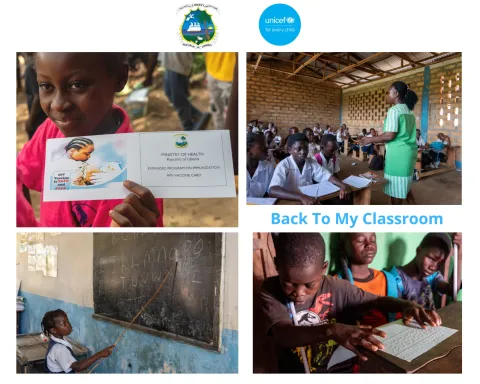
Getting Liberian children back to school: The Back to My Classroom campaign aims to help 250,000 out-of-school children enroll and learn.

Three Mothers, One Hope: Back to My Classroom in Buchanan
There are seven children squatting among the pieces of charcoal. Four of them are still wearing their school uniforms; they have just come home from school. With their hands blackened, they help pack the black blocks into plastic bags. Patricia is in charge of the operation; and she is the one who brought the precious fuel back from the bush. She pays 750 Liberian dollars for each large bag. Once divided into plastic bags sold for 20 Liberian dollars each at the Buchanan market, she can expect a total profit of 150 Liberian dollars.
“It's not much, but at least I'll be able to bring home some food.”
A little way off, sitting on a chair, her sister Mamie cuts the potato greens into tiny cubes.
Patricia and her sister Mamie live with their cousin Hannah. To reach their brick and corrugated iron houses, you have to take a dirt road, a good kilometer from the school. Three of the children attend classes there, including Fayor and her twin brother.
Patricia, Mamie, Hannah: three women, three mothers, with fairly similar stories.
Mamie speaks a local dialect while her older sister translates. She never learned English, having never been to school. She has five children, “alive,” she points out. Her husband quickly fell seriously ill, unable to speak, struck by dementia. She found herself with nothing, no support, yet still had to take care of the whole family.
“I had no way of sending my children to school; the little I earned at the market was just enough for food. Especially since there have always been ups and downs, and too often downs, as is the case right now.”
Her children did not go to school because she needed them to help bring in some money. From a very young age, Fayor also walked around the markets selling bags of charcoal. When she was 10 she was sent to Monrovia to live with an uncle. He promised to send her to school, but in reality, she was used as a maid. Her daily routine consisted of cleaning the house and doing laundry, including washing her cousins' uniforms and shoes. Her uncle has since passed away and Fayor has returned to Buchanan. Thanks to Back to My Classroom, she has finally started school. At 14, she is in kindergarten 1, with children who are sometimes half her age. This is not unusual in Liberia, where the vast majority of students are overaged.
“I am happy now, and not as worried about Fayor as I used to be. Now that she is going to school, she will have a better future and will be able to help me more later on.”
Her twin brother also benefits from the Back To My Classroom campaign and attends the same school-the Rilo Foundation Education School. They go to class from 8 a.m. to 12 p.m., just like Patricia's three children. “Well, not always. Sometimes they don't have uniforms and can't go,” she explains curiously, without further elaboration. “We don't always have the money.” Unlike her sister, Patricia did attend school but dropped out in fifth grade. “My parents couldn't afford it anymore.” History seems to repeat itself over and over again...
One in three children in Liberia is not registered
In some cases, it is not only the cost of registration, uniforms, or materials that prevent parents from enrolling their children in school. Some parents cannot do so because their children do not have birth certificates. Legally, birth registration is free in Liberia for all children under the age of 12. In practice, however, there are many abuses. It is not uncommon for parents to be asked to pay 200 to300 Liberian dollars, or even more, at registration centers. This alone discourages many parents. In addition, there is still a lack of information. As a result, it is estimated that one in three children in the country is not registered.
One aspect of the Back to My Classroom campaign aims to rectify this situation. The county-level part of the campaign launched at the end of June 2025 in Buchanan, for example, was accompanied by a mass registration drive in schools. After tearfully explaining how difficult it had been for her as a mother not to be able to send her children to school, Hannah, the cousin, was able to benefit from this.
“My three children weren't registered because I didn't have the money to do so. When I heard that they were doing it for free at school, I sent them. So, I was able to register them too. Since September, my three children have been in school, and I'm very happy about that.”
Hannah tells us that although she was able to take advantage of free registration this year, she fears the future, even in the very short term. To make ends meet, once they come home from school, her children go to sell charcoal in town almost every day.
Through Back to My Classroom, the mass birth-registration drive in Buchanan turned what once felt impossible into a real chance for families like Hannah’s. For the first time, all three of her children are in school, an achievement built on courage, persistence, and timely support.
But Hannah’s story is also a reminder that access is only the first step. When children must sell charcoal after class to help their families survive, the risk of dropping out remains close. Sustained support for the most vulnerable households is essential to ensure children are not only enrolled, but able to stay, learn, and build a different future.