
Early childhood care and development
Developing young minds
Challenge
Early childhood care and development (ECCD) in Lesotho face significant challenges, primarily due to limited access to pre-primary education. Currently, only 3 out of 10 children have the opportunity to attend early childhood education (ECE). Additionally, the quality of services is often low, and infrastructure is insufficient. As a result, many children enter primary school unprepared. Children with disabilities are particularly underserved, with just 9 per cent enrolled in ECE programs as of 2023 (Education Statistical Report, 2023).
In Lesotho, the first level of education is divided into three categories: reception classes, home-based programs, and ECCD centers. Reception classes, which were introduced in 2006 and are attached to existing primary schools, currently number 310, representing only 10 per cent of total ECCD enrolment. These classes offer one year of free pre-primary education for five-year-olds before they transition to primary school. However, their limited availability means not all children in need can access them.
ECCD centers, though numerous (over 2,300 across communities), are predominantly privately owned and charge fees, making them inaccessible to families who cannot afford to pay. Home-based programs, which are community-initiated and intended to serve disadvantaged children, suffer from major shortcomings: they are often staffed by unqualified, unpaid teachers who frequently leave for paid opportunities, making these programs unstable and unreliable.
From 2016 to 2023, enrolment in ECE has steadily declined, dropping from a gross enrolment rate of 42.2 to 35.2 per cent. Enrolment in ECCD also fell from 50,056 in 2018 to 46,622 in 2023. Many ECE facilities lack basic infrastructure and learning materials. Teachers, particularly in home-based programs and ECCD centers, often lack the professional training necessary to effectively implement the curriculum. Basic sanitation and hygiene facilities are a significant concern, with many schools relying on rudimentary toilet structures that are unhygienic and inadequate.
Despite having a strong curriculum in place, the lack of trained educators has hindered its full implementation. Moreover, while the Ministry of Education and Training, with support from the Roger Federer Foundation, has introduced the School Readiness Initiative, it is not yet available in all schools. Even in those that have adopted the initiative, community involvement remains weak, and as a result, the development of natural playgrounds—intended to be built by local communities—has been limited.
Solution
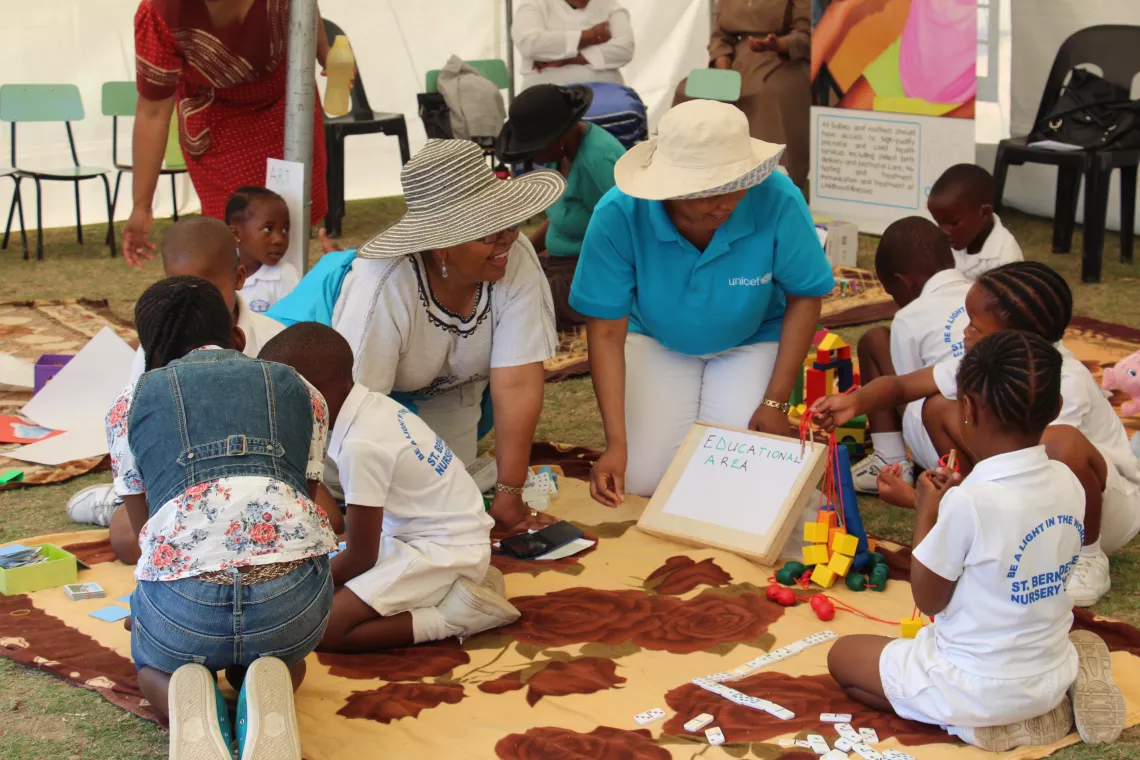
UNICEF supports an integrated, cross-sectoral approach to ECCD, focusing on quality early learning, inclusive education, and parenting support. This includes strengthening teacher training, developing inclusive curricula, supporting nutrition and early stimulation, and promoting the early detection of disabilities.
By advocating for free ECE and scaling community-based services, UNICEF ensures that all children have the foundation to thrive and learn. UNICEF also advocates for scaling up reception class as it is the only government-owned type of pre-school that is reliable, and parents do not pay fees. UNICEF is also focusing on improving teacher professional development by investing in the Lesotho College of Education’s institutional development so that teacher training is improved by offering accredited courses and programmes.
UNICEF commissions various studies such as on disability inclusion and gender transformation in foundational literacy and numeracy so that programming is evidenced-based.
The partnership with Roger Federer Foundation, the Ministry of Education and Training and Network of Early Childhood Development of Lesotho is scaling up the School Readiness Initiative for all five-year-old children that are in pre-schools. Teaching and learning materials are being procured for children aged 3-5 years and hopefully enrolments will increase in the coming years.