

The Palestinian Programme in Lebanon (PPL)
The Programme aims to improve the lives of Palestinian refugee children and their families, as well as other vulnerable people living in Palestinian camps. It focuses on providing support in core sectors, including health, education, and child protection
- English
- العربية
Lebanon hosts approximately 210,000 Palestinian refugees, the majority of whom
live in poverty, struggle to provide for their children and face legal, civil rights and integration challenges.
Almost half the refugees live in the 12 recognized Palestinian refugee camps in Lebanon, where overcrowding, poor housing conditions, insufficient infrastructure, poverty and violence put children and youth at significant risk. Refugees in adjacent areas known as ‘Palestinian gatherings’ are often even more vulnerable.
- 93% of Palestinian refugee families live in poverty. Many suffer from food insecurity.
- Nutritional deficiencies are widespread among young children. Stunting – when a child’s height is well below average – is a significant concern among children under age 5.
- Far too many children under age 5 suffer from developmental delays, often as a result of food insecurity and stunting.
- Children are at risk of child labour, exploitation, violence and abuse.
- More than half of the Palestinian refugees in Lebanon are excluded from paid employment. They are barred from about 39 professions, including medical, legal and engineering.
- The war in Lebanon severely affected Palestinian camps, leading to widespread displacement. The crisis strained education systems, limited access to child protection services and challenged the capacity of service providers to maintain quality support.
Solution
Improving the living conditions and the rights of Palestinian refugee children and their families requires, among others:
- Providing a comprehensive response to their needs.
- Ensuring every child and family has access to healthcare, child protection, and water and sanitation.
- Ensuring all Palestinian children have access to quality education.
- Enhancing vocational training programmes and providing Palestinian youth with practical skills and better employment opportunities.
- Promoting social initiatives that encourage interaction between Lebanese and Palestinian communities.
- Providing legal support and advocacy for Palestinian families.
- Establishing the Lebanese Working Group on Palestinian Refugees Affairs as recommended by the Lebanese Palestinian Dialogue Committee (LPDC), an inter-ministerial government body.
- Implementing the Youth Strategy for Palestinian Refugees prepared by the LPDC.

Our key achievements
PPL, in collaboration with NGOs, aims to address the critical needs of Palestinian and non-Palestinian refugees through a multifaceted and adaptive approach. It focuses on delivering impactful, inclusive and sustainable support. In 2025, the Programme expanded efforts to address climate change, disability inclusion and accountability to affected populations.
Solution
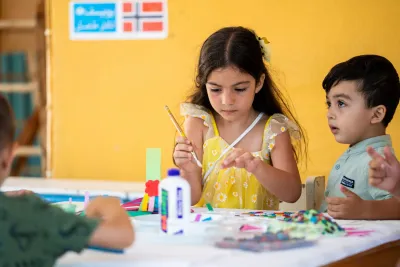
PPL works to promote inclusive and equitable education by expanding access to early childhood education (ECE) for marginalized children and strengthening efforts to reduce dropout rates. Educators are capacitated to deliver quality and inclusive education. These efforts were intensified during the devastating 2023-2024 cross-border conflict.
- The programme provides ECE support to 5,000 children aged 3–5, including children with disabilities, and provides learning support to 3,500 children.
UNICEF, through QUDWA initiatives, delivers a comprehensive range of child protection services, including community-based mental health and psychosocial support, prevention of gender-based violence, case management and parenting support. We also help partners provide protection from sexual exploitation and abuse (PSEA) and develop the child protection network (CPN). These interventions were scaled up in response to the mass displacement from Palestinian camps during the escalation of the conflict in 2024.
- Some 30,000 children benefit from community-based activities, 3,000 receive specialized psychosocial support and 700 access case management.
The Programme provides vocational and life skills training to young people and adolescents, promotes civic engagement through youth-led initiatives and supports income generation through small businesses, internships and mentorships. During the 2024-2024 conflict, youth were mobilized to play an active role in community resilience. They engaged in volunteering, participated in emergency preparedness and life skills workshops, and gained practical experience in fields such as robotics, app development and solar system installation.
- PPL empowers 3,800 adolescents with life skills and health education, and 1,750 youth through formal and non-formal skills training.
UNICEF trains healthcare workers, ensures the regular procurement of vaccines, and provides cold chain infrastructure for clinics run by UNRWA, the UN agency responsible for Palestinian refugees. PPL supports the use of solar energy in health and education facilities. During the 2023-2024 conflict, these systems were critical in maintaining access to clean water and routine immunization. We also promote positive health and hygiene practices through awareness-raising.
- More than 5,000 infants receive essential vaccines, and 35,000 people engage in awareness initiatives promoting hygiene and disease prevention.