Water for people and progress in Lao PDR
The Past, the Present, and the Future of Clean Water

Today, 95% of households in Lao PDR have access to at least basic drinking water. But this wasn't always the case. In 2000, only 48% of the population had access to basic drinking water. Getting from 48% to 95% took more than 25 years of sustained collaboration among the Government of the Lao PDR, UNICEF Lao PDR, and partners, including the Australian Government, the Government of Japan, USAID, the Japan Committee for UNICEF, and the Korean Committee for UNICEF.
As we mark World Water Week 2026 under the theme "Water for People and Progress," UNICEF Lao PDR is highlighting this progress in water, sanitation, and hygiene.
How far we’ve come together
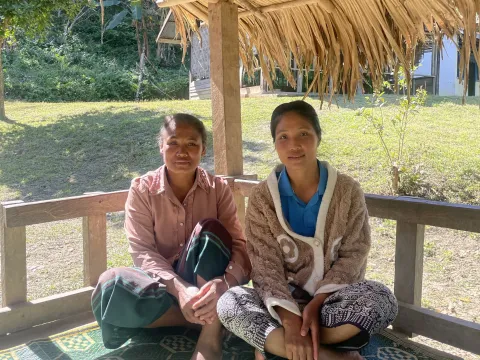
"Ever since I moved here, there have been many challenges. Going to work was hard, and after a long day we still had to fetch water, carrying three or four loads just to have enough for the day. Even washing clothes was difficult."
"Ever since I was a child, my parents carried water from the river, sometimes coming back late or in the rain, which brought real risks."
"Before, we used open areas as toilets. Later, we dug pit latrines, laid branches across the hole, and used that."
These are the real experiences of villagers. In 2000, less than half of Lao PDR's population had access to basic drinking water, and the situation was harder still in rural areas, where only 30% had a household water system and fewer than 25% had a private toilet.
To address this, UNICEF began working closely with the Ministry of Health and Centre for Water Supply and Environmental Health as early as the 1990s to expand access to safe water and sanitation. The first underground water project began in 1993. By 1998, working with the World Bank, UNICEF introduced a community guide that helped villages set up WASH committees. In 2017, Laos began shifting from shared public taps to household water connections, making access more convenient, reliable, and sustainable.
Today, good progress has been made in improving access to water, with strong momentum toward safe sanitation practices. But the journey is not over. This progress has not yet reached everyone, especially households in the last mile who still need support to access and use safe toilets.
The Path Forward
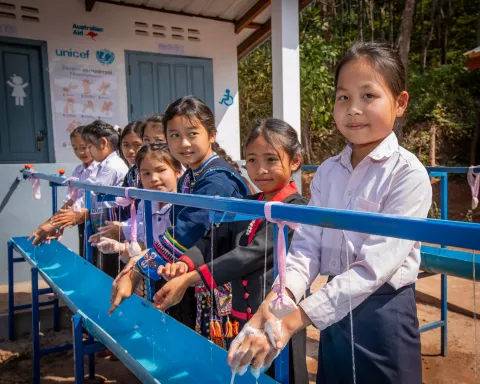
Clean water, basic sanitation, and regular handwashing protect children's lives by preventing diseases like diarrhoea. For children under 5, these illnesses are especially dangerous, by weakening the immune system and making it harder for their bodies to absorb nutrients and grow.
Around 320,000 people in Laos still lack clean water and basic sanitation. Many live in remote rural areas, face poverty, or live with disabilities, and women and children often carry the greatest burden. Even where basic water access exists, it isn't always safe: about 73% of drinking water in Laos still contains harmful bacteria like E. coli, which can cause severe illness and, in the worst cases, prove fatal for young children. Women and girls, who bear the majority of water-related care work, such as collecting water, managing household hygiene, and caring for sick family members, are often disproportionately exposed to contaminated water and its related health risks. This unequal burden can also limit their time for education, income-generating activities, and rest.
Climate change is adding further pressure. Laos is one of the countries most at risk, with annual floods and landslides destroying wells, water points, and toilets, and contaminating water supplies. The impact isn't equal. Children from the poorest families and some ethno-linguistic groups are disproportionately affected by these disasters.
Now we must finish the job: reaching the families still left behind, investing in water treatment so it's safe to drink, and ensuring the last-mile households have toilets that are safe and inclusive. It means building climate-resilient systems that can withstand floods and drought.
With continued partnership and investment in water, sanitation and hygiene from the government of Lao PDR and developing partners, we are building systems that can withstand and support the lives of children, reaching every community and protecting every child in Lao PDR.