Out of Sight No More
The Quiet Courage of Families Raising Children with Disabilities in Rural Laos and how a UNICEF parenting programme is helping improve their lives.

The village of Soi stirs early in the morning and two mothers in two different households wake up, prepared to face the day with quiet determination.
In the first household, the mother begins by preparing herbal compresses to ease the body of her four-year-old daughter. Her little girl does not speak, barely hears and struggles to respond to the world around her. She was born after a complicated labor and delays in her development became apparent within her first year. However, her parents, subsistence farmers, had no understanding of what was happening or what they could do. “We wanted to help her,” her mother says, “but we didn’t know how.”
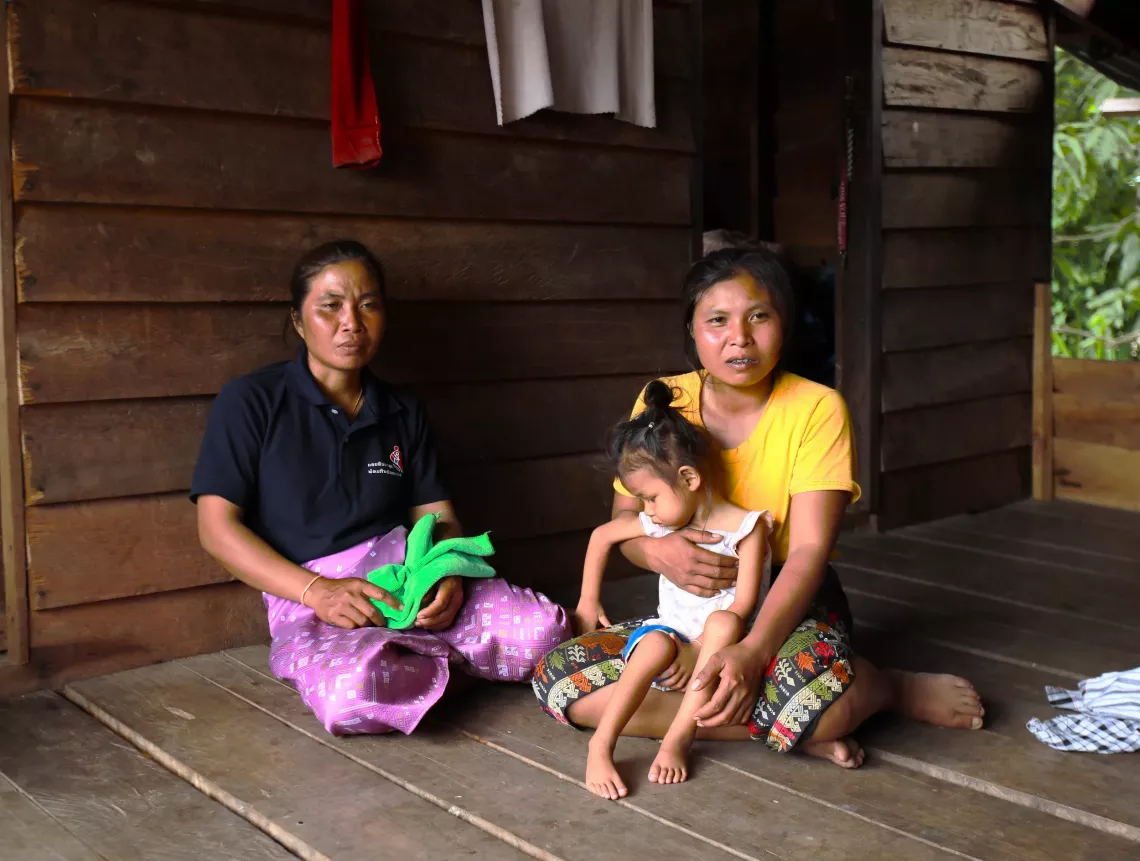
In the second household, the mother steadies her 12-year-old daughter as she walks with a limp across the house floor, her body still bearing the physical consequences of a fall she suffered as a baby. Her family, like many in the area, turned to traditional remedies as the health system never reached them and the girl’s fracture went untreated. Now an adolescent, she walks with pain and difficulty.

Many families like these two from Soi village, tucked deep in Bualapha District of Khammouane province, often live in the shadows, out of sight for many. Theirs are not isolated stories since in rural Laos, poverty and geography often conspire to keep the struggles of those living with disabilities hidden. These silents struggles also continue to be invisible because of the lack of health systems that could reach them.
But change is beginning to take hold in Soi village.
The “Love and Care for Every Child” Parenting Programme, implemented by the Lao Women’s Union with support from UNICEF, is expanding its reach to include one of the most overlooked groups: children with disabilities. New tools are now being developed and validated to help village facilitators recognize early signs of developmental delays. Once finalised, these tools will be used to train local facilitators—many of them mothers themselves—to spot concerns and guide families toward care.
Facilitators have begun engaging with the two aforementioned families in Soi village, not offering a full solution yet but something just as essential - recognition. They’ve connected the households with district health officials, who are now coordinating with provincial partners to map out possible pathways for formal assessment and treatment of the children.
It is a modest step but a meaningful one. UNICEF’s long-term vision is to embed disability identification into the parenting curriculum across all 451 villages where the programme is active. In communities like Soi, the change may feel slow but it is real.
For the two young girls in Soi, time may not undo the past and its consequences. But for the next child or those who come after in their village the future looks a little different because awareness has arrived and with it the promise of better care.
This critical work is made possible with the support of UNICEF Australia through the Australian NGO Cooperation Program (ANCP), ensuring that even the most remote families are no longer left unseen.