Nothing About Us Without Us
The Journey of Khamta Sengmany, leading the first youth with disabilities initiative in UNICEF Lao PDR

Khamta was born in Phonngam Village, Khamkirt District, Bolikhamxay Province, and began school like many other children that were excited, curious, and eager to learn. However, after his first semester in Grade 1, his eyesight began to deteriorate. Gradually, the letters on the blackboard disappeared from his view.
“I remember trying so hard to see what the teacher was writing. Even when I couldn’t see clearly, I never stopped loving school. I still wanted to go to school and study,” Khamta recalls.
At that time, the teachers and school were not familiar with how to support a child with visual impairment. Sometimes in the class, the teacher asked him to sit outside the classroom, unable to fully participate because they lacked experience. At home, his mother, who had completed only Grade 2 herself, held his hand and guided him in writing using chalk on a small blackboard.
In 2005, his family brought him to Vientiane, hoping for medical treatment.
“The doctors explained that my eyesight could not be restored. My mother, determined to help me, even asked if she could donate one of her eyes, but there was no treatment. However, I still have hope for a future,” Khamta said.
That moment became a turning point in his journey.
In August 2005, Khamta enrolled in the Special School under the National Rehabilitation Center in Vientiane. In school, Khamta started learning Braille, orientation and mobility skills, and how to walk independently using a mobility cane. For the first time, he met other children with visual impairments.
“When I studied in school, I realized I was not alone. Blindness was not the end of my education. It was the beginning of learning differently,” Khamta shared.
After completing primary education, Khamta transitioned to an inclusive school in Vientiane. Every day, together with his friends, Khamta walked about two kilometers to school using his mobility canes. However, there were still challenges.
“People with disabilities are not allowed to join the youth committee at the national level, because they were considered unable to contribute to physical activities like cleaning or event preparation,” Khamta said.
Khamta and his visually impaired friends proposed a solution to contribute through cultural performances, playing traditional Lao instruments and singing at school events and youth activities. Their performances demonstrated that contribution takes many events.

“In the year of 2014, my friends and I were officially permitted to become members of the committee,” Khamta shared.
The experience later shaped Khamta’s opportunity to contribute as a national athlete in the ASEAN Para Games in Singapore and Malaysia. This experience strengthened his confidence and belief in equal opportunity.
Soon after, new inclusive education policies allowed visually impaired students to access university. Khamta enrolled in the Faculty of Letters, majoring in English. During his four years at university, he volunteered at the Disability Service Center and trained fellow students in public speaking. Working alongside more than 40 students without disabilities, he promoted inclusive collaboration and peer support across six campuses.

“University showed me that inclusion is possible when people are willing to learn from each other,”- Khamta shared.
After graduation, however, entering the workforce proved challenging. Few institutions had policies or confidence in hiring people with visual impairments. Despite these barriers, Khamta continued advocating for employment inclusion. He worked as a facilitator supporting visually impaired students at Dongkhamxang College and later volunteered with the Vocational Development Blind Association to promote vocational training and employment access.

“We don’t want sympathy. We want opportunity, and we need everyone to believe that we can perform just like anyone else.” Khamta said
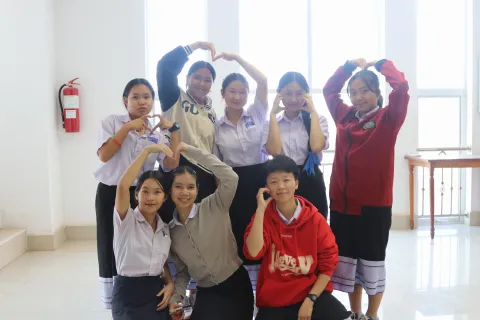
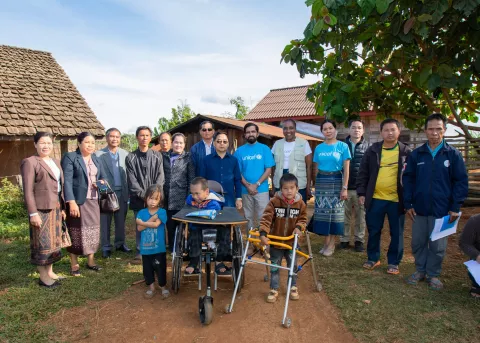
From then till now, Khamta has continued contributing to people with disability, and so far, he supports the youth with disability to advocate about their rights. Together with the support from UNICEF Global initiative and implementing partner like UNICEF Laos, along with the efforts from someone like Khamta, the barriers become challenges that can be overcome. Everyone has extraordinary potential to help build a more inclusive and welcoming community.
“I have seen how talented and determined young people with disabilities are. They need access, support, and a platform to express themselves,” Khamta shared
From a child struggling to see the blackboard to a national athlete, university graduate, advocate, and youth leader, his journey reflects resilience, courage, and determination. More importantly, it reflects the power of opportunity.
His vision for Lao PDR is clear: a country where all young people regardless of ability can access education, employment, sports, and leadership equally.
Because inclusion is not only about removing barriers. It is about building a future where everyone belongs.