Colombia: Mine action, an essential step to consolidate peace
International Mine Awareness Day
- Español
- English
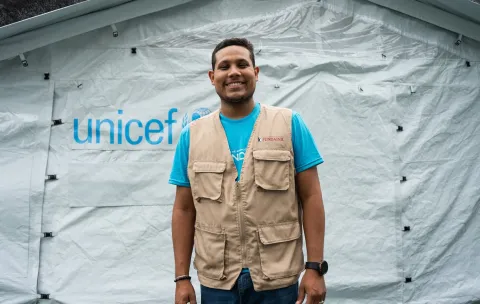
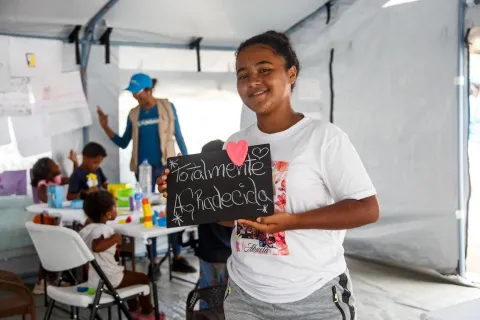
On International Mine Awareness Day, we share the stories of Josué and Maribel, two adolescents who survived a landmine accident in Tumaco, South of Colombia, and who became an example of courage and resilience. They are also an example of everything we still need to do to ensure that these devices do not continue to generate new victims in Colombia: without action against landmines, it is impossible to consolidate peace.
Tumaco, 4 April 2024.
No person - not even a child or adolescent - should have to face that pain, that shock… that one of being injured or losing a body part in an explosion caused by a landmine. No parent should have to see his or her child go through that, either.
The event, traumatic and violent itself, is always compounded by other effects: displacement, confinement, mobility restrictions, impeded access to humanitarian action. Not to mention that the after-effects and consequences of explosive devices last a lifetime: most mines cause amputations and the victims will have to adapt to this new reality.
In the case of children, the impacts are amplified because their bodies are still growing, their motor skills are still developing, and their identities are still forming. “If they suffer an amputation and have a prosthesis, it must be changed every six months; they need more check-ups, psychosocial support and family accompaniment. "This difficulty increases when we talk about children in rural areas, where mine accidents are common and where access to health care is more limited," says Sandra Salazar, UNICEF mine action officer.
Colombia is one of the most affected countries by anti-personnel landmines in the world, with more than 100 victims per year, 60 per cent of them civilians. Many mines have accumulated over the years of the armed conflict, others emerge every day, with the increase of confrontations and new hostilities between armed actors. According to information compiled by the Area of Responsibility for Mine Action in 2023, more than 520,000 people, inhabitants of 122 municipalities in Colombia, are at risk of suffering an explosive ordnance accident or being confined or displaced by the presence of these devices (UNMAS, 2023).
On International Mine Awareness Day, commemorated this April 4, we share the stories of Maribel and Josué, two 16-year-olds, supported by UNICEF and its implementing partner, Corporación Paz y Democracia, who lost one of their legs in a landmine accident in the rural area of Tumaco, in the Pacific region of Nariño, the municipality most affected by this problem in Colombia.
"That's what it's all about, you have to keep on playing": Josué, 17 years old
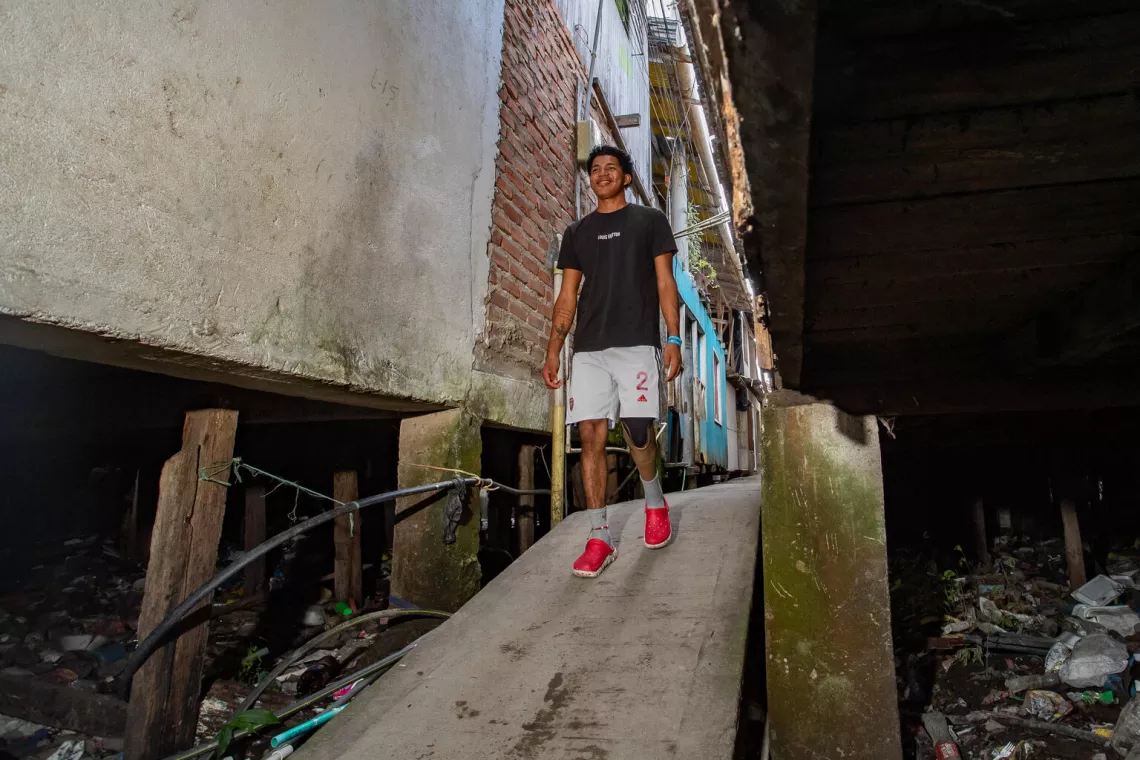
It was December 16, 2022. Six days earlier, on December 10, Josué had turned 16. The cocoa plants were ready to be harvested in Santo Domingo El Progreso, a village in Tumaco, Nariño, very close to the border with Ecuador, where his family had crops and survived by farming, crabbing and collecting shells. Josué and his brother decided to go into farming, a few blocks from their house, to harvest, to sell the cocoa and thus collect enough for subsistence and, if it was enough, for the Christmas holidays: "for food and clothes to wear."
What Josué did not imagine was that on that day, in the peak of his adolescence, his life would change: he stepped on an anti-personnel mine with his left leg. That explosion postponed his dream, -the only one he admits with a passion- that of becoming a professional soccer player.
He remembers flying through the air, seeing stars, "I felt I was up and down", and then his brother making an improvised tourniquet with a T-shirt to staunch his blood, his family and community evacuating him, thanks to that first aid lesson learned in the school of a life in the midst of armed conflict. Josué says that at that moment he felt nothing, neither pain nor anguish: the sedative adrenaline of the blow, the anesthesia of war. Then began the journey to get to the hospital in Tumaco - on foot, by boat, by car - to receive - at least four hours later - health care.
He was conscious until he arrived at the hospital, then he woke up two days later in Pasto. After having surgery, he learned that they had needed to amputate his left leg, almost from the knee, but he was alive, he was alive! And that was a miracle. The initial dismay at losing a part of his body, at knowing that he could not go back to his life as it had been, that he could not go back to being the best central defense of his soccer team, the one with the number 5 jersey, was followed by acceptance, struggle, resignation and courage.
"The doctor told me that I was going to walk again with a prosthesis, that made me happy, but I thought I was not going to play soccer again."
He says it calmly and even with the smile of someone who has already gone through the worst part: when he talks about soccer, his voice gets more melancholic, but he has been told that with a new prosthesis that the EPS (health insurance) will give him, maybe he will be able to resume training.
"In the beginning I wanted to quit studying."
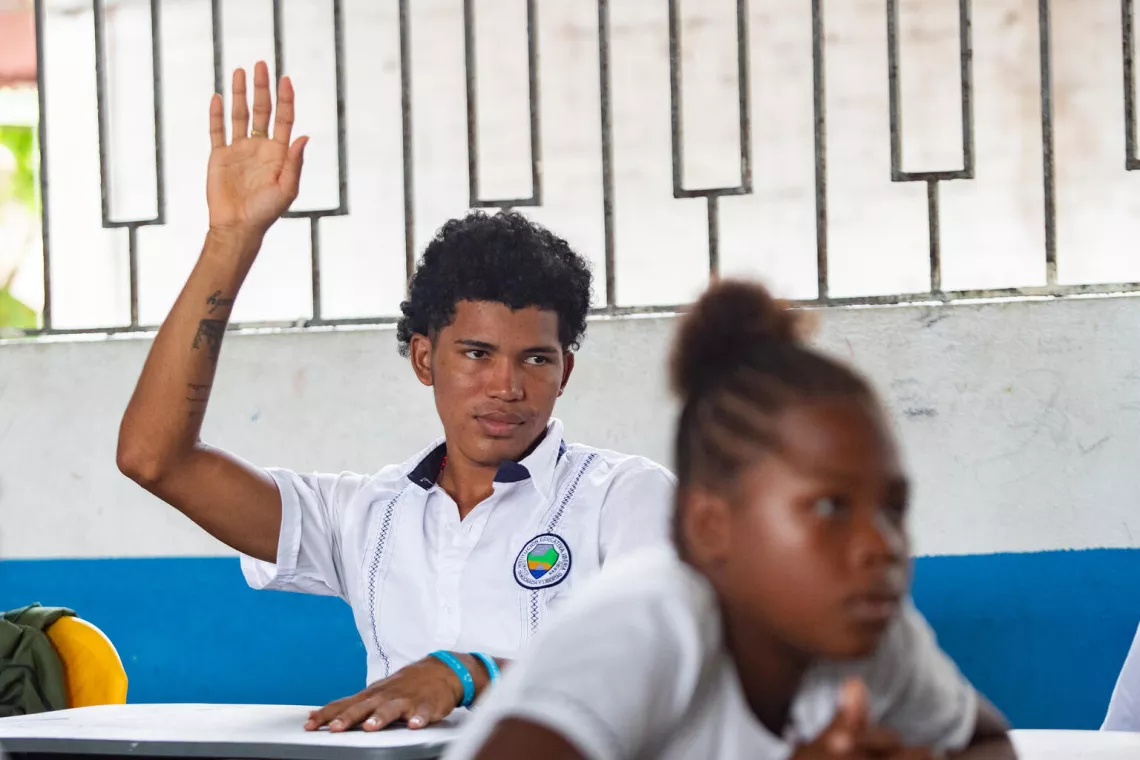
Since Josué's accident was in December, part of his recovery time was during the end-of-year vacations. Unlike other cases, the accident did not cause him to drop out of school and he only missed a month of classes.
"At first I wanted to stop studying, I was embarrassed to go back to school, but the teachers encouraged me and my mom and dad told me to keep studying. If I wasn't here studying, what would I be doing? Nothing.”
The support of his family, his father, his mother, his grandmother, his brothers, his cousins, his uncles and aunts has been fundamental for Josué's recovery process: having someone to help, someone to support him, made a difference in this difficult situation.
"My family is always there, telling me to keep going, reminding me that this is a learning process in life."
In Josué's case, his family has been impacted multiple times: his father and his paternal grandmother are also landmine victims who also suffered the amputation of one of their legs. They all support each other, but the pain is deep because with the accidents also came displacement: they manage to survive in Tumaco, far from their crops and with reduced mobility.
Josué says that at first he was given crutches as a walking aid and learned to use them in one day, using them to go to school and climb the stairs to his classroom. Later, the International Committee of the Red Cross (ICRC) gave him his first prosthesis, which he also learned to use in two days: "I wanted to walk fast, so I adapted”. Josué has such a good step, a continuous walk without hesitation. So much that when he wears long pants, he doesn't look like he has a prosthesis.
Lailis Quiñonez, academic coordinator of his school, the Iberia Educational Institution, located in the urban center of Tumaco, says that Josué is responsible, well judged, that he is getting ahead and that his classmates have been very supportive of him. "He is a boy who does not give up, even when he is defeated; he does not give up, he is there."
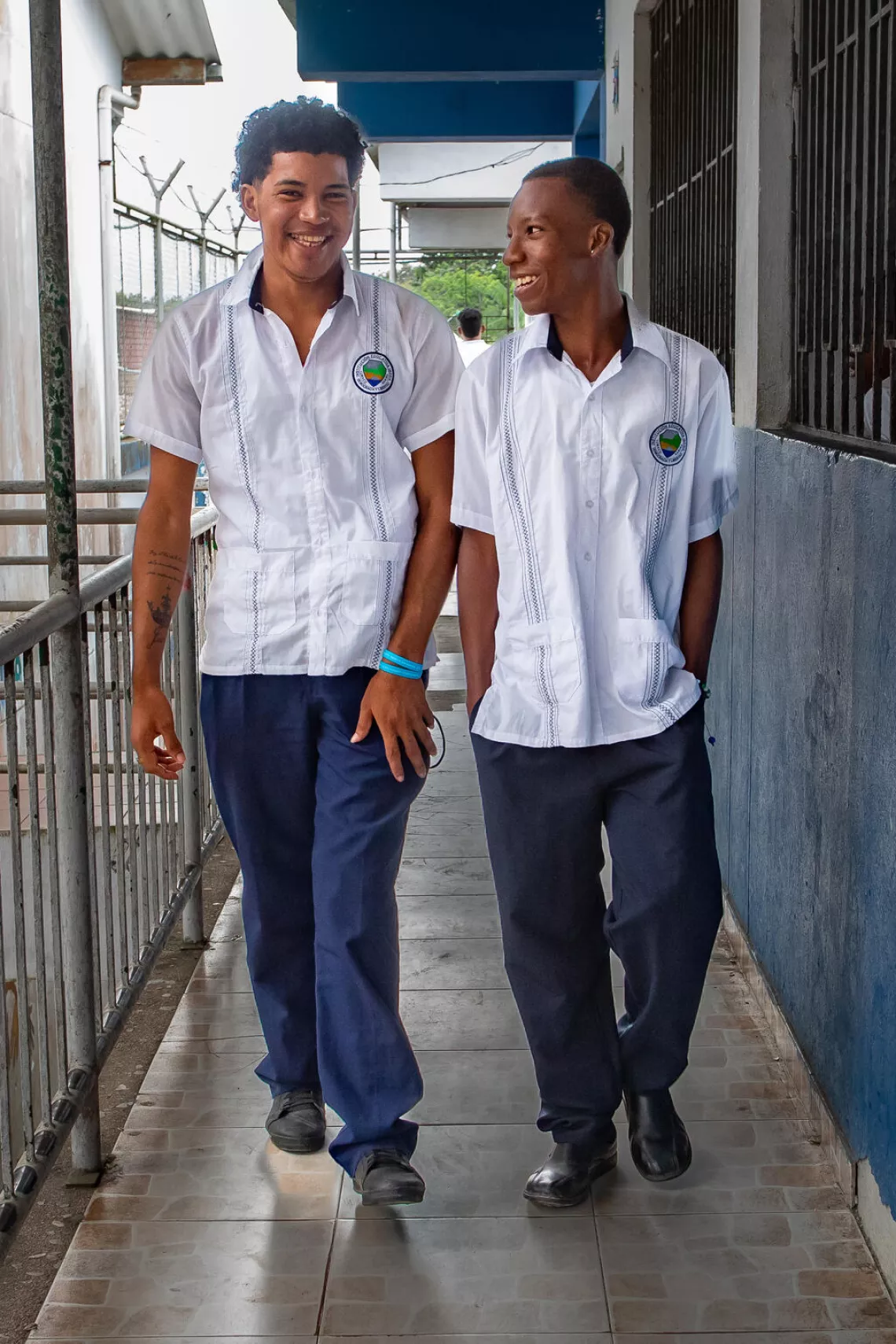
This is the first time that the school has had a student who survived a landmine accident, but today, the directors know they must define protocols to ensure students with disabilities are not left behind, including providing psychosocial support. "My life has changed, and…no! I lead a normal life. The only thing is that I can't play soccer. Otherwise, I can walk, and I go wherever I want." Josué says he will continue studying, he is now in eighth grade (middle school), "and wait until I get the new prosthesis to see if I can try to play."
In spite of everything, he still has the dreams we all have as teenagers: to go out with his friends, to play, to study, to experience romance. No one should have to go through what Josué went through, landmine accidents should be prevented so that no family lives in fear and no child or adolescent have to postpone their dreams.
"Sometimes I get a rush, but in general it doesn't hurt or feel anything where I lost my leg. I'll keep going, that's what it's all about, to keep playing."
"My dream is to become a lawyer to fight against injustice”: Maribel, 17 years old
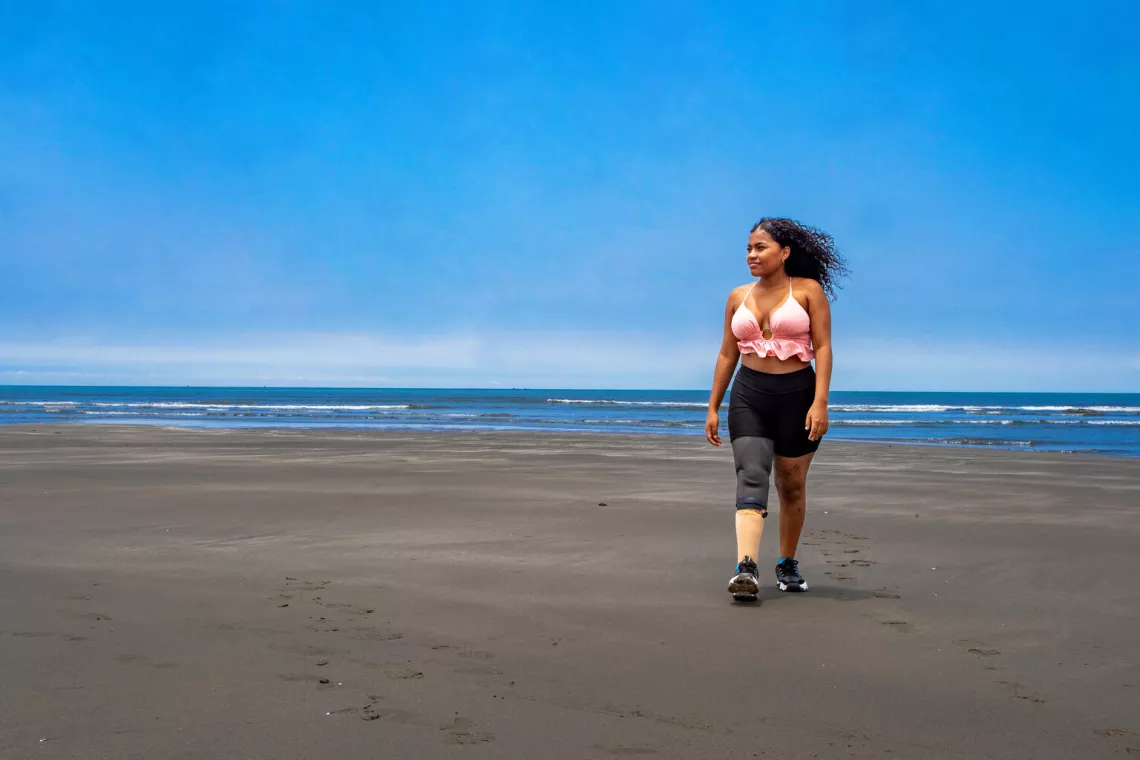
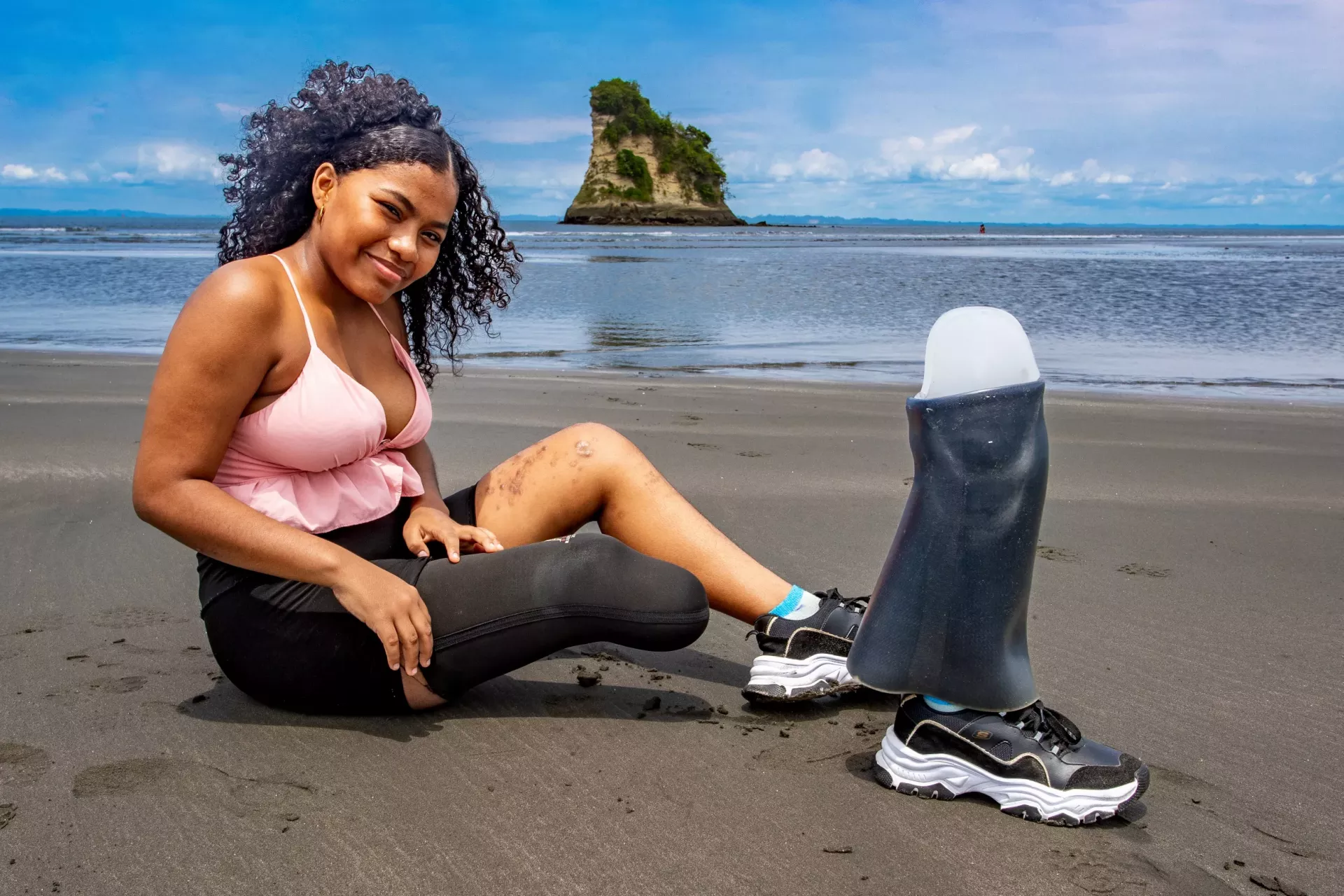
She presents herself gracefully. "I am Maribel, I am 17 years old, I live in Tumaco and I am a happy person who’s constantly laughing. I see the bright side of life: as long as there is life, you have something to go on. If you breathe, you can go on. My self-esteem is very high. I accept what happened to me, I take it calmly... because sometimes things happen for a reason.”
What happened to Maribel should not happen to anyone, for any reason. At 16, she faced war head-on: armed confrontations, explosions, crossfires. Fear and escaping. It all happened between Saturday, December 10, and Sunday, December 11, 2022. In her village of Alto Mira y Frontera, a rural area of Tumaco (Nariño, Colombia), there were constant clashes happening between armed groups all weekend. Maribel remembers that she was watching soap operas with her sisters when they had to run away to escape danger: they had never seen anything like this before.
"We grabbed our documents. We went out. That's when the "tirotera" (shootings) began, we were caught in the middle of the bullets. We went to a bush, to the farm where my father and mother were gathering the harvest because it was far from the fighting. It got dark and we had to sleep there because the groups were still at war. That Saturday everyone continued fighting. We never imagined that they were hiding landmines. We went further inland because it was calm there. We slept there. At night the fighting started again, for about three hours. Then it calmed down and dawn broke, everything was calm, quiet, peaceful.
For that reason, on Sunday they decided to leave and return to the village, where their home was. They returned along the same road they had travelled on the day before, the main road. "We never imagined that there would be landmines on that road because we had already been there and nothing had happened. We were maybe too confident.”
Communities in rural areas know some behaviors to protect themselves from landmine accidents, one of which is to always travel on main and known roads. Maribel says that her father, Fredy, was in front, leading the family, and she was behind him with her four other sisters. Fredy passed without a problem, but when Maribel stepped on a dry leaf that her father had not stepped on, they felt a loud explosion, so stupefying and loud that they thought it was a cylinder bomb.
"I felt like I was in a limbo. Everything became a haze because of the gunpowder smoke. I screamed... my dad held me. Then I couldn't stand up, I couldn't stand on my leg. That's when I realized I had stepped on [a landmine]. They tied a T-shirt around my leg to control the bleeding. They carried me and the confrontation started again."
Maribel remembers that everything was like in the movies, never like in real life, despite living in an armed conflict zone. Her father carried her home in the midst of the fighting. Then, with the support of relatives and neighbors, they made a handmade stretcher, with bamboo and a hammock, to transport her. After several roadblocks by armed groups and explanations, they finally made it to the hospital in Tumaco.
"I was conscious all the way, I didn't feel sleepy. I didn't cry when the accident happened: my other sisters cried, but not me. My fingers on my hand were broken, I had wounds on my other leg, and I hit my lungs, but I didn't feel any of that. I was admitted to the emergency room. They asked me my name and I didn't know anything else. I woke up four days later in Pasto."
Stand up, recover dreams and insist on them
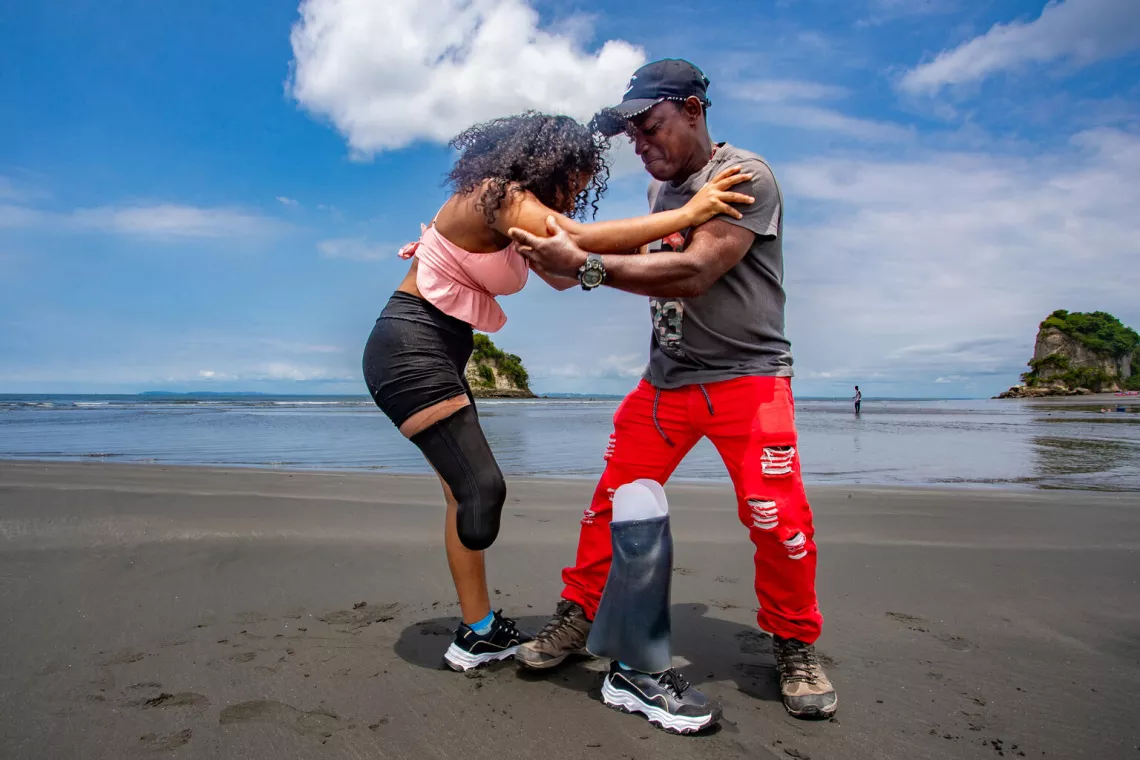
The shock came after everything happened and she woke up in bed in a different city from her own, in Pasto, capital of Nariño, where she was hospitalized for more than two months. UNICEF and its implementing partner, Corporación Paz y Democracia, supported her family financially so that they could accompany her during her rehabilitation process and also so that she could receive psychosocial support.
Maribel says that there, far from everything and the noise of war, in the intensive care unit, she did cry, but she also accepted what had happened to her and made the decision to move forward. "For three days I was crying. Then I calmed down and didn't cry anymore."
"I had not graduated from high school. I had studied in Ecuador, which was closer. That day at the UCI I decided that I was going to continue studying, to go ahead and pursue a career. That's when the idea that came to my mind was to study law.”
When she was released, Maribel returned to Tumaco, where her family now lives and survives after being displaced. She enrolled in a local school, in an educational acceleration course, and in one year finished high school. She now hopes to go on to university and continue her higher education.
"I want to be a lawyer to fight against injustice. But if I don't manage to study for this career, because it is difficult to go to university, I would also like to help other young women like me, who have landmine accidents, to get ahead."
Maribel gets scared when she hears thunder, but she scares away the fear with her laughter. The sound brings her back to that day in December when she saw the face of war, but also fills her with pride when she looks at herself in the mirror, contemplates her beauty, her strength, and knows that as long as life goes on, she will persist in continuing to grow.