“The gamification hackathon changed my life goals.”
The United Nations Children’s Fund (UNICEF) and its partners held a gamification hackathon at Kazakh-British Technical University (KBTU) in Almaty

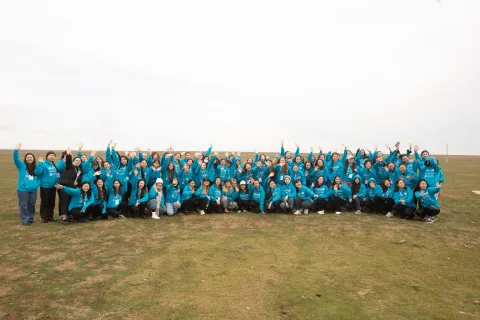
The United Nations Children’s Fund (UNICEF) and its partners held a gamification hackathon at Kazakh-British Technical University (KBTU) in Almaty. Fifty young Kazakh girls from ages 15 to 24 took part in the hackathon. They had previously participated in a special free online course developed by UNICEF in partnership with GameLab, the video game development and research laboratory at KBTU. The course is part of UNICEF’s global initiative to support girls in STEAM (Science, Technology, Engineering, Arts and Mathematics).
Kamila Solomatina, a graduate of Nazarbayev Intellectual School from Kyzylorda, participated in the hackathon. Kamila has only recently showed interest in developing video games, but she is already making progress.
Kamila: “I became interested in computer science when I was in eighth grade. As part of the curriculum, we learned the programming languages C++ and C#. Even then, I realized that programming was not just a set of code but a way to turn my ideas into functional apps and games. This experience at school awakened a passion for computer science in me.”
According to Kamila, others comments, such as, “Girls have a hard time understanding complex code concepts” or “what men can do in seconds takes minutes for girls’ minds to process,” often discouraged her new passion. But rather than succumb to the pressure, Kamila decided to take on the challenge and prove to herself that gender stereotypes about girls’ abilities do not affect her skills. To top it all off, her parents and close friends always supported her and never told her that she could not achieve something just because she was a girl.

She learned about the online game design and development course on Instagram. Kamila confesses that she was most interested in the fact that a major organization like UNICEF supported the course and that the course was designed specifically to help girls in STEAM.
Kamila: “I thought game design was a very interesting area of study and that it was very cool to get help like this. In general, I was most interested in the fact that it [the course] was specifically for girls. That is, the target audience is girls, and the whole program is designed to empower girls in STEAM.”

During the hackathon, she worked on the ‘Nanosat Chronicles’ project. The team’s task was to gamify satellite creation. To this end, the participants developed a game in which fictional customers provide players with terms of reference (ToR) and the player, as an engineer, was required to assemble all the necessary elements to meet the ToR.
“For example, the customer could be an alien who needs to specifically study magnetic waves. And the player is required to add the necessary sensors that affect the measurement of magnetic waves. And so, the process becomes more interesting by gamifying the creation of nanosatellites,” Kamila explains.
Kamila Solomatina is extremely grateful to the mentors and tutors who supported the participants on their journey and shared their expertise. According to Kamila, [NT1] their creative ideas and constructive comments helped make the game unique, informative, and interesting. The mentors also supported the girls in all stages of programming, from choosing technologies and tools to solving complex technical problems. Kamila is convinced that without the mentors their project would not have been so successful and of such high quality.
Kamila: “With the mentors’ support, I learned not only how to write code but also how to solve complex problems, work on a team, and improve the project. The mentors helped not only with the game’s story and concept but also with every stage of programming. They also shared their technological and game design knowledge. Through the mentors, I learned how to create a high-quality program design with the user experience in mind.”

UNICEF’s online course and subsequent hackathon inspired Kamila so much that she seriously considered starting her own project. And, in general, she now wants to dedicate her life to technological development – creating applications, mechanical engineering, and software engineering.
“This experience changed my career plans and gave me confidence in the direction I have chosen. Now, I am better prepared for the challenges of computer science and confident that I can contribute to technological development. In other words, participating in the course and hackathon was an important step in my professional development and has opened up new opportunities for my career in computer science.”
According to Kamila, even as time passes and the world changes, it takes strong community support to ensure girls in STEAM are no longer viewed with prejudice. Only through equal representation in all areas will girls who believe in themselves be able to build a more equitable future free of stereotypes and restrictive social norms.