The Digital Accessibility: A Special Insight
Following the results of a course on working with digital technologies, devices, and programs, adolescents with visual impairment talked about their impressions

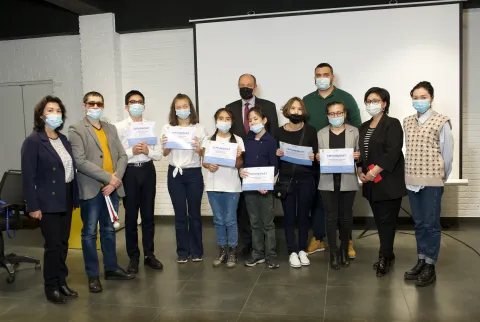
It is time to take stock in December and, as usual, reflect on the results and the high points of the year. The project “Developing digital skills for visually impaired adolescents” participants have much to be proud of. Kymbat Kuyrbekkyzy, Sofia Shestakova and four other students from the special boarding school №4 for blind and visually impaired children named after N. Ostrovsky in Almaty became the first graduates of the course which is a joint initiative of the Public Association called Asian Society for the Rights of Persons with Disabilities “Zhan” and the Representative Office of the United Nations Children's Fund (UNICEF) in Kazakhstan.
The long-term project was aimed, first of all, at the formation of digital skills among adolescents from 10 to 19 years old with visual impairment. At the Certificate Award Ceremony for the first graduates of the project, Arthur van Diesen, UNICEF Representative in Kazakhstan, said that the digital skills learned by adolescents through the partnership with the NGO “Zhan” will give them a chance to succeed in the future and expand their employment opportunities. The project was supported by EPAM Kazakhstan and the State Fund for the Development of Youth Policy of the City of Almaty.
And now, a few months after the end of the course, the participants remember their summer full of useful skills and abilities. During the holidays, they spent three times a week and two hours a day, studying under the direction of coaches.
“The training program was intense, so we theorized a new topic in detail and then practiced it daily. There is another new topic for every lesson. Thus, the holidays did us lots of good. We learned how to use the phone and its voice commands, computer and keyboard combinations,”
One of the most important statements of inclusive education is to ensure an individual approach to visually impaired children. The training requires different methods and a specific pedagogical approach. But in terms of their intellectual potential, visually impaired or blind children are no different from their peers. Instead, their motivation may be many times greater. But the successful development of knowledge directly depends on the interaction of the teacher and the student.
“Even though we learned difficult things, the coaches gave information in a playful, comic form. They tried to find a common language with each of us because the level of technology proficiency was different for everyone. We learned a lot, but it was so easy and fun that we often didn't even want to go home after classes,”
In their daily lives, children and adolescents often face difficulty overcoming fears. Children with visual impairment have well-founded concerns and fears, which are usually associated with social interactions and planning their future. Sofia confessed that she was afraid to seem stupid to her peers a year ago. Kymbat was scared that she would not succeed, and she would not learn anything. This is usually the point where it is important to find an effective tool to combat internal anxieties and fears. Mastering skills, gaining new knowledge, and finding like-minded people can help in this.
“It seems to me that after completing the course, I began to feel much more confident and open-minded. I have made more new friends, whom I've only met in passing. It turns out that we have a lot in common,” Kymbat answered the question about what changes after training surprised her.

Speaking about the technical base of skills and abilities, students have also learned how to type with the ten-finger method, work with the Google Chrome browser, and Zoom conferences, as well as download books, text via WhatsApp and other messengers, use a navigator and a voice assistant and call a taxi online. The project participants have mastered the functionality and applications available to almost every user on his phone or tablet. But usually, no one uses them or understands the true purpose of useful functions.
Sofia gave an example, “Many people do not know that they already have TalkBack installed in their smartphones. It helped me a lot in the course that I mastered this voice assistant. Now I can use any touchscreen or smartphone blindly”.

There may be difficulties in any big case. The girls admit that memorizing all kinds of commands and combinations was not easy for them. However, classes and diligent extracurricular training can make progress because today Sofia and Kymbat are curiously continuing their studies in a new project on digital accessibility. They need it to obtain the next set of soft skills that contribute to a successful start of adulthood, employment, and social or business entrepreneurship within the framework of the project launched by UNICEF, the Ministry of Labor and Social Protection of the Population of the Republic of Kazakhstan and the NGO “Community of Youth Workers”.
Despite the young age of the project participants – they are only 13 and 14 years old – they are thinking about how possible it is today to get an education and lead activities without the use of digital technologies. According to Sofia, “a person who doesn’t know how to use computers will be considered an outcast in society today”.
She said, “I know that we will not be taught Braille in college. But I will be able to type in Microsoft Word and complete tasks”.
The girls' impressions after the course were unambiguous. As Kymbat recalled, “I remember having mixed feelings. At first, I thought it wasn't necessary at all, but at the same time, I was curious. After finishing thecourse, I knew for sure that I had learned a lot, and I was glad about it. But it was sad to say goodbye to everyone because over these months I got used to people and new knowledge”.

“I would recommend this course to my doubting peers. The important thing is that the project helps for free. For example, for my classmate, a push-button phone was difficult before training. After that, she even learned how to use WhatsApp,” said Sofia.
Now, the course participants do not create limits and boundaries for themselves. Fatkulin Ilyas, the project manager, spoke about this superpower, summing up the results of the training, “Thanks to our partners, children get a “ticket into a future life” where they have zero restrictions”.
The girls confidently talked about mind expansion in addition to expanding boundaries. Remembering their doubts again, now they identified participation in the course and this whole year as a stage of overcoming fear. Sofia concluded that her fear of appearing stupid grew out of a more serious fear of making a mistake. Now she says that “mistakes are cool. They allow us to learn from them”.
And finally, dreams are built from overcoming fear. The girls' courage is that they are not afraid to dream. As Kymbat said, “I see myself as a good person who will help children like me in the future. Maybe I will also become a coach who will allow others to master new technologies”.