UNICEF, the European Union, and Kazakhstan Summarize the Joint Programme Supporting Children Returned from Conflict Zones
At a final meeting in Turkistan, experts presented the results of two years of work, discussed best practices, and outlined future cooperation for the sustainable reintegration of children returned from conflict zones.

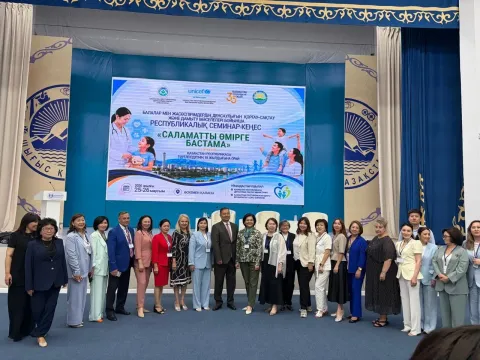
TURKISTAN, 19 September 2025 — Representatives of the United Nations Children’s Fund (UNICEF), the European Union (EU), and Kazakhstan held the final meeting of the coordinating working group on the ‘Second Phase of the EU–UN Programme to Support Central Asian States and Their Citizens Returned from Conflict Zones’ (the Programme).
Meeting participants presented the final results of the programme, implemented from October 2023 to October 2025. Participants shared key achievements and lessons learned in strengthening child protection and reintegration efforts. Discussions focused on further enhancing the national child protection system to ensure the sustainability of the achieved results and providing quality support to vulnerable children and their families.
During the meeting, experts presented updated data on the Programme’s progress and sectoral and regional experiences, including best practices and challenges. Meeting participants reviewed specific tools developed under the Programme, such as a monitoring and evaluation framework assessing service accessibility for children returned from conflict zones, parenting programmes to strengthen family skills, and the innovative intergenerational storytelling approach. Presenters also gave special attention to capacity building for professionals working with returnee children to improve support quality.
Stanislav Vasilenko, Ambassador-at-Large of the Kazakh Ministry of Foreign Affairs, stated:
“The successful completion of this stage of the programme is a vivid example of our close and effective cooperation. Kazakhstan demonstrates a firm commitment to protecting the rights of every child, and through our joint efforts with UNICEF and the EU, we have created a solid foundation for the long-term and successful integration of returnee children into society. Our experience is becoming a model for other countries, and we are ready to share our expertise.”
Experts gave particular attention to the practical implementation of methodologies: participants visited the Psychological Support Centre and the Family Support Centre in Turkistan, where they observed how assistance programmes are being carried out at the local level.
Aaro Julitallo, Deputy Head of the EU Delegation to Kazakhstan, noted:
“Our partnership with UNICEF and the Government of Kazakhstan aims to create a safe and enabling future for children who have gone through traumatic experiences. We see real, positive changes in their lives, which confirms the importance of our collective efforts to protect human rights and ensure children’s well-being.”
Dr. Rashed Mustafa Sarwar, UNICEF Representative in Kazakhstan, emphasized:
“Our main goal is to ensure that all children, regardless of their past, have the opportunity to realize their potential. This programme has enabled us not only to provide targeted support but also to strengthen the national child protection system as a whole, making it more responsive to the needs of the most vulnerable. We are grateful to the Government of Kazakhstan for its leadership and to the EU for its unwavering support in this important work.”
The meeting concluded by identifying a framework for future cooperation aimed at further developing and integrating successful practices into national policies and programmes for child protection.
Kazakhstan was among the first countries to repatriate its citizens from areas of armed conflict. In total, more than 500 children have returned to the country and received comprehensive support for their adaptation and full integration into Kazakhstani society.
Media contacts
Additional Information
The ‘Second Phase of the EU–UN Programme to Support Central Asian States and Their Citizens Returned from Conflict Zones’ is funded by the European Union. It is aimed at supporting women, children, and families who have returned from conflict zones, ensuring their successful reintegration into local communities and providing them with protection and access to social services and education.
About the European Union
The European Union (EU) is a political and economic union of 27 European countries, founded on the values of human dignity, freedom, democracy, equality, the rule of law, and respect for human rights, including the rights of persons belonging to minorities. The EU acts globally to promote the sustainable development of society, the environment, and the economy for the benefit of all. Collectively, the EU is the largest donor of humanitarian aid in the world, assisting millions of victims of conflicts and natural disasters every year.
For more information about the EU’s activities in Kazakhstan, please visit the website of the EU Delegation to Kazakhstan and follow its pages on Instagram, Facebook, Twitter, Telegram , and LinkedIn.
Press Office of the EU Delegation to Kazakhstan: [email protected]
About UNICEF
UNICEF, the United Nations agency for children, works to protect the rights of every child, everywhere, especially the most disadvantaged children and in the toughest places to reach. Across more than 190 countries and territories, we do whatever it takes to help children survive, thrive, and fulfil their potential.
For more information, visit www.unicef.org.