Prioritizing the Early Years: the early years of a child’s life are becoming a national priority.

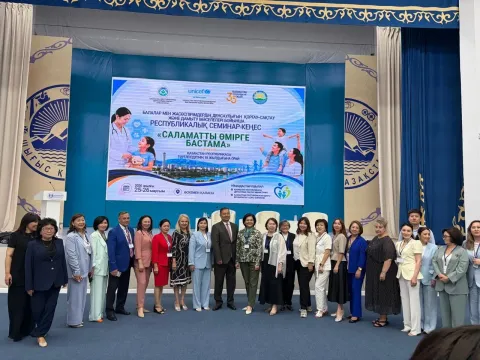
ASTANA, 31 October 2025 — Kazakhstan has taken a decisive national policy step towards making every child’s early years an investment priority for human capital development. At the international conference ‘The Best Start for Every Child in Kazakhstan’ held in Astana, representatives from the Government, international organizations, the private sector, academia, and parent associations signed the ‘Astana Call to Action’ – a strategic document aimed at building a system where, from birth, every child has an equal opportunity for health, learning, and development.
In 2009, Kazakhstan adopted a state programme that, through the strengthening of public–private partnerships, made it possible to expand the network of preschool institutions, including private ones. Over the past five years, the number of preschool organizations has grown to 12,000. Currently, state orders are placed in all public and more than 90 per cent of private kindergartens. The enrolment rate of children aged 3 to 6 in preschool organizations now stands at 98.5 per cent. Since 2023, these preschools have created 171,000 new enrolment slots, and around 130,000 more slots are expected to be opened by 2027.
“The early years of a child’s life are not only a time of preparation for school but also a period of developing vital cognitive, emotional, and social skills. With this in mind, Kazakhstan approved the ‘Model for the Development of Preschool Education and Care’ in 2021. Between 2021 and 2023, the Government conducted research to assess the quality of preschool education. Based on the findings, Kazakhstan updated the state standard and model curricula, and work is ongoing to align them with international standards,”
emphasized the Minister of Education, Zhuldyz Suleimenova.
Kazakhstan is home to more than 6.7 million children, including 1.6 million under the age of three. Conference participants highlighted that the first 1,000 days of life form the foundation of a person’s future. During this period, a child’s brain develops millions of neural connections every second, with 90 per cent of developmental and learning potential formed before school age. Research shows that every dollar invested in early childhood yields a ninefold return to society, while inaction costs 8 to 19 times more.
The Astana Call to Action outlines the following specific commitments: (1) ensuring equal access to early development services regardless of location, social status, or developmental differences; (2) strengthening cross-sectoral cooperation between health, education, social protection, and cultural agencies; (3) supporting parents through digital and community services; (4) enhancing the qualifications of professionals working with young children; (5) introducing new technologies and models in preschool education; and (6) establishing a sustainable financing system.
“By investing in the early years of life, we invest in the future of Kazakhstan,” said Dr. Rashed Mustafa Sarwar, UNICEF Representative in Kazakhstan. “It is time to unite efforts across all sectors and bridge regional disparities in access to quality preschool education and early development programmes, so that all children – regardless of where they are born – have the opportunity to reach their full potential.”
The Ministry of Education organized the conference in partnership with UNICEF. Participants included the ministers of education, health, labour, and social protection; World Bank representatives; and government officials, international experts, and researchers from Australia, Ireland, Türkiye, Azerbaijan, the Republic of Moldova, and the United Kingdom of Great Britain and Northern Ireland . Among the speakers were Professor Frank Oberklaid (University of Melbourne), Ivelina Borisova (UNICEF Regional Office for Europe and Central Asia), Professor Filiz Polat (Ireland ), Feyza Kübra Alpagat (Ministry of National Education of Türkiye), and Joanna Yuson (Genesis Analytics, UK). The experts presented compelling evidence showing that high-quality early childhood and preschool programmes can reduce the education gap by up to 40 per cent between low- and high-income countries and significantly improve social well-being.
The adopted document, Sätti Bastau (‘The Best Start’), reflects the ambitious vision of Kazakhstan to build a system where every child receives care, attention, and opportunities for development from birth. The Call to Action’s signing marks a turning point in shaping a new national agenda – where investments in early childhood are recognized not as expenditures, but as vital contributions to human capital and the country’s sustainable future.
Media contacts
About UNICEF
UNICEF, the United Nations Children’s Fund, works to protect the rights of every child, everywhere, especially the most disadvantaged children, and in the toughest places to reach. Across more than 190 countries and territories, we do whatever it takes to help children survive, thrive, and fulfil their potential.
For more information, visit www.unicef.org.