Experts in Astana Discuss Protecting Children from Emerging Online Threats

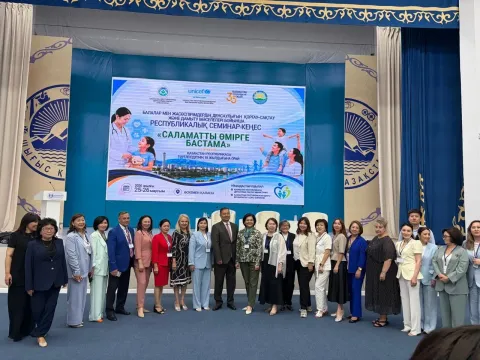
Astana, 22 May 2026 – Cyberbullying, sexual extortion, online grooming, and AI-generated deepfakes are becoming increasingly serious digital threats to children. Participants discussed these challenges during a national conference held in Astana titled ‘Protecting Children in the Digital Environment: Current Challenges and Approaches’.
The Ministries of Culture and Information, Internal Affairs, Education, and UNICEF in Kazakhstan jointly organized the conference.
The conference took place as part of a two-year programme titled ‘Protecting Children from Online Violence, Abuse and Exploitation’, which Kazakhstan is implementing with support from the Global Safe Online Fund. The programme aims to strengthen child protection systems in the digital environment, improve legislation, enhance interagency cooperation, and build the capacity of specialists working with children and families.
Participants noted that digital technologies create new opportunities for children to learn, communicate, and develop, while also exposing them to new risks. Participants identified cyberbullying, harmful content, privacy violations, online grooming, sexual extortion, and online child sexual exploitation and abuse among the most alarming threats. They also paid special attention to new risks linked to artificial intelligence, including the creation of sexualized deepfakes featuring children and adolescents.
During the conference, experts presented the results of an analysis of the national system Kazakhstan utilizes for preventing and responding to online child sexual exploitation and abuse. Researchers prepared the study using the WeProtect Global Alliance’s Model National Response (MNR).

Participants discussed ways to strengthen prevention and response measures to online violence affecting children. They emphasized the importance of early risk detection; effective reporting and referral mechanisms; child-friendly justice; psychosocial support for affected children; specialist training; and awareness-raising campaigns among parents, children, and the general public.
UNICEF Representative in Kazakhstan Rashed Mustafa Sarwar said:
“Every child has the right to a safe digital environment. As technologies evolve, child protection systems must also evolve and adapt to new risks. Governments, international partners, the tech industry, parents, and young people themselves must work together to achieve this.”
The programme also included a youth panel, where adolescents and young people shared their experiences with online risks and presented recommendations to improve digital safety.
A youth representative and UNICEF volunteer stated:
“Young people must actively participate in discussions about digital safety. Adults need to understand the real online risks that adolescents face and work with us to create a safe and supportive digital space.”
At the end of the conference, participants adopted recommendations to further strengthen the digital national child protection system, expand cross-sector cooperation, and reinforce preventive measures.
Media contacts
About UNICEF
UNICEF, the United Nations agency for children, works to protect the rights of every child, everywhere, especially the most disadvantaged children and in the toughest places to reach. Across more than 190 countries and territories,
we do whatever it takes to help children survive, thrive, and fulfil their potential.
For more information, visit www.unicef.org.