UNICEF Drives Education Recovery in Jamaica Following Hurricane Melissa

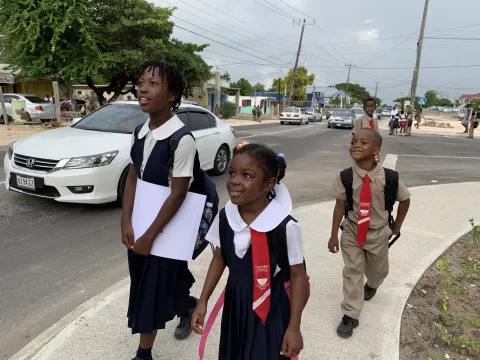
KINGSTON, December 6, 2025: In the wake of Hurricane Melissa, which left widespread damage across Jamaica, UNICEF has stepped up efforts to restore education and support the emotional wellbeing of thousands of children affected by the disaster. More than 650 schools, serving approximately 150,000 students, are experiencing significant disruption.
Working closely with the Government of Jamaica and local partners, UNICEF is focusing on creating safe, child-friendly learning environments while helping students and teachers recover from the storm’s psychological impact.
UNICEF is supporting the Ministry of Education, Skills, Youth and Information (MOESYI) to enable continuity of learning, and has participated in a high-level education meeting with CARICOM to discuss best practices for education in emergencies, current needs in the sector and planned activities.
Rebuilding Classrooms and Learning Spaces
UNICEF is supplying more than 1,000 tarpaulins and hundreds of learning kits to help re-establish safe, child-friendly spaces where students can learn, play and regain a sense of normalcy.
A total of 105 classroom tents, along with printed learning packets that are aligned to the curriculum, are being distributed to ensure teaching can continue despite damaged infrastructure. In addition, grants for school repairs will support at least ten institutions, benefitting nearly 10,000 students, as well as their parents and teachers.
Ensuring Safety and Sanitation in communities and schools
To protect children’s health, UNICEF has supported the restoration of water, sanitation, and hygiene (WASH) facilities in schools and emergency shelters, helping to prevent the spread of disease in the aftermath of the hurricane. Hand-washing stations will be installed and community water points with pumps, generators and pipe repairs are being established.
More than 980,000 litres of treated water have been supplied to affected communities and healthcare facilities in Westmoreland, through partnership with Water Mission International serving approximately 50,000 people.
Supporting Families and Teachers
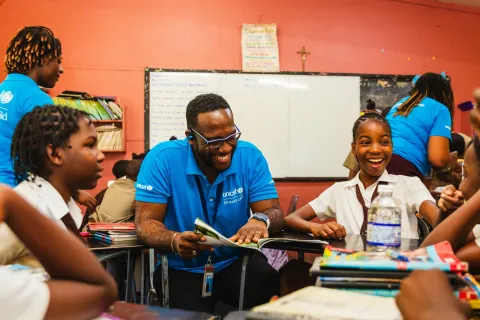
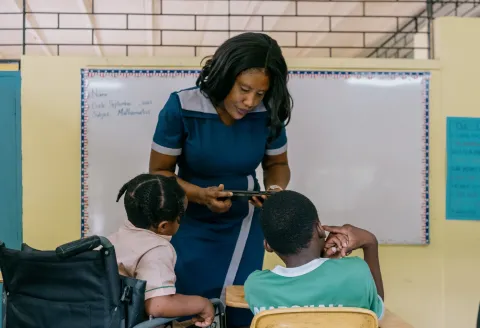
Recognizing that families are integral to recovery, UNICEF is supporting the Ministry of Labour and Social Security with the delivery of humanitarian cash transfers to households in the hardest-hit communities. Teachers, too, are receiving specialized training in Mental Health and Psychosocial Support (MHPSS), equipping them to guide students through the emotional challenges following the disaster.
Psychosocial First Aid activity booklets have also been developed for students from early childhood through secondary school to aid in their recovery as part of an overall series of mental health and psychosocial support interventions targeting more than 100,000 students and their families.
Six hundred (600) teachers from the most affected schools will be trained in the Return to Happiness (RTH) methodology to strengthen their own recovery and enable them to provide enhanced guidance to some 18,000 students. The Guidance and Counselling Unit of the Ministry will train an additional 450 counsellors and volunteers to support delivery of more in-depth psychosocial recovery to at least 5,500 of the most affected students and families.
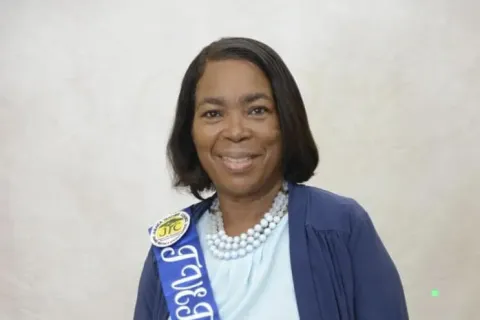
“Jamaica’s children are at the heart of this recovery,” said Rebecca Tortello, UNICEF Jamaica Education Specialist. “Our goal is to help rebuild not just classrooms, but confidence, not just infrastructure, but hope,” she emphasized.
UNICEF’s coordinated response highlights our commitment to ensuring that every child can continue learning safely and with the resources they need, even in the wake of natural disasters.
Media contacts
About UNICEF
We support government and non-governmental partners to promote and fulfil the rights of children, especially the most disadvantaged. Across more than 190 countries and territories, we work for every child, everywhere, to build a better world for everyone.
For information about UNICEF and its work, visit www.unicef.org/jamaica.