Rebuilding Learning with Data
How EMIS Helped Schools Bring Students Back After Hurricane Melissa
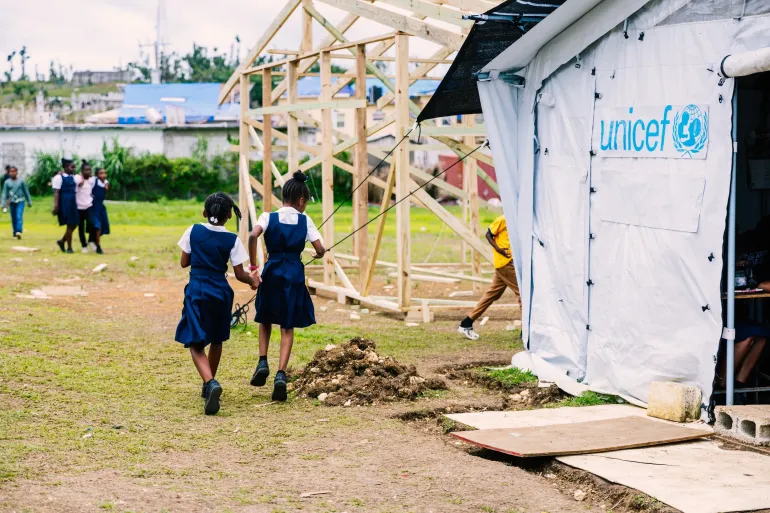
KINGSTON, APRIL 07, 2026: When Hurricane Melissa swept across Jamaica on October 28, 2025, classrooms in the western region fell silent. Roofs were ripped apart, roads were flooded and blocked, and hundreds of families were displaced. The storm disrupted schooling, particularly in vulnerable communities where families were already facing economic strain.
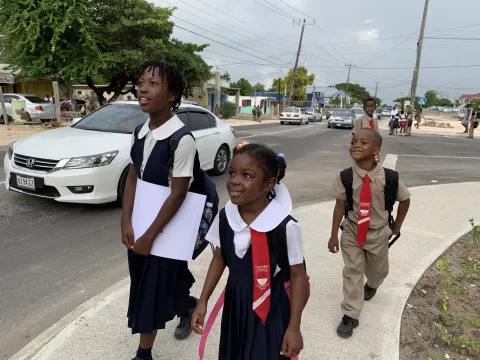
At Barrett Town Primary and Infant School in St James and Bromley Primary and Infant School in St Mary, the biggest question facing the principals was urgent and deeply human: Where are our children and how do we bring them safely back to school and learning?
Just weeks before the hurricane, both schools had started using the Education Management Information System (EMIS). Staff were still adjusting, learning how to navigate this new digital platform, inputting attendance data and updating student records. What initially felt like a modern administrative tool quickly became the backbone of their recovery efforts. With paper records damaged and communication lines choppy, having digital student information after the hurricane, proved critical.
Data as a Lifeline After Disaster
At Barrett Town Primary and Infant, Principal Anthony Murray described the first days after reopening as a period of intense coordination and compassion. The school community mobilized to provide psychosocial support, uniforms, books, bags, shoes, clothing, bedding, and daily hot meals - anything to remove the burden from families and create a safe space for students to return.
But what guided these efforts was EMIS. “Through EMIS we tracked attendance in real time and followed up on absences,” Mr. Murray explained, “which made it possible to reach families directly.”
By monitoring attendance daily, the school discovered that 90% of students had returned. The remaining students were quickly flagged for follow‑up by the guidance department. Many had transferred after the storm; others needed targeted support. The data ensured that no child slipped through the cracks during an already chaotic recovery period.
Principal Murray calls EMIS the school’s “early‑warning and action system,” which shows enrolment, attendance patterns and resource gaps, enabling them to respond and allocate resources needed before problems escalated. He explained that the EMIS helps school leaders to know which students needed transportation, shelter or health follow up. “That turns a crisis scramble into a coordinated response,” he declared.
At Bromley Primary and Infant School, Mr. Calef Williams, Principal shared a similar picture, though the journey had its own difficulties.
His school adopted EMIS in September 2025, focusing first on attendance tracking. When the hurricane struck, connectivity became unreliable, but teachers worked together to keep the system functioning. “During the hurricane and early recovery, it was a bit tedious with intermittent connectivity,” he said. “However, we collaborated and used it to ensure we were consistent.”
The school returned to normal operations by November 17, 2025, and Mr. Williams credits EMIS for keeping the team grounded during the transition back to in‑person learning.
Turning Data into Direction and Hope
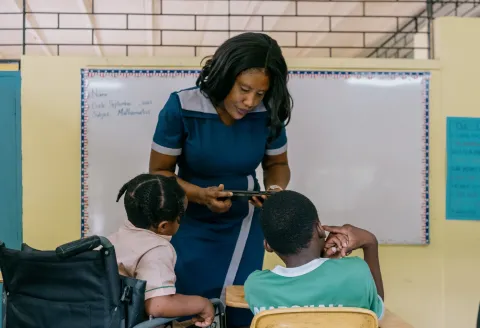
Across both schools, EMIS did not just replace paper registers; it helped rebuild learning. When communication lines were unreliable and families scattered, having digital, accessible records made recovery faster and more equitable. Teachers spent less time reconstructing damaged files and more time supporting students academically and emotionally.
The experience at the schools reflects the wider aims of the SDG Joint Programme on Digital Transformation for Education, which supports the introduction of tools like EMIS to strengthen education systems. While designed to improve planning and data-driven decision-making, the programme has also proven its value in times of crisis, helping schools respond faster and more equitably when a disruption occurs.
As recovery continues, the schools are looking beyond Hurricane Melissa. The schools plan to fully integrate EMIS into daily operations, using data to monitor attendance, identify learning gaps and better prepare for future shocks.
As Mr. Murray reflected: “The hurricane showed us how fragile things can be. But it also showed us that with the right tools, we can recover faster and build back stronger for our children.”
In a season marked by loss and uncertainty, the early adoption of EMIS by these two schools has helped transform disruption into direction. Their experience stands as a compelling example of why scaling digital systems across all schools is not only possible, but essential, for protecting learning and children’s futures.
Media contacts
About the SDG Joint Programme on Digital Transformation for Education
The Ministry of Education, Skills, Youth and Information, in partnership with UN agencies, is implementing the “Empowering Jamaica’s Future: SDG Joint Programme on Digital Transformation for Education,” a three‑year initiative designed to modernize Jamaica’s education system through digital innovation. It aims to strengthen outcomes for more than 450,000 students. The initiative is institutionalizing digitalization across the sector by enhancing data governance, digitizing key administrative and nutrition‑tracking processes through an improved Education Management Information System (EMIS). It is aligned with core SDG targets on Quality Education and Zero Hunger. Ultimately, the Joint Programme aims to create a digitally transformed, child‑centered education system that improves learning outcomes, teacher engagement, and access to nutrition, ensuring that all Jamaican children, particularly the most vulnerable, can reach their full potential.
About UNICEF Jamaica
We support government and non-governmental partners to promote and fulfil the rights of children, especially the most disadvantaged. Across more than 190 countries and territories, we work for every child, everywhere, to build a better world for everyone.
For information about UNICEF and its work, visit www.unicef.org/jamaica.