The first thing I noticed when I walked into Three Miles River Early Childhood Institution in Westmoreland was the smiles.
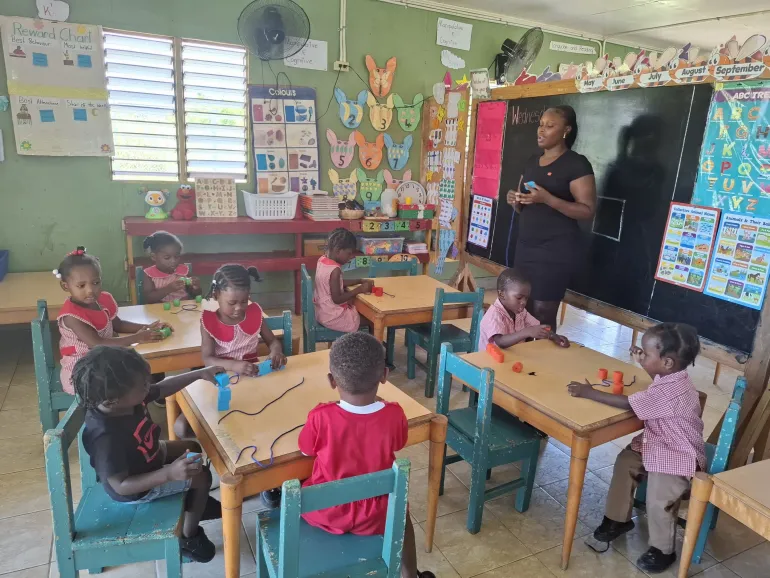
Inside the classrooms, children were busy building, laughing and learning. Colourful posters covered the walls, and small groups gathered around puzzles, blocks and games. At first glance, it felt like any other day at school.
But Hurricane Melissa had changed a lot for this community.
Many families living near the school lost roofs and belongings during the storm. The school itself sustained significant roof damage and became a shelter for community members seeking safety. In the weeks that followed, teachers worked hard to restore a sense of normalcy for the children.
Today, support from UNICEF is helping make that possible.
Three Miles River ECI is one of more than 100 early childhood institutions that received a UNICEF Early Childhood Development (ECD) Kit following Hurricane Melissa. The kits help replace damaged learning materials and provide opportunities for children to learn through play while rebuilding routines disrupted by the disaster.
Play is an important part of early childhood development. Through play, children explore their world, strengthen social and emotional skills, build confidence and develop essential foundations for learning.
The Kit contains puzzles, building blocks, picture books, art supplies, puppets and other materials designed to support up to 50 children aged 0 to 8 years, along with guidance for caregivers.
In one classroom, children carefully threaded colourful blocks onto shoelaces, creating necklaces and bracelets while practising shapes, colours and fine motor skills.
“Honestly, the ECD kit makes my day easier,” said Tia Valentine, one of the Pre-K teachers at the school. “When I’m working one-on-one with a child, the materials keep the others engaged and learning.”
Next door, another group of children focused intently on a puzzle. Later, their teacher introduced a memory game from the kit and the room quickly filled with excitement.
“Yaay!” the children shouted.
As cards were matched into pairs, classmates celebrated every success with applause. Along the way, they were strengthening memory skills, practising counting and learning about different animals, all while having fun.
But rebuilding after a hurricane involves more than restoring classrooms and replacing materials. Children also need support to understand and express their feelings.
In another classroom, children gathered for a lesson using Ready and Resilient, a psychosocial support guide developed by UNICEF Jamaica, the National Education Trust and the Ministry of Education, Skills, Youth and Information.
Using a story about emotions, the children reflected on their experiences during the hurricane.
“Were you afraid during the hurricane?” their teacher asked.
Some children shared their thoughts confidently, while others listened quietly. Together, they talked about the people who helped them feel safe and supported.
The lesson ended with movement and breathing exercises. Soon, the room was filled with laughter as the children danced, stretched and practised calming techniques they could use whenever they felt worried or afraid.
For Principal Shanique Berley, the activities go beyond play. They help children develop self-awareness, emotional regulation and problem-solving skills that will support their wellbeing and learning for years to come.
Since October 2025, UNICEF Jamaica has supported the distribution of more than 100 Early Childhood Development Kits to early childhood institutions impacted by Hurricane Melissa. The Ready and Resilient guide supports children’s emotional recovery through age-appropriate psychosocial activities developed in collaboration with the National Education Trust and the Ministry of Education, Skills, Youth and Information.