Young People in Duhok Tackle Water Challenges for Healthier Communities
Duhok

- English
- العربية
Duhok, Iraq - 05 October 2025, young people are taking the lead in protecting their communities from unsafe water storage and its risks to health.
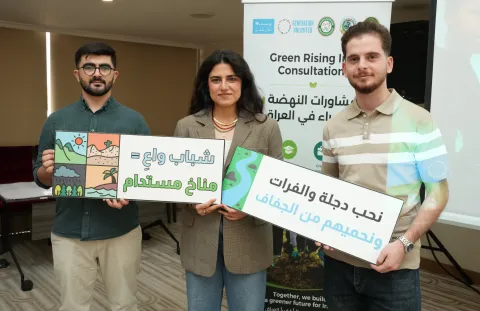
Asmaa Kareem, 24, a graduate of the University of Duhok’s Chemistry Department, has always cared deeply about the environment. After graduation, she was selected to join a special initiative supported by UNICEF, the University of Duhok, and funded by the Government of the Netherlands through the PROSPECTS partnership. Out of 300 applicants, only 30 youth were chosen.
“We were aware that our society is going through challenges in terms of widespread water scarcity, contamination, and unsafe storage practices, which directly affect health and wellness,” said Asmaa.
Through the Participatory Action Research (PAR) project, the youth received training in leadership, teamwork, and research skills. Divided into groups, they chose issues to tackle. Asmaa’s group, which called themselves Aqua Heroes, focused on the safe water handling and storage at the household level.

Clean Water Starts at Home
“Many people complained of dirty water,” explained Asmaa. “But when we tested, we found the source of the water was good. The problem was how people stored it. Some families cleaned their tanks regularly; others had never cleaned theirs in 20 years. That made a huge difference in water quality.”
The group surveyed 222 households, gathering evidence about storage practices. They then launched awareness campaigns, distributing brochures with practical advice: choosing good-quality tanks, cleaning them regularly, covering them properly, and avoiding direct sunlight.
Helen Issa, 22, a university student and member of the Aqua Heroes, said: “The most important thing is to identify society’s challenges and to find solutions that are realistic and available.”
The impact was immediate. Families began cleaning and replacing tanks, and even two government departments took action to improve their water storage systems. The group also reached wider audiences through TV channels and advocacy efforts.
Asmaa reflected proudly: “We saw real change after our awareness actions. People’s behavior changed. This is not just about tanks—it is about health and the future.”
The three-month project showed how youth can bring research, awareness, and action together to improve lives. With the support of UNICEF, the University of Duhok, and the Government of the Netherlands, these young leaders proved that simple, practical solutions can transform communities.