UNICEF Innovation Watch List: Promising solutions in Latin America and the Caribbean
Problem-driven innovative solutions making impact for children and their communities

UNICEF’s Latin American and Caribbean Regional Office (LACRO) coordinates and supervises the work of UNICEF in 36 countries and territories stretching more than 11,000 kilometres from the north of Mexico to the southern tip of Chile.
Across this vast and varied region, UNICEF is meeting diverse challenges with groundbreaking innovations in areas such as gender equality, education, health, climate change and youth training.
Here are five promising solutions:
Climate Change
1. Dronebots | SDG 1 & 13 | Guatemala
The problem: Guatemala ranks in the top five countries in the world most affected by natural disasters, and some parts of the country most prone to emergencies often lack reliable electricity and internet connections, slowing the spread of life-saving information
The solution: emergency response drones with the ability to transmit data over long distances using radio communication (LoRa) instead of the usual satellite, mobile and internet networks that can be disrupted. This allows vital information about affected communities or damaged infrastructure to be shared in real time when natural or climate disasters strike, such as floods and hurricanes, or volcanic eruptions and earthquakes
The impact: a pilot with Guatemala’s National Coordinator for Disaster Reduction (CONRED) proved Dronebots’ effectiveness as a lifeline when other communications networks fail, with the expectation that communication times will be slashed by 80 per cent in times of emergency

Gender Equality
2. Game Changers Coalition | Sustainable Development Goal (SDG) 4, 5 & 8 | Brazil
The problem: half of the roughly two billion video game players worldwide are female, yet only a quarter of those working in game development are women, meaning lost opportunities for the video games industry and for adolescent girls who do not transition from playing, to learning, to earning
The solution: the Game Changers Coalition (GCC) curriculum – developed by UNICEF with partners including the Global Video Game Coalition, Bitget and Micron Foundation – bridges this digital gender divide by enabling adolescent girls to learn STEAM subjects (Science, Technology, Engineering, Arts and Mathematics) through video game development
The impact: GCC operates in eight countries, including Brazil, has engaged with 154,000 adolescent girls, parents and teachers, and aims to reach 1.1 million students by 2027, creating a new generation of young women equipped with the digital skills of the future

Health
3. Docokids| SDG 3 & 10 | Colombia
The problem: the lack of medical professionals in rural and remote areas means that the parents of sick children struggle to access timely information and the paediatric care their children need
The solution: a paediatrician-backed, AI-powered chatbot offers 24/7 support and information to parents via WhatsApp aiming to enhance medical outreach, especially in rural and remote parts of the country
The impact: the pilot programme in Colombia – where Docokids was founded by a team of paediatricians and is supported by UNICEF’s Venture Fund – is already managing over 7,000 conversations a month, with almost a fifth now coming from other countries as word has spread

Learning
4. GigaMeter | SDG 4 | Anguilla, Antigua and Barbuda, Argentina, Barbados, Belize, Brazil, British Virgin Islands, Colombia, Costa Rica, Dominica, El Salvador, Grenada, Honduras, Montserrat, Panama, Peru, St. Kitts and Nevis, St. Lucia, St. Vincent and the Grenadines, Trinidad and Tobago
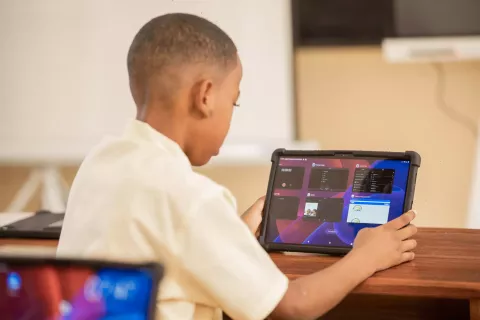
The problem: one-third of humanity lacks internet access and children at schools without connectivity have fewer opportunities to learn and fulfil their potential
The solution: GigaMeter is a real-time connectivity monitoring tool that enables schools worldwide to monitor and visualize their internet connectivity. It is part of Giga, a joint UNICEF and International Telecommunication Union (ITU) programme aiming to ensure every school is connected to the internet by 2030
The impact: through Giga, 2.2 million schools have been mapped worldwide; 454,000 have their connectivity status mapped; and 98,000 supply real time data

Youth Skills
5. UPSHIFT | SDG 4 & 8 | Brazil, Guatemala, Nicaragua, Uruguay
The problem: education alone is not enough to prepare young people for the future, they also need skills like problem-solving, creativity, collaboration, leadership, communication and more
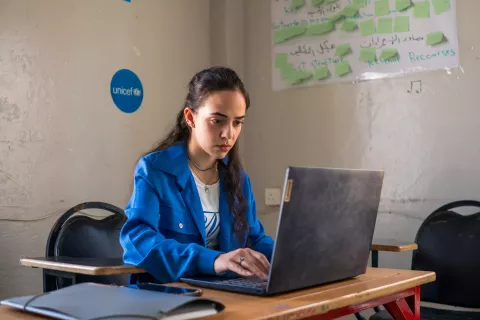
The solution: UPSHIFT is a social innovation accelerator in the form of a modular curriculum with adaptable trainings that equips young people with the professional, transferrable skills and the confidence to create meaningful change in their communities
The impact: over 5.2 million young people worldwide have graduated from UPSHIFT training in over 56 countries, learning the skills they need to tackle local challenges

The Wider Regional Innovation Ecosystem
These five promising initiatives are not all. Other innovative solutions being implemented in the region, aiming towards a wide range of SDGs include: Renovus Clean Energy, ZedLabs, Learning Explorers, accessible digital textbooks (ADT), the climate polices for children dashboard, FunDoo and digital equity platform Laaha.
“Whether in education or health, or when meeting the challenges of climate change, bold innovation and strong partnerships have a fundamental role to play in addressing inequalities in children across the region,” says Roberto Benes UNICEF Regional Director for Latin America and the Caribbean. “Finding new ways to harness technology for children opens new pathways to progress for all.”