Future present: AI solutions changing children’s lives today
With UNICEF support, emerging market startups are using artificial intelligence to transform children’s lives through health, education and climate resilience

Artificial intelligence (AI) holds real potential to address challenges affecting children's lives – from accelerating access to healthcare and quality education to building climate resilience in low-resource communities. But technology that is not designed with children’s rights and wellbeing in mind can cause real harm.
UNICEF has a clear purpose: to ensure AI is of benefit to every child, not just some. That means unlocking AI’s potential to do good and putting guard rails in place to protect children.
The UNICEF Office of Innovation (OOI) works alongside innovators, governments and partners across sectors and around the world to co-create solutions, generate evidence and shape the conditions in which AI delivers for children. This article sets out why and showcases examples of AI solutions developed in, by and for emerging economies. They are the proof points of possibility-driven innovation.
In Lao People’s Democratic Republic air pollution is a threat to health and lives, but a project installing AI-powered pollution monitors in schools is giving authorities the data and insights they need to protect children.
Already 148 real-time monitors have been installed – feeding live information to government databases – and many more are planned as this frontier tech use case is developed into a scalable solution for children.
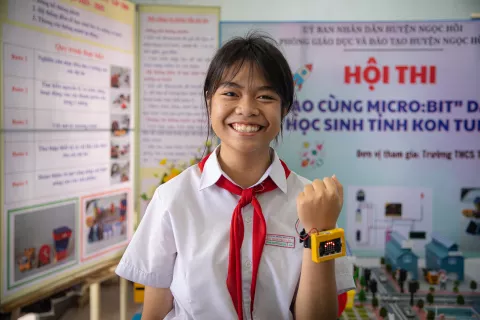
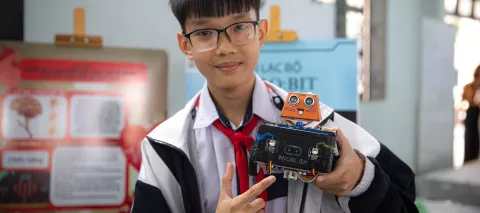
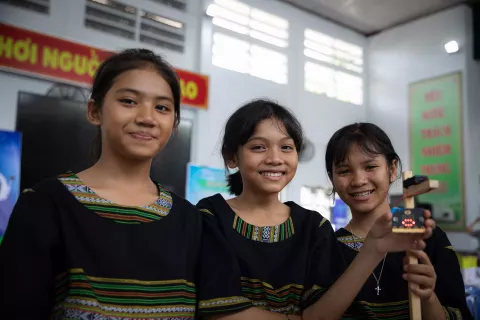
As AI rapidly advances, OOI is harnessing its potential to deliver global social impact for children. This is about more than just imagining a brighter future, it’s about changing realities today. UNICEF is working with an ecosystem of entrepreneurs and technologists in emerging economies, to bring AI solutions for children into play in Africa, Asia, Latin America, the Middle East and Pacific. The future is now.
Hard tech, soft skills
At OOI, we are constantly scanning the tech horizon and advocating for AI systems that uphold and protect children’s rights. The innovators we work with share this commitment as they design novel, AI-powered solutions that meet social challenges in their communities, addressing health, climate resilience, and education and accessibility.
This kind of hard tech is crucial, yet digital revolutions also demand soft skills to ensure children benefit and thrive. UNICEF’s AI in Play platform brings these two together creating a foundation for partnerships that support diverse builders of AI for social good and equip young people everywhere with AI literacy.
AI can deliver public benefits if governments and companies embed children’s rights into emerging AI governance frameworks. There are risks, but also opportunities to improve outcomes for children. The use cases below – in health, education and accessibility, and climate resilience – prove that exciting, transformative applications are already emerging, demonstrating how frontier technology can be harnessed for children and their communities.
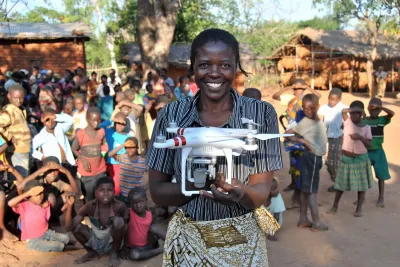
AI for Health
There are an estimated 3.8 million community health workers in 98 countries, providing community-based care and referrals. AI can support these unsung heroes with training and education, automated diagnosis, triage and case management.
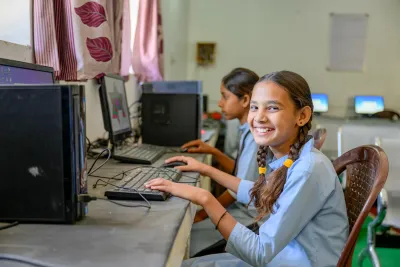
AI for Education and Accessibility
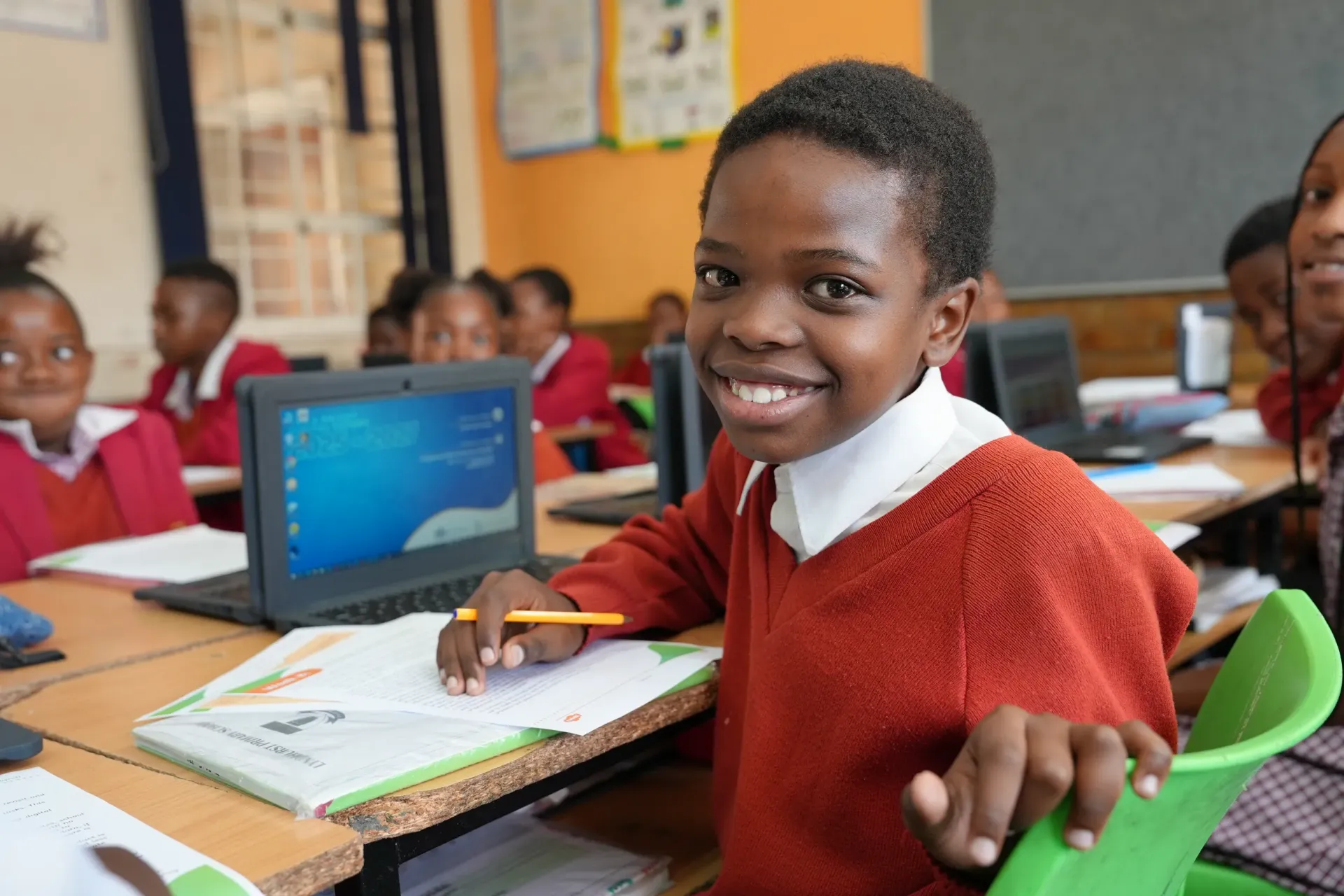
AI can benefit students, teachers and education systems, making learning more accessible and personalized for students, while supporting teachers with automation and data.
Learn more.

AI for Climate Resilience
As the impacts of climate change grow more severe, UNICEF is focused on designing systems that not only track and anticipate climate risks but also enable targeted interventions that safeguard children and strengthen their resilience.
Building the future we want
No single solution will transform childhood outcomes on its own, but together they are mapping the contours of possibility. The solutions above are part of an expanding ecosystem of AI-powered tools that are designed by emerging market startups in response to identified social needs in their communities. UNICEF is supporting this ecosystem, funding, testing, piloting, verifying and scaling solutions that give every child a fair chance at a healthy, educated and climate resilient life.
Decisions made today will determine whether AI amplifies inequality or helps dismantle it. UNICEF will not sit on the sidelines. We are convening governments, backing innovators, shaping governance and building proof points of responsible, child-centred AI. The tools to meet urgent needs exist, what is needed are the partnerships and commitments to act: together, at scale and without delay.
The startups and partners we already work with – including Arm, Ethereum Foundation, GSR Foundation, Sida (the Swedish International Development Cooperation Agency) and Temasek Foundation – are unlocking the potential of socially impactful technology.
The future we want for children is not a distant prospect. It is already taking shape, in clinics in Tanzania, classrooms in Indonesia and flood-prone communities in India. These solutions prove that AI can be developed with equity and rights at its core, and that emerging economies are not waiting to be handed technology: they are building it.
UNICEF's role is to help that work travel further and faster, connecting innovators with resources, evidence with policy, and ambition with accountability. The future is present. Our task is to make it universal. Join us.