A Lifesaving Legacy for Children in East Nusa Tenggara
Healthcare Heroes Improve Maternal and Child Health

- English
- Bahasa Indonesia
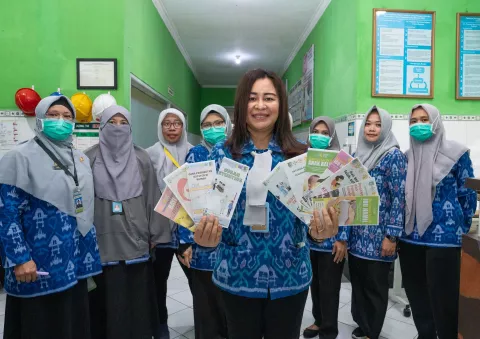
For nearly three decades, Petronela Banamtuan, fondly known as Midwife Inche, has been a cherished presence at the Niki-Niki Community Health Center in Timor Tengah Selatan Regency, East Nusa Tenggara. Born and raised in Amanuban Tengah District, Ince has an unshakeable commitment to her community. “This is my life's calling,” she says. "Through the hands of a midwife, we save two lives – the life of a mother and the life of a baby.”
As a senior midwife, Inche not only delivers babies but also mentors and supports other midwives, often sacrificing her own personal time. "Sometimes I can only sleep for one to two hours, then I have to respond to an emergency call to help with a birth,” she shares.

Inche has a deep understanding of the local culture and the challenges it presents, including the common practice of “naketi" which leads many families to seek advice from village elders and use traditional medicine when a family member is sick.
This often delays essential medical care, worsening initially mild illnesses. "It is common for parents to take their children to the community health center only when their condition is so severe that they cannot be helped,” says Inche. “We have experienced many incidents, including a child who was sick with diarrhoea for four to five days before being taken in. We tried to provide help, but the child could not be saved."

East Nusa Tenggara Province has one of the highest child mortality rates in Indonesia, with 30.37 per deaths per 1,000 live births, according to 2020 Census data. This is significantly higher than the national average (19.83 per 1,000), mainly due to lack of access to quality health services and poor decision-making by families for seeking treatment.
Since 2019, UNICEF has been working closely with local governments and partners across Indonesia to improve maternal and child health. This includes the introduction of a family-based monitoring card for children, which is used to educate families, especially parents and caregivers, to identify when babies are healthy and when they need immediate care at a health care facility.
In 2020, acknowledging this innovation, the Ministry of Health started to adopt the family-based monitoring card nationally and expanded it to cover other at-risks populations, including mothers and children under age five.

The expanded version of the family-based monitoring card was tested in 10 provinces, including East Nusa Tenggara, and has been implemented nationwide since 2022. A key focus is to equip trained healthcare workers like Midwife Ince with the necessary tools and knowledge to address local practices that prevent timely medical care.
Timor Tengah Selatan is one of six districts in East Nusa Tenggara which UNICEF supports to improve the capacity of health workers in providing comprehensive care for under-five children, using the Integrated Management of Childhood Illnesses (IMCI) approach. In 2022, at least two or three personnel at each of the 37 puskesmas in the district were trained on IMCI.
Central to the provision of comprehensive child care is the Maternal and Child Health Book (KIA Book), which Midwife Ince uses to educate parents about the importance of proper child care at home and when to seek immediate medical care. "This book is very helpful in explaining to parents that if a child is sick, they must immediately be taken to the Puskesmas. After that, I will check with the parents again if they are still confused," she explains.

Cheryl, known as Nurse Lili, works in Maunum, a remote and hard-to-reach village in the Niki-Niki Health Center’s service area. She also faces challenges with the naketi practice.
“Every time a child gets sick, families say the child is being harassed by their ancestors. At every home visit we have to work extra hard to convince them that the child must be immediately taken to the nearest health facility,” she explains. “Now, after we've been trained and know more about how, it feels easier to persuade people.”

The efforts of health workers like Midwife Ince and Nurse Lili are making a significant difference. With frequent home visits and encouragement, more families are starting to trust and use health facilities.
Yuliana, her husband Marten and their eight-month-old child Sami live in Maunum village, only accessible by a rocky, winding dirt road. "In the past, every time Sami was sick, we gave him rubbing oil and onions, plus honey," says Yuliana, with a hint of sadness. “Midwife Ince taught us to use the KIA book and always told us to quickly take Sami to the closest puskesmas or hospital."

Before they met Midwife Ince, Sami was often unwell with diarrhoea and the common cold. His appetite was poor, he was not as lively as other children and his growth lagged. This was largely because his parents did not know about monitoring his growth and were reluctant to take Sami to a health facility whenever he was sick.
Now, Sami is a healthy, active and cheerful child, a testament to the life-saving work of Midwife Ince, Nurse Lili and other trained health care workers. Yuliana and Marten understand the importance of seeking medical help quickly and are better at monitoring and maintaining Sami's health using the KIA book.
Sami’s parents have a clear message for other families. "Never ignore the importance of the existence of health facilities, the role of cadres and health workers,” Yuliana says. “Stop naketi. If a child is sick, immediately take him to a health center or health facility to seek treatment. Monitor his health every day. Follow the advice of midwives and health workers because they want to save your child's life.”

"Never ignore the importance of the existence of health facilities, the role of cadres and health workers. Follow the advice of midwives and health workers because they want to save your child's life.”