Working across Sectors to Provide a Safe Return to Learning in Indonesia
Learning outcomes transformed in South Sulawesi and Papua

The impact of COVID-19 on global learning was immediate and severe and – as is always the case – the world’s most vulnerable children bore the brunt of the crisis.
Indonesia was no exception to the rule, with 60 million of its children affected by 18 months of school closures.
Children living In South Sulawesi and Papua – two provinces that have long grappled with poor learning outcomes – were particularly hard hit, suffering losses in basic literacy and numeracy skills, mental health challenges among parents, teachers and students, experiences with violence, and lack of access to health and sanitation facilities.
Moreover, children in other rural and underserved areas of the country who were also struggling with learning before the pandemic, were left at greater risk of falling even further behind.
UNICEF’s Education Chief in Indonesia, Katheryn Bennett, knew her team had to work urgently with local authorities to get children back to school safely. In a radically new ‘normal’, they were also certain that getting children back to the classroom wasn’t enough.
“It was really important to act as quickly as possible in the most disadvantaged communities where we were already working, and to take a holistic approach to this emergency response,” says Katheryn. “We knew we had to converge interventions from different sectors to have substantive impact for children.”
A 2021 baseline study showed that children’s learning had been hit particularly hard: only 32 and 31 per cent of early grade students could correctly perform basic addition in Makassar city and Bone district, respectively, and 57 per cent of students in Asmat district and 25 per cent in Nabire district were unable to read.
Meanwhile on the health front, children were missing out on routine vaccinations due to fear. In the Papua districts, 15 per cent of parents rejected immunization and over half of all the students said cyberbullying happened frequently, and most – victims or witnesses – remained silent about it.
Pulling Together
The data made a clear case to address learning loss and other negative impacts of COVID-19 through an integrated approach combining learning, health, psychosocial and WASH interventions. Over several months, UNICEF’s Education team in Jakarta and across two field offices worked closely with local partners to design and implement the Safe Return to Learning programme in both provinces.
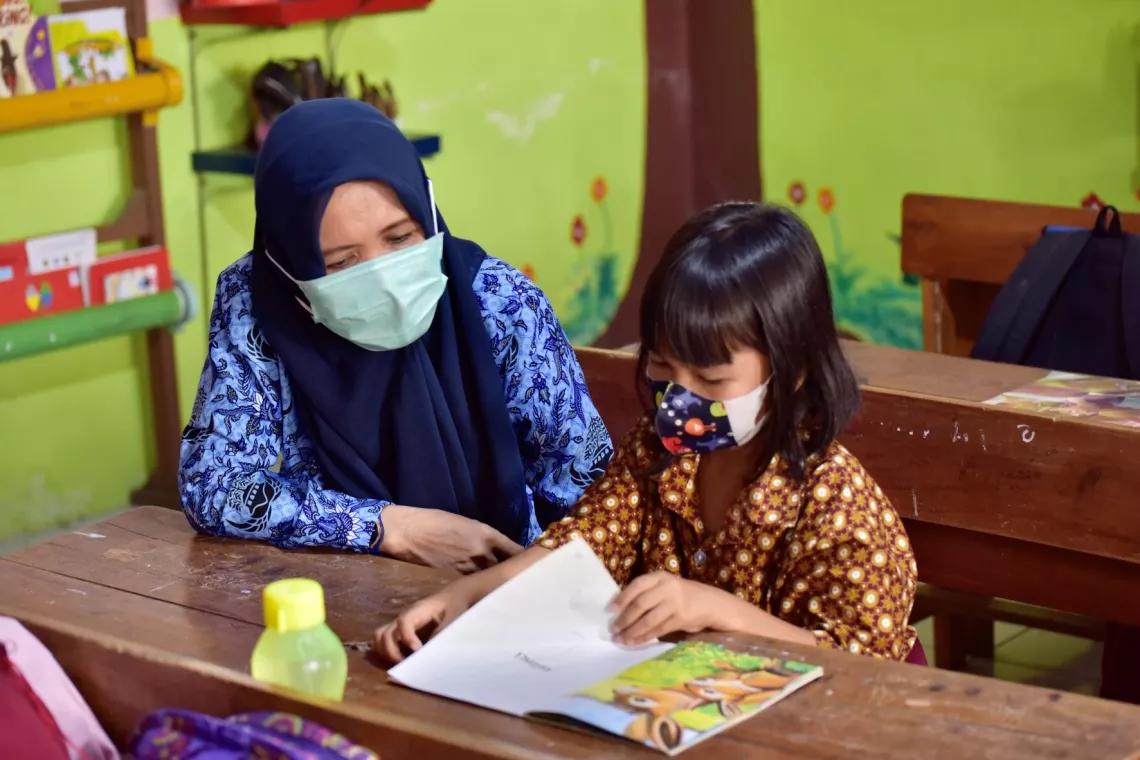
To tackle learning loss, over 500 teachers were trained on new and engaging ways to teach literacy and numeracy, including the use of age-appropriate reading books and classroom reading corners.
“A lot of the books in the schools weren’t appropriate for early graders; nobody touched them,” recalls Eliza Mufti, Education Specialist in South Sulawesi. “The children were so excited about the books we provided – they would run towards the reading corner, pick out books and volunteer ‘I want to read this for you’. The teachers became enthusiastic, even competing against each other about who has the best reading corners, and then they started to get innovative – not just focusing on the classroom – like making a reading area in the garden.”
Working closely with local health authorities, UNICEF’s partners explained the benefits of routine immunization to families and supported health centres to organize in-school vaccination. Two thousand children were screened and immunized for diphtheria, tetanus, measles and rubella in the four districts.
In addition, hundreds of teachers and frontline workers learned how to identify and refer mental health challenges and close to 2,000 students were trained in peer-to-peer mental health support. District and village government stakeholders worked together to develop strategies encouraging 6,500 out-of-school children and students at risk of dropping out to go back to school.
“There is always a challenge when you’re implementing multisectoral programmes to ensure that the different activities are in sync at the right time. It took a lot of effort to ensure that all the pieces came together when and how they needed to,” says Katheryn. “But our job was made a lot easier since we have good partnerships with local government and communities. The door was wide open for us to create this intervention – that really made a big difference.”
Measuring Progress
Last year, the Education team carried out an endline study to assess the impact of the programme and the results were striking.
The percentage of students who could now read fluently with comprehension had more than doubled in both South Sulawesi districts, and in Nabire district in Papua. The percentage of non-readers in the South Sulawesi districts had decreased by eight per cent and five per cent, respectively. In Asmat (Papua), non-readers had decreased by 18 per cent.
And out-of-school students who were supported in returning to school felt more confident and motivated.
“What the programme did was to reverse the backward slide in learning, while also propelling students forward beyond the learning they had lost during the pandemic,” says Katheryn. “To have done this over such a short period of time shows what you can do with a very intensive intervention.”
The study also showed that parental perception on vaccine safety improved. The percentage of teachers who knew about mental and psychosocial health had increased significantly, and most students who were victims of cyberbullying said they were less likely to remain quiet about it.
Sustained Impact
“From the outset, we were very committed to trying to measure the impact of the programme so that we could take as many lessons learned as we could and ensure they informed our ongoing programme for COVID-19 recovery and more broadly,” says Katheryn.
The programme invested significantly in building the skills and knowledge of key personnel within schools and the wider education system, to help ensure teachers could apply this learning with current and future students. District governments were supported with planning and budgeting to prioritize quality early grade learning (EGL) within their resource envelopes.
“This was not just about having a highly localized programme – we made deliberate efforts to create usable and contextually adaptable tools for other districts that were not part of the programme to emulate and create their own pathways to implement quality EGL services,” says Katheryn.
To that end, a ‘scalability roadmap’ was developed for other districts to adapt or replicate EGL services in their own schools. Working with the Ministry of Home Affairs, key elements of the roadmap were incorporated into guidance that was disseminated nationally to all provinces and districts.
“Given the complexity and scale of Indonesia, we are thinking through how our interventions can be long-lasting and actually change the mindsets of local authorities, educators and school communities. There is so much work to do,” says Katheryn. “We need to constantly challenge ourselves and innovate to reach the children who we haven’t been able to reach to date.”