When Vaccination Reaches the Hardest-to-Reach Places
The MSPP, with the support of UNICEF and thanks to funding from Gavi, Japan, and Canada, organizes catch-up vaccination sessions for children and women living in Artibonite.

- Français
- English
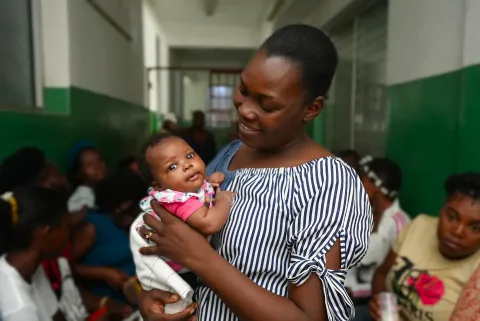
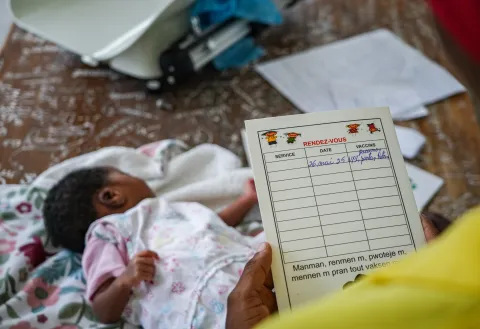
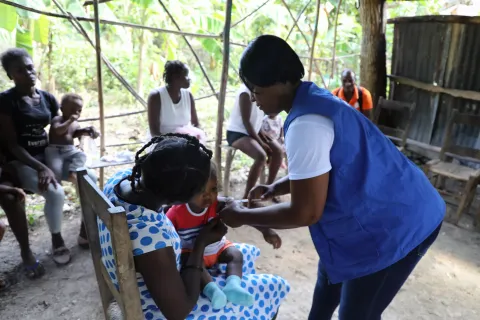
Gonaïves – Haiti. Under the attentive gaze of her father, four-month-old Anayah receives a vaccine from Miss Abigaelle, a nurse at Providen ce Hospital in Gonaïves, who carefully administers the injection into her thigh. The tiny body shivers slightly from the prick, but Abigaelle’s precise and reassuring movements bring immediate calm. A few meters away, other families wait patiently for their turn, some having walked for several hours to reach the vaccination room.
As part of the implementation of the national plan to ensure vaccination for all children, coordinated by the Expanded Program on Immunization (DPEV), the Artibonite Health Directorate (DSA) carried out a large-scale catch-up vaccination campaign, with support from UNICEF and financial contribution from Gavi, Canada, and Japan.
Faced with vaccination delays and difficulties accessing remote areas, the campaign reached several health centres, including those in Gonaïves, Saint-Michel, Gros-Morne, and Pérou, among others.
Thanks to effective logistical support, vaccines were delivered to over 40 institutions and multiple fixed vaccination sites. Community Health Agents (ASCPs) played a crucial role in reaching isolated locations, often inaccessible to vehicles due to impassable roads.
Transporting the vaccines required long hours of work and coordination to ensure that every child and every pregnant woman could receive this vital protection.
For parents, these moments bring immense relief. Each dose administered is more than an injection, it is protection.
“I am relieved to see my baby receive her vaccines,” says Guilliano, Anayah’s father. “We now know we can protect her from diseases that could be serious.”

Relieved Families
In her village, Miss Abigaelle has become a strong advocate for maternal health. Aware of the risks that expectant mothers face, she emphasizes the importance of vaccination during pregnancy.
“I know how essential it is to get vaccinated to better protect your child,” she says with emotion. “Thanks to vaccines, we can prevent many diseases and give our babies a healthier start in life.”
Today, Miss Abigaelle is delighted to see more and more pregnant women receiving their tetanus vaccines, strengthening their immunity and that of their future children.

A Collective Effort for Health
Miss Mickerlange, a nurse in Saint-Michel, highlights the importance of coordination and commitment:
“Even in the most remote areas, we can see that every child can be protected when everyone works together and puts their heart into it.”
With the support of UNICEF, the supply chain, maintenance of the cold chain at the Departmental Supply Center for Medical Supplies (CDAI) in Gonaïves, and the provision of necessary equipment have enabled local teams to vaccinate effectively and safely.

In just two weeks of the campaign, over 3,000 children and 1,800 pregnant women were vaccinated in Artibonite. For Mickerlange, every child who receives a vaccine represents a victory for health.

In 2025, thanks to the commitment of the Ministry of Public Health and Population and the logistical support of UNICEF, over 187,320 children were vaccinated across the country, gaining access to essential healthcare and contributing to their health and a brighter future. This achievement was made possible through funding from Gavi, the Vaccine Alliance, as well as the governments of Canada and Japan, strengthening national efforts to protect all children from preventable diseases.