Guinea-Bissau: making childbirth less risky
-

- English
- Portuguese
When Djara Fati, 33, delivered her four children at home with her mother’s help, she was lucky there were no complications. But this fifth pregnancy was risky.
Fati was diagnosed with anaemia which can lead to fatal haemorrhaging during childbirth if unattended by a skilled health worker. It is one of the many preventable conditions that contribute to the country’s high maternal mortality ratio of 667 per 100,000 live births, far above the Sustainable Development Goal (SDG) target of less than 70 maternal deaths per 100, 000 live births. Anaemia can also lead to pre-term delivery and a low-birth-weight baby, which also increases the probability of infant death. In Guinea-Bissau, about 22 babies per 1,000 live births die during the first 28 days of life, most of them during the first week, which is also well above the SDG target of less than 12 deaths per 1,000 live births.
Fati lives far from the hospital in the sparsely populated north eastern region of Gabu. If Fati went into early labour and bled heavily, the chances are she would not survive. The only ambulance in the region is in high demand and can take up to four hours to reach some areas, and during the rainy season might not reach at all as roads become impassable. About 40 per cent of births in the region are not assisted by skilled health personnel.
So Fati was advised to move to the Casa das Mães, a transit home for pregnant women set up by the Government of Guinea-Bissau in partnership with the NGO, Caritas, in the hospital grounds. Fati shared the home with around 20 other pregnant women, one of them being Wazeline Da Costa, 23, who had suffered two miscarriages, one at two months and the other at four months. Her husband brought her to the home on foot. “It took me one and a half hours as I was in pain so I had to walk slowly,” says Da Costa who is now eight months pregnant.

Mamasaliu Jalo, who oversees the Casa das Mães, explains that while the pregnant women are at the Casa das Mães, he reinforces what they have been told by the community health workers back home, including the importance of good nutrition while pregnant, hygiene, early and exclusive breastfeeding, immunization and birth registration. The Casa das Mães provides for all their basic needs, including nutritious food. Also, literacy classes are due to start as many of the women do not know how to read and write. Jalo says he loves his job, “I gain friendships and I feel valued, and I feel I am helping the community,” he says.
Jalo is slightly out of breath as he had just rushed out of his office when he heard that one of the pregnant women he escorted to the maternity ward a few hours ago had given birth to a healthy baby girl. He shares the news with the pregnant women nearby. There is a buzz of excitement.
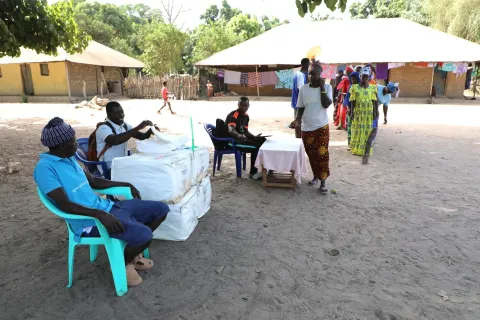
Most women in rural areas, however, are unable to benefit from this facility. There are only five in the country. Instead, the women have to rely heavily on community health workers who play a key role in maternal and child health. The community health workers’ tasks include registering pregnant women, checking their nutritional status by measuring their mid-upper arm circumference, and referring them to health centres. Women with risky pregnancies are advised to move near health facilities with obstetric care but this is often not possible as either they do not have family in town or they are persuaded usually by the mother-in-law or sister-in-law to have a home birth. To help prevent neonatal mortality, including those who give birth at home, community health workers regularly visit during the first critical week of the baby’s life.
UNICEF supports the training of community health workers and provides technical support to upgrade the skills of midwives as in some cases poor obstetric care has contributed to high maternal death rates. In addition, “UNICEF has supported these temporary houses for expectant mothers and is working on how to scale them up across all regions,” says Renato Pinto, UNICEF Health Chief in Guinea-Bissau.

Once pregnant women arrive at the hospital, the chances of death are greatly reduced. Since Jalo took up his post at the Casa das Mães in 2014, he remembers one loss in 2021. It was a 23-year-old woman who like Fati, was suffering from anaemia. She was referred to the Casa das Mães two months before her due date where she was treated for severe anaemia and monitored. During childbirth, everything seemed to be going well. She gave birth to a healthy baby but then three hours later the mother bled heavily and despite all efforts to save her, she died, a tragic reminder that childbirth can be risky.

But for most of the women in the Casa das Mães, including Fati, the outcomes are joyous. Fati is in Jalo’s office cuddling her baby girl who was delivered at the hospital five days ago after a one-month stay at the home. “I haven’t named her yet,” she says smiling. Her baby weighed 3.60 kilos at birth and Fati took her for her first vaccination. “We will discharge Fati tomorrow,” says Jalo, admiring Fati’s newborn baby.