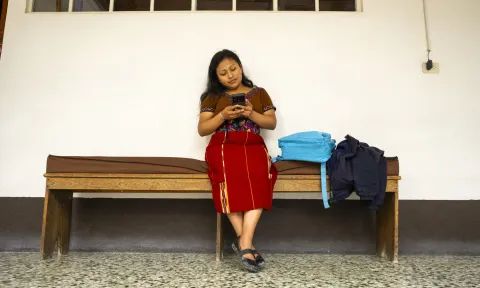
UNICEF and the Mayan Language Academy of Guatemala enter into a partnership to strengthen the lingüística and cultural rights of children in the country.
In Guatemala there are 2.8 million indigenous girls, boys and adolescents. • Fewer than 50% of bilingual teachers express themselves fluently.

- Español
- English
Guatemala City, 27 August 2020 - The United Nations Children's Fund (UNICEF) and the Academy of Mayan Languages of Guatemala (ALMG) sign a collaboration agreement for the purpose of making joint efforts to ensure that the respect and promotion of the rights of indigenous children and adolescents are given priority in the country.
According to 2018 census data, there are 2.8 million indigenous girls, boys and adolescents in Guatemala, which represents 48% of the population aged 0 - 17. And although 4 out of 10 students enrolled in Ministry of Education schools are indigenous, less than half of the teachers can speak their language fluently. This represents an additional difficulty for these girls and boys to learn.
Guatemala has a rich cultural diversity in which the Ladino, Xinka, Garifuna and Mayan peoples coexist, and includes 22 Mayan linguistic communities. Throughout the country, indigenous peoples have preserved their identity and transmitted their worldviews, languages and traditions. Their mother tongue is essential to ensure the continuity of this wealth.
“Girls and boys come first; in mitigating the pandemic, they must come first. The Academy of Mayan Languages of Guatemala thanks UNICEF, the United Nations System in Guatemala and all the peoples and nations that help Guatemalan children, especially Mayan children. With great simplicity, I confirm our commitment, to ensure that this inter-institutional partnership bears fruit in favour of children,” said María Esperanza Tuctuc Mux, president of ALMG. “Today, in the context of the new reality resulting from the crisis caused by the Covid-19 pandemic, the importance of developing all types of multicultural communication processes to strengthen the linguistic and cultural identity of children and adolescents is confirmed,” stressed Tuctuc Mux.
UNICEF works to promote behavioural changes around health, nutrition, special protection and education, so that girls, boys and adolescents and their families can live better. This implies recognizing the languages and worldviews of each of the linguistic communities, to jointly create messages that bring about true changes.
“I am proud to formalize this agreement with the ALMG. This partnership offers an opportunity to ensure effective communication and a true dialogue for mutual understanding. We must recognize the specific rights of indigenous children and strengthen concrete and clear actions to ensure the comprehensive development of children in Guatemala,” said Carlos Carrera, UNICEF representative.
Through this partnership, both institutions will offer all their technical knowledge and advice to strengthen the linguistic and cultural identity of children and adolescents in Guatemala. The ALMG will advise UNICEF in the joint development, translation and validation of materials with the linguistic communities, to help disseminate communication strategies with messages in the Mayan languages.
Media contacts
Acerca de UNICEF
En UNICEF promovemos los derechos y el bienestar de todos los niños, niñas y adolescentes en todo lo que hacemos. Junto a nuestros aliados, trabajamos en 190 países y territorios para transformar este compromiso en acciones prácticas que beneficien a todos los niños, centrando especialmente nuestros esfuerzos en llegar a los más vulnerables y excluidos, en todo el mundo. UNICEF responde en las emergencias protegiendo los derechos de los niños. En coordinación con los asociados de las Naciones Unidas y los organismos humanitarios, UNICEF pone a disposición de las entidades que colaboran con él sus servicios singulares de respuesta rápida para aliviar el sufrimiento de los niños y de las personas responsables de su cuidado.
Obtenga más información sobre UNICEF Guatemala y su labor siguiéndonos en: Facebook, Instagram, Twitter, YouTube, Tik Tok, Linkedin y Medium