Change from Within: How Community Health Committees are Transforming Lives in Northern Ghana
The Silent Heroes: The Impact of Community Health Management Committees (CHMC)

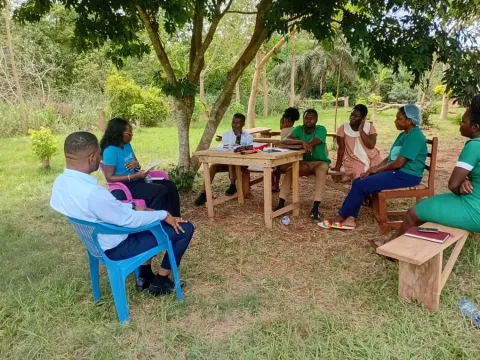
At Atampintin, a rural community located in Bongo district in the Upper East Ghana, the sky was heavy with grey clouds, a storm threatening in the distance, but the arc of plastic chairs remained firm on the sandy ground. Lined up in the chairs were the quiet guardians of the community’s health, the Atampintin CHMC.
“We meet like this every month,” said madam Atigire, her voice steady, “and sometimes, even when there’s no meeting, we still come. This clinic belongs to us.”
Across the North East and Upper East regions, where trained health workers and volunteers grab headlines, an unacknowledged group keeps the wheels of rural healthcare turning, the Community Health Management Committees. Composed of farmers, teachers, elders, traders, religious leaders, and youth, CHMCs are not medical professionals yet their fingerprints are on every painted wall, every ceiling fan spinning overhead, every clean bench in the waiting area and the sign post leading to the facility.

“We painted it ourselves,” interjected Abdullaihi, the CHMC secretary at Atampintin, referring to the health post behind him. “White and blue. To show that health is peace and hope.”
Their latest achievement? Installing ceiling fans and makeshift office spaces so that health workers do not have to conduct consultations under the hearing of other patients. With no official budget, they pooled together community donations to raise funds. “We don’t wait for the government,” said Mr. Abel, the chairman of the committee, “If we waited for government every time a wall cracked, this place would be closed.”

In Yorogo, the legacy is even older, at the bright yellow Yorogo CHPS compound, the atmosphere is different, more structured, but no less spirited. This CHMC has been active for over two decades.
That land that the facility is currently situated on was donated by a couple in the community in 2000,” said Mr. Simon Agana, the chairperson for the CHMC and a teacher by profession, pointing to the land the facility is situated on.

Indeed, Yorogo’s CHMC does not just sit in meetings, they have donated benches which were funded by each of the six communities that they serve, a sign post for the CHPS facility and now, they are constructing improved washrooms. Also, an annex facility for outreach has been built in Yaliga, one of the distant communities that seek health service at the Yorogo CHPS compound.

Meanwhile, in Buzulungu and Bowku communities in the North East Region, their CHMCs have built local pavilions to provide shade for waiting patients and constructed incinerators to improve medical waste management, proving an inclusive, community-owned approach to health system support.

At all the CHPS compounds in these regions, the CHMCs bridge a critical gap between the community and the health system. They mobilize people for clean-up campaigns, resolve disputes between health workers and residents, and even mediate when rumors spread about vaccines or medications. And they do it all without salaries. Why? “You don’t wait to be paid to protect your family,” said Auntie Atigire, the CHMC women leader at Atampintin CHPS. “And this clinic? It is our family’s lifeline.”
In the CHPS Plus intervention supported by UNICEF and KOICA, technology and training are important but without the CHMCs, the system would stagger. They are the ones who organize fuel for the tricycle ambulance when it is empty, and the clock is ticking for a life to be saved. They are the ones who believe, fiercely and stubbornly, that health is not just a right, it is a shared responsibility because for them, health does not happen to the community, it starts with them.