Amina’s New Beginning: From Fear to Hope in Ghana
How a mother of six rebuilt safety, dignity, and stability with support from social welfare services and UNICEF-EU assistance

When the gunfire began creeping closer to Laroho in Burkina Faso, Amina knew she could no longer wait. A mother of six, she gathered her children — the oldest just 16, the youngest barely 15 months — and joined other families fleeing the uncertainty of the escalating attacks.
Though the violence had not yet reached her community, it was near enough to force her to make the difficult decision of leaving everything familiar behind before it was too late.
Their journey by road into Ghana’s Upper West Region was long, frightening, and exhausting. When they finally arrived at a small community near the border, Amina tried to rebuild from nothing. She worked as a farm hand whenever she could, but even with her efforts, there was never enough food. “There were days,” she recalls, “when I did not know what I would feed the children.”
Not long after the displaced families settled, Ghana’s Department of Social Welfare and Community Development, NADMO and other partners stepped in. Officers brought food and water — a lifeline for mothers like Amina — and began supporting the traumatized families who had escaped the conflict by providing psychosocial counseling and documenting cases in the Social Welfare Information Management System for case management. Using the Government’s Child Protection in Emergencies toolkits, social welfare personnel sensitized the parents on the risks of sexual and gender-based violence in emergencies and guided them through tools like the child development ladder to help them care for their children. They encouraged families to enroll their children in the local school so they could regain a sense of normalcy and also learn the English language.

The officers also worked with the host community. With many displaced families now living in the area, social cohesion became essential. Using a community engagement toolkit, they organized sensitization sessions to help residents understand, accept, and support their new neighbours.
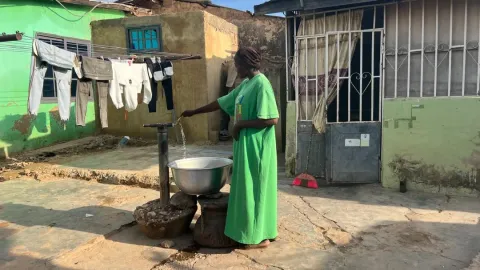
As numbers grew, pressure on basic services — especially water — increased. To ensure both host and displaced families had enough, World Vision provided additional boreholes with overhead storage facilities at the settlement center, expanding access to clean water.
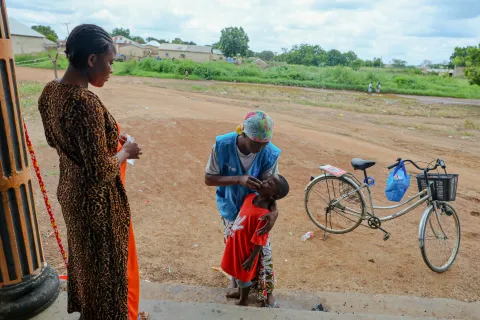
Another challenge soon emerged: many of the children had never been registered at birth and could not access healthcare services. Supported by EU funding from the Project facilitated through UNICEF, social welfare workers negotiated with the National Health Insurance Scheme to bring mobile registration teams to the camp in Zini, where displaced families later relocated. More than 152 people, including Amina and her children, were profiled. One hundred have since been enrolled in the national health insurance scheme, and the births of 32 children — including Amina’s three-year-old son, Sawadogo Tchiougou — have now been officially recorded.
Today, the transformation in Amina’s life is visible in her smile.
“Now I can take care of my children because of the services. I am very happy,” she says, her voice full of relief.
Two of her children attend the Complementary Basic Education (CBE) school in the camp, while the other goes to the formal education school in the Zini community. With health insurance, the family can access medical care when they need it. With improved water access, school enrollment, and civil registration, Amina finally feels anchored again.
She calls herself one of the “fortunate ones.” After months of fear and uncertainty, she is watching her children reclaim their childhood, she is still far from home and all things familiar but, she is — safe, registered, protected, and able to dream again.