A beautiful shore along Volta Lake is home to quaint mudbrick houses. There are no modern distractions such as electricity, TV, social media or running water. I haven’t stumbled upon the Ghana of the 1950s; instead, I am in Bumpata, a remote community located in the Kwahu Afram Plains South District of the Eastern Region.

I am here as part of a mission team with the UNICEF Representative in Ghana, Osama Makkawi Khogali. Today we return to the heart of UNICEF’s mandate as we observe, first-hand, the situation of children in the hardest-to-reach parts of the Eastern Region.


The community did not take our visit lightly. The chief himself makes it clear; NGOs speak to them on phone but rarely (if ever) visit in person. This is not an indictment. Getting to Bumpata from the regional capital of Koforidua is a five-hour journey over road. This is followed by forty-five minutes on a pontoon from Adawso to Ekye Amanfrom, and finally another forty-five minutes by boat.
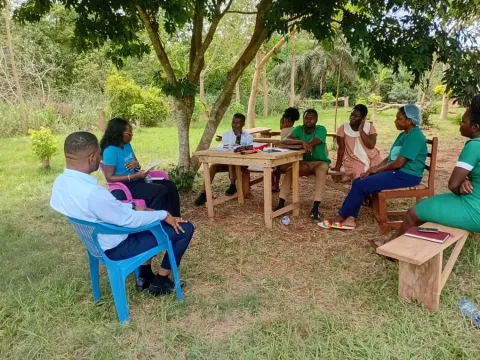
The mission team discusses challenges and possible solutions with community leaders. Top amongst them are birth registration, health and education.
Whilst discussions are ongoing, I try to talk with a young man, David.

David is in no mood to talk. I have better luck with his parents, Samuel and Philomena. They’re both young teachers, posted to the community just before David was born. Samuel tells me the story of his arrival to Bumpata,
After crossing the lake on the pontoon, I was looking for a car to reach my posting location… That was when I was told that Bumpata was not a community closer to Ekye. The cost for a boat crossing was 400 cedis [USD 39].
Bumpata is one of the ‘island communities’ on the Volta Lake. Like most of these communities, it is not completely cut off by the lake. Which meant that Samuel had an option, he could go the long way, by road.
“But when I asked of the cost by road, I was told 600 cedis! So, I had to pay to cross by boat.”
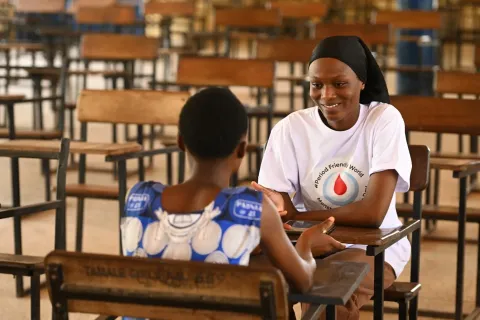
As we converse, I try to understand what is like to live in Bumpata as a teacher stationed here.

Resources brought into the community come via boat on market days at high cost. The CHPS compound and the community church are the only places where a cell phone can be charged because they have solar panels. As a new mother, Philomina is concerned about the humid heat that causes rashes on David’s skin.
Through the challenges, they share the coping strategies that they use to overcome. I never doubt their commitment to serve in this community.
Samuel teaches in the Junior High School (JHS). This JHS takes students from eight other primary schools in the surrounding communities. Some children walk for over an hour through winding bush paths to get to the JHS each weekday. Between form 1 and completion (form 3), enrolment plummets as students begin to question the cost-benefit of going to school.
The few JHS students that make it through the crucible—limited textbooks, disintegrating furniture and no light for studying after school—must cross the lake to write the Basic Education Certificate Exam (BECE).

Crossing the lake daily to write the BECE exams would be too costly. Instead, the class crosses with their teachers and then relies on benefactors to obtain shared rooms for sleeping over in Ekye.
In 2024, fourteen students wrote the BECE exam. Only four made a grade high enough for placement in a senior high school. I ask about those who didn’t make it. They’ve gotten pregnant and/or gone into farming or fishing. Their potential is cut short.
Philomina’s recommendation for the one thing that will change education in Bumpata? Electricity.
Access to electricity in the community will grant students the grace of study time beyond sunset—an opportunity taken for granted elsewhere. Additionally, I’m told, it is easier to get teachers to accept postings to remote rural communities if power and clean water are in place. Teachers, she says, will find a way to navigate everything else.
Before I rejoin the main mission group, I ask about toilets. Do households have them? The response is a wry smile from Philomina. Land is plentiful and most community members prefer to ‘go to the bush’, open defecation in the bush, rather the communal toilet.
The school is no exception. Samuel gives me a tour of what remains of the JHS toilet. A toilet was built with three cubicles. Then, the soil said “No.”
Expansion of the clayey soil has shattered the pit and concrete slab. There are technical solutions for this problem, but it takes money to bring in human resources to support. The same theme runs through providing social services in the Afram Plains Districts: it’s going to take much more money per person to deliver sustainable development.

in the evening, the team splits up. One group joins a community engagement, whilst the other group rushes back to Donkorkrom, the capital of Kwahu Afram Plains North District.
I am part of the second team, and whilst we make the 2-hour journey northwards, I am reminded of something from the previous day.
We had gotten down from the Pontoon at Ekye, in Afram Plains South when I heard whispers of discontent. Locals, eyeing our convoy of landcruisers and cameras, voiced their frustrations in hushed tones. “Look at these people,” one said. “They’ll come, take pictures, and do nothing.” Another added, “We don’t want talk—fix our road for us!””
The road lives up to its reputation.
The meeting at the Kwahu Afram Plains North shares a lot in common with the one held at the Afram Plains South District Assembly the evening before. The status of children in the Afram Plains districts is the lowest in the Eastern Region. Deprivations in areas like birth registration are compounded by challenges in healthcare and education. Potable water supply, even in Donkorkrom, is via boreholes and not a piped system.

Reflecting on today’s experiences, I can’t help but feel that tomorrow will reveal even more truths. The memories of Bumpata and similar communities haunt me, highlighting the stark reality of children living in the shadows of development. Their laughter contrasts with the challenges they face, and I’m eager to explore their stories further.
Stay tuned for more about my next experiences and the lessons I hope to learn. There’s so much more to uncover, and I can’t wait to share this journey with you.