Fun fact: As a middle-aged person, I can truthfully say that AI was part of my formative education (just not in the way that you think).
I grew up in the US state of Delaware and attended AI Middle School and AI High School in the 1990s, back when going online meant waiting for the bulky family desktop computer to boot up, then listening to the crackles, hums and beeps of a dial-up connection as it slowly connected us to the internet.
Our AI, however, had nothing to do with artificial intelligence. It stood for Alexis I. du Pont, the public schools’ namesake and a member of Delaware’s prominent duPont family.
At school sports games, we cheered loudly and proudly for AI. We would raise our arms to a point over our heads yelling “A,” then stretch our arms out from our shoulders yelling “I.” We’d repeat the pattern, “A…I…A…I,” faster and faster until it devolved into flapping arms and a nonsensical “AIAIAIAIAIAIAI!”
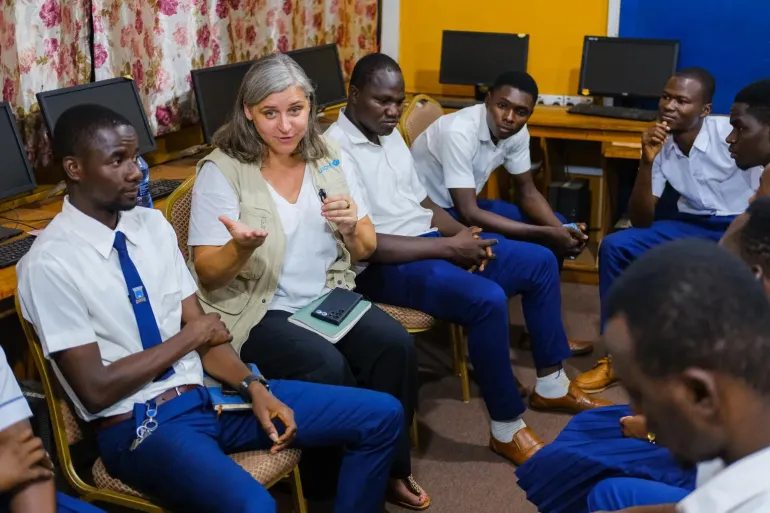
A few decades and a career in global education later, I once again find myself talking about AI and education almost every day. Currently based in Ghana, I also use AI nearly every day, much like millions of people around the world. It has become a sort of personal assistant: helping me sharpen communications, digest new evidence, think through strategic questions and, on a more practical level, explore family-friendly dinner recipes with ingredients I can reliably find in Accra.
Across education globally, AI presents something of a paradox: raising substantial concern about what may be lost when learners rely too heavily on it, alongside growing interest in how teachers can use it strategically to strengthen their teaching and better support learning.
In Ghana, we’ve been exploring that second question with teachers and teacher trainees themselves: How are they already using AI? Where could it genuinely make their work easier or their teaching better? And if an AI tool were designed specifically for Ghanaian teachers, what would they want it to do? What are the risks and guardrails we need to put in place to ensure responsible AI in learning? How do we keep children safe? And how can it improve learning outcomes?
How teachers are already using AI
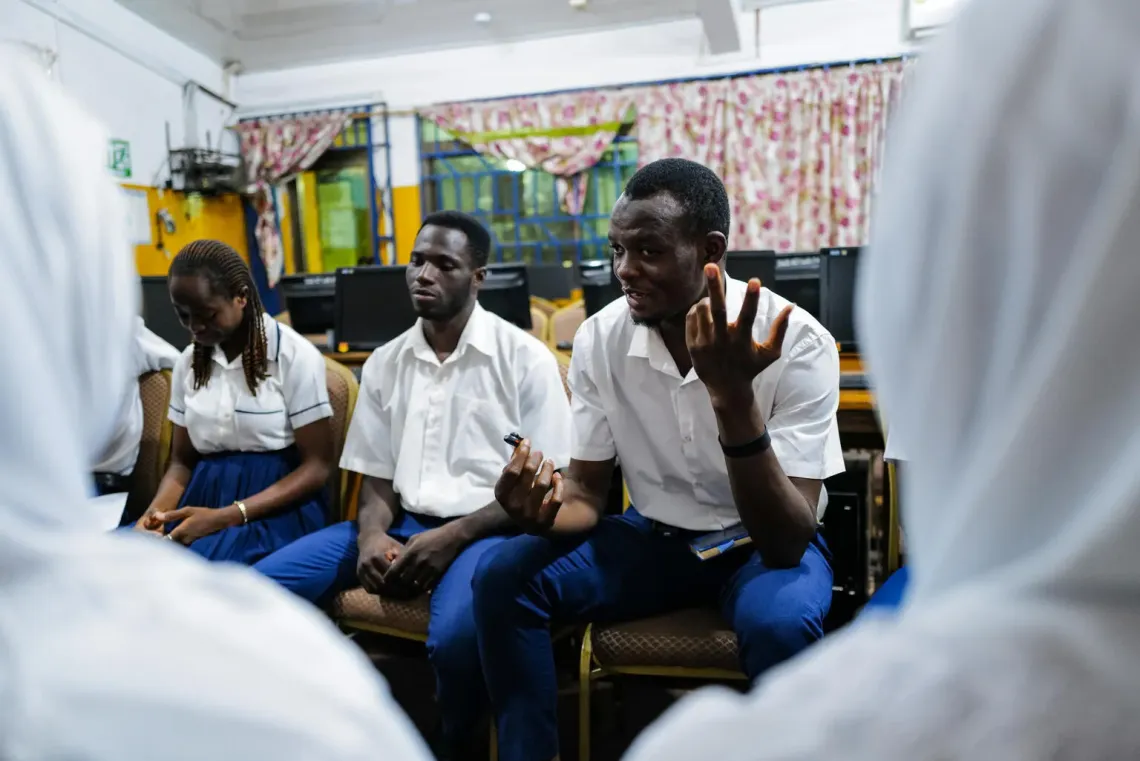
Through a series of focus group discussions with teachers and teacher trainees over the past year, we’ve had some clear feedback. Largely that AI is not something Ghanaian teachers and teacher trainees are simply waiting to arrive as many are already using readily available AI tools in their work and studies.
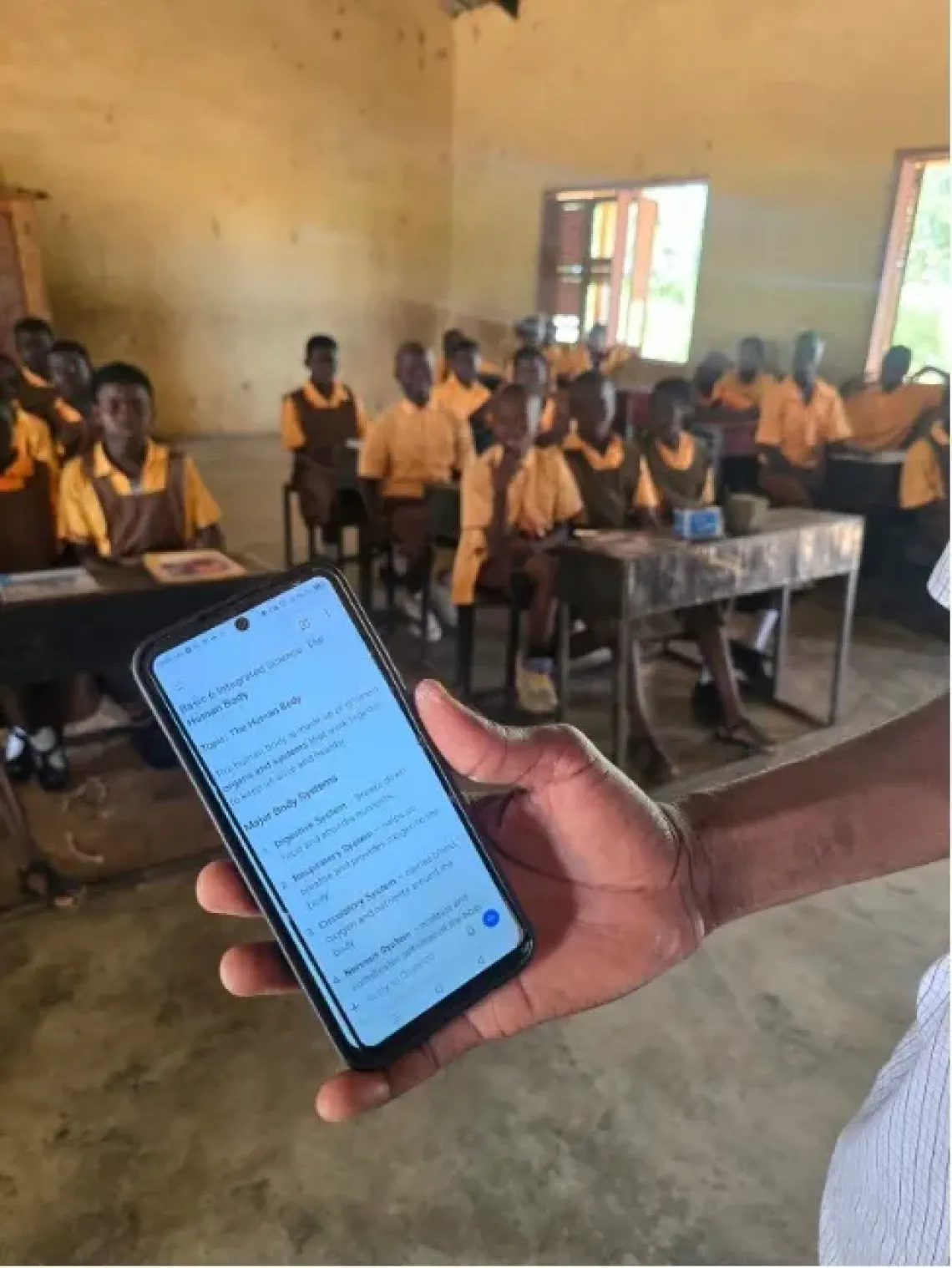
For example, last month one teacher in the Northern Region described how they use ChatGPT to get information on a specific topic that they are teaching, “As teachers we use it to plan our lessons, for example, the water cycle in Primary 5. ChatGPT gives me everything.”
Teacher trainees interviewed described using AI to support assessment, improve their writing, and develop classroom management strategies:
“It can help with grading and scoring, for example using Google Classroom”
“AI gives me techniques and strategies to better keep the attention of my students”
What teachers are asking for from AI
Teachers were also quite aware that the usefulness of AI depends on how they use it. As one aptly observed, “the app and what prompts you use matter. How well you know AI and the commands that you give will make a difference if it is helpful”
Another expressed a similar challenge, noting “you don’t know how to put the question well to AI so that you get the type of info you actually need”
This raises an important question about how teachers are being prepared to use AI effectively. As one lecturer at a teacher training college noted, “we don’t have formal instructions on the use of AI. How can we incorporate this formally into our pre-service teaching?”
Another teacher trainee warned, “we need to be taught how to use it effectively and how it won’t kill the art of teaching.”
Beyond knowing how to use AI, teachers also had clear ideas about what they wanted the technology, itself, to do. Much of what we heard was what we expected. Teachers were looking for practical ways it could help them with the everyday work of teaching: planning lessons, assessing learning, explaining difficult concepts, and supporting children at different learning levels. And they wanted it to work in their reality so that it was aligned with Ghana’s curriculum, relevant to local contexts, usable with limited connectivity and, importantly, able to communicate in local languages.
A teacher trainee emphasized the importance of age-appropriate support, noting that “AI needs to understand the age group I’m trying to teach.”
Fidelis, a kindergarten teacher I spoke with last month, wanted AI to provide him strategies for managing his KG class, including a better seating arrangement. He would also want to generate varied lesson plan ideas to more effectively teach a multi-grade classroom.
Other teachers raised the practical realities of teaching in Ghanaian schools and communities:
“We have poor network at this school. I would want it available offline.”
“I use AI for grammar and helping with my writing. But some AI that we use may not be right for our context. It was giving me something my students won’t understand”
“I want it to talk to me in our local language”, one teacher explained. “I can’t do what I’m supposed to do best in a community where I don’t speak the language. This is where I hope it can help me.”

AI demands beyond the mechanics of teaching
But the conversations also began taking us beyond the mechanics of teaching. Teachers weren’t only asking how AI could help them teach; they were also asking how it could help them navigate the everyday realities of being a teacher.
One teacher wanted support with classroom relationships. She noted, “I would ask AI to give me advice on how to command respect in the classroom.”
Another was thinking about relationships with colleagues and parents, noting “I would ask AI on tips for earning the respect of my head teacher and how to form good relationships with parents.”
And then there were questions about teachers' own well-being. One female teacher suggested giving AI the initial prompt: “Today I have taught 75 kids for 6 hours and I am feeling exhausted and under-supported, how can I better support my mental health?”
This initially surprised me. We had approached these conversations largely thinking about how AI could support the practice of teaching through things like lesson plan and assessment support, but teachers were also imagining it as a source of support for the human challenges that come with being a teacher.
On further reflection, perhaps this shouldn't have been so surprising. People around the world are already turning to AI for advice on literally everything; why should teachers be any different? And given the demands placed on teachers, particularly those working in challenging classroom environments, perhaps we should have expected these needs to emerge alongside requests for more practical teaching support.

AI demands beyond the mechanics of teaching
But the conversations also began taking us beyond the mechanics of teaching. Teachers weren’t only asking how AI could help them teach; they were also asking how it could help them navigate the everyday realities of being a teacher.
One teacher wanted support with classroom relationships. She noted, “I would ask AI to give me advice on how to command respect in the classroom.”
Another was thinking about relationships with colleagues and parents, noting “I would ask AI on tips for earning the respect of my head teacher and how to form good relationships with parents.”
And then there were questions about teachers' own well-being. One female teacher suggested giving AI the initial prompt: “Today I have taught 75 kids for 6 hours and I am feeling exhausted and under-supported, how can I better support my mental health?”
This initially surprised me. We had approached these conversations largely thinking about how AI could support the practice of teaching through things like lesson plan and assessment support, but teachers were also imagining it as a source of support for the human challenges that come with being a teacher.
On further reflection, perhaps this shouldn't have been so surprising. People around the world are already turning to AI for advice on literally everything; why should teachers be any different? And given the demands placed on teachers, particularly those working in challenging classroom environments, perhaps we should have expected these needs to emerge alongside requests for more practical teaching support.

From listening to designing
These conversations are not simply research or consultation, but rather they are directly shaping the AI-powered teacher support tool AI Teacher Companion currently under development in Ghana. The AI Teacher Companion as a localized tool is designed for Ghanaian teachers, aligned with Ghana’s curriculum and designedintended to support everyday teaching practice.
At the core of this tool development is the belief that if AI is going to genuinely support teachers, let’s not start not with what the technology can do, but instead with teachers themselves: the realities of their work, the problems they actually want help solving, and building off of how they are already using AI and see gaps for Ghana-specific support.
For this to work, we’ve placed teachers at the very center of the design process in alignment with .UNICEF’s Beyond Digital As Usual Digital Education Strategy. Current teachers and teacher trainees are being involved in co-designing the tool and soon will play a key role in its testing and iteration. Admittedly, we do not yet know exactly how teachers will ultimately use the tool, which features will prove most valuable, or what we will learn when it reaches real classrooms, but that is why continued teacher involvement, testing and iteration matter.
As the AI-powered teacher support tool Teacher Companion becomes a reality in Ghana, I’m excited to see how teachers will use it, how it might provide some much-needed support in their everyday work, and ultimately what difference it could make for learning in the classroom.
Decades later, I find myself cheering for AI in education once again. And just as it was back then, it’s ultimately the students I’m cheering for.