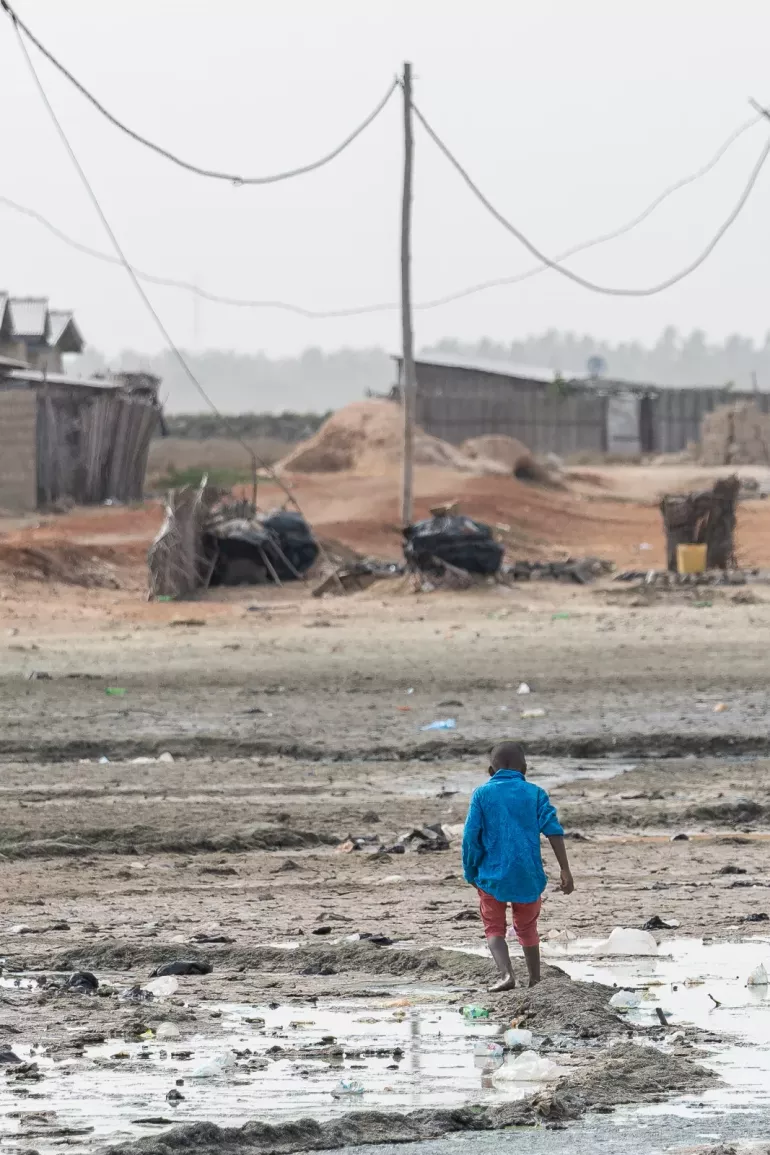
My eyes caught movement and without thinking, I swung my camera up. A few seconds later I had captured the photo above: A boy in a blue shirt.
The colour of the shirt is a cousin to UNICEF’s cyan blue. A fact that was not lost on me when I reviewed it. In the background are a mix of sandcrete block buildings and thatch huts.
You would imagine that the thatch huts are temporary housing or kitchens.
You would be wrong. More on that later.
To get to school, the boy in blue walks at least a kilometre from his community, Salakorpe, to the neighbouring one, Amutinu in the Volta Region of Ghana.
The public primary school, like several buildings in Amutinu and Salakorpe, perches on a strip of sand that is steadily being eaten by the sea.

Salakorpe, Amutinu and Agavedzi, are communities in the Ketu South Municipality of the Volta Region. All three communities are within 2.5 kilometres of each other. And all of them lost houses in February 2025, when a tidal wave attacked and then receded

On 13 March 2025, I joined a joint Inter-Agency mission to assess the aftermath of tidal waves in Ghana’s Volta Region. Our destination was the Ketu South district, a low-lying coastal area less than an hour’s drive from the Togo border. 24 hours earlier, I had no plans to travel, but duty called.
The mission was coordinated by the World Food Program (WFP) which leads Ghana’s Interagency Working Group on Emergencies (IAWGE). The IAWGE had received basic figures on the impact of the tidal wave.
51 houses were destroyed and over 700 people affected. The rapid assessment mission was to understand the deprivations that came along with the destruction.


Community members in Amutinu, Salakorpe and Agavedzi were quick to remind us that the recent tidal wave was unexpected, but not unseen.
Over the past decade, wide scale devastation from tidal waves has happened at least twice. In between major events, the sea continues to eat into communities, like a demolition happening in slow motion.
After an hour of listening to focus group discussions, I wandered towards the mud flats I mentioned earlier. My guide was a community member with whom I shared no common language—unsurprising in a country with more than 70 spoken tongues and dialects. Fortunately, Ghana’s deep-rooted culture of hospitality bridged the gap. Through my gestures and his hospitality, we found common ground.

At the mudflats I had a conversation with 15-years-old Fiadife and her mother, Vida.
Fiadife stays with her grandmother. Her mother, Vida was only visiting for a while. Both of her parents have had to migrate for work. It has become harder to make ends meet.
Even though Fiadife missed several years of school, her mother has made sure she has been re-enrolled in school in the public school at Amutinu, just over a kilometre away.
Vida was the first one who explained the thatch huts to me. Each time a house is lost to the sea, inhabitants cross the road and set up a new home. The first home was blockwork, but the second one rarely is. Although they may have been meant to be temporary, most have been standing for years.
These huts are symbol of inhabitants’ resilience.

14 March 2025.
“We’re sitting in what used to be my kitchen.”The chief fisherman of Solakorpe, Emmanuel Tettey, lives in a house that has been eroded by the hungry sea.

The World Food Program (WFP) communications team and I had an extended conversation with Mr. Tettey. A former seaman who worked as far afield as Australia, he settled close to his roots once he retired.
Despite strong community spirit and resilience, the challenges seem unending “The sea takes canoes and houses. Now the buildings are under the sea, it becomes a problem for fishermen going out to sea.” Nets, which should be a long-term investment, are ripped up by wreckage hidden under the shoreline.

Mr. Tettey also shared with us how the loss of livelihoods and homes affected children. As parents’ resources become limited, more and more children miss school days to engage in fishing related activities to make up for household income. Destruction of homes, and their toilets also increases the number of people practicing open defecation:
“Because of this tidal wave we no more have any toilets anywhere. We have to be using this beach for defaecation.”
At 11am, I hitched a ride with the WFP team. I hoped to have a look at the school that served all three communities. Barely a few minutes into the ride, I hopped off when I saw women fetching water. For me, it was a chance to understand if access to clean water had been affected by the tidal wave.

Once there, I spoke to one of the women fetching water.
Patience Hovor (26) lost her home in Agavedzi to a tidal wave over 5 years ago. Since then, she moved into a thatch, single-room, hut within her brother’s compound. A single mother, she takes up small jobs to make ends meet so that her 5-year-old son can continue going to school. As a child she lost out on the opportunity to go to a secondary school because money was tight at home. She is determined to make sure her son can get the best education she can afford.
At UNICEF, we are grateful for commitment of the government of Ghana to invest in long term solutions to the problem of tidal waves and sea erosion. We will continue to work with communities and partners to ensure that children are protected in the face of both slow and sudden onset climate emergencies.
Our long-term mission, for every child, is to make sure that all of them, including the boy in the blue shirt, never have to walk on their own.